



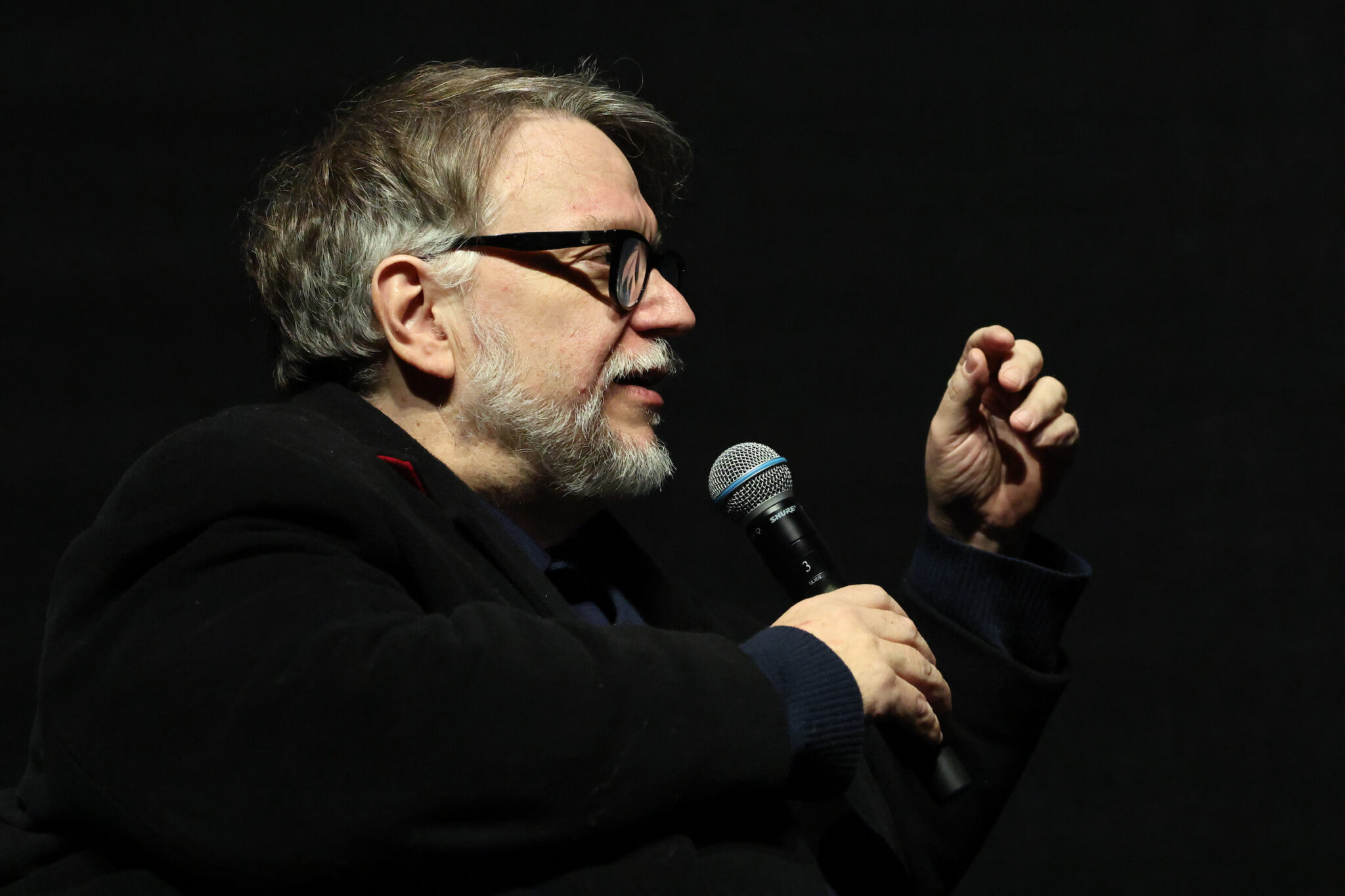
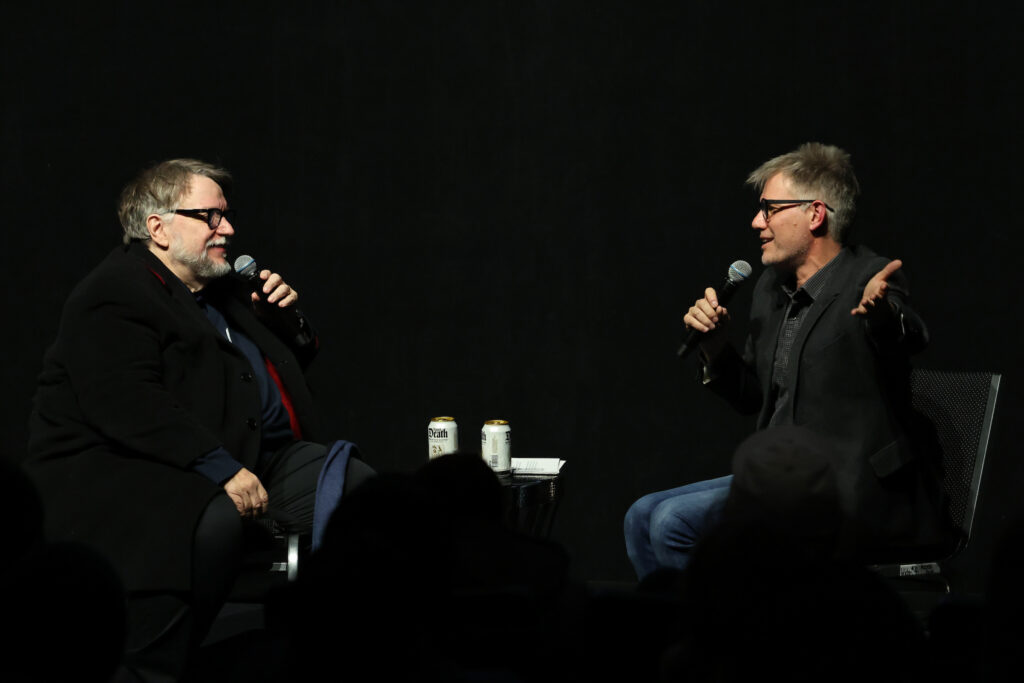
Guillermo del Toro attends the Q&A for a restored screening of his film “Cronos,” an official selection of the 2026 Sundance Film Festival. (Photo by Stephen Speckman/Sundance Institute)
By Lucy Spicer
Thirty-two years after his debut feature screened at the 1994 Sundance Film Festival, writer-director Guillermo del Toro appears before a rapt Park City audience once more. The auteur filmmaker is at The Ray Theatre to present a new 4K restoration of Cronos as part of the Festival’s Park City Legacy program, followed by an extended conversation with senior Festival programmer John Nein. And it’s a good thing Nein was ready for a lengthy discussion, because del Toro is overflowing with insights about Cronos, his childhood in Mexico, the mythos of filmmaking, and so much more. The writer-director was poised to make the most of his time, and an eager audience hangs on his every word.
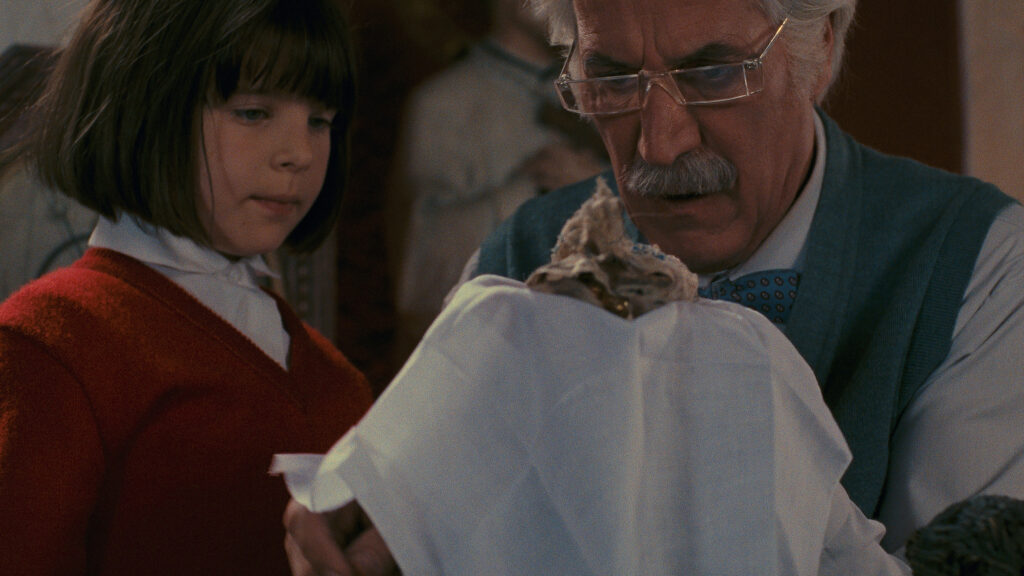
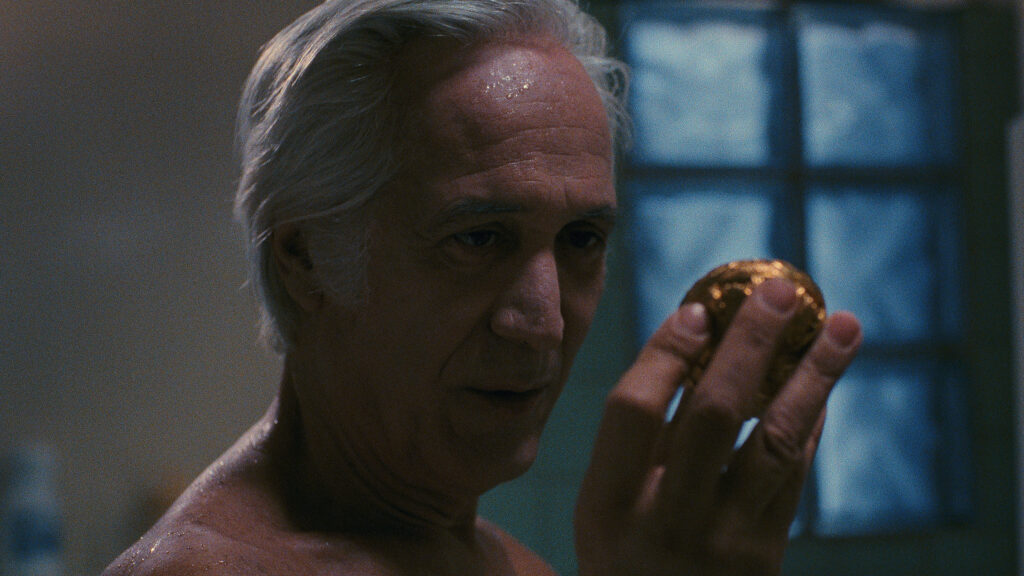
A powerful, imaginative debut that introduced the world to many of del Toro’s narrative and stylistic signatures, Cronos follows Jesús Gris (Federico Luppi), an elderly antiques dealer who comes across a mysterious, scarablike device in the base of a hollowed-out statue. When the object attaches itself to Gris, he experiences a supernatural physical rejuvenation — at a price. Along with developing a thirst for blood, Gris attracts the concern of his young granddaughter, Aurora (Tamara Shanath), and the dangerous attentions of a covetous businessman (Claudio Brook) and his brutish nephew (Ron Perlman).
Cronos established del Toro as a notable filmmaker to watch in the horror space, and he continued to wow audiences through the years with visually stunning and thematically rich projects that have spanned multiple genres, from Pan’s Labyrinth to Pacific Rim to Pinocchio, and, most recently, Frankenstein.
The writer-director discusses the threads that knit his filmography together — from his first vampire story all the way to his latest monster tale — during the dynamic and enlightening Q&A following the screening of the newly restored Cronos. Read on to discover some of our favorite moments from the conversation.
Guillermo del Toro on the stamina required for filmmaking:
The first movie feels like you’re climbing a mountain and you expect the valley on the other side. You get all the way there and you realize it’s a mountain range. You have to go up and down all the time if you wanna be in this magnificently brutal sport of making movies.
On filmography as biography:
Little by little, what you know as my filmography happened. But it’s my biography. You see it; I live it. For you, you’re in a restaurant and you see a guy crashing a car and you say, “A car crashed.” I’m inside that car in slow motion. I break my teeth on the wheel, I hit my head on the rest, I go through the windshield all through decades. And that was filmography for me. And for you it’s something that is in a little shelf.
And that’s what you need to understand — that the time and the impatience and the adversity should never stop a storyteller. And that includes what we’re going through right now. We are being told that art is not important because they’re fucking afraid of it. That’s why they tell us it’s not important. And we are told that we need to believe that we are us and them and that we are not the same, and they want that because they don’t want us to look up and see that every motherfucker that makes life impossible is not to our sides, he’s up there.
On the spirit of Sundance Institute:
The spirit of the [Sundance Film] Festival was so incredibly wholesome, benign, positive, and I think that’s the thing we have to keep. In my opinion, there is no need for cruelty among artists. I believe that you can dedicate your work and part of your love to giving to others, and the Festival had that. And in 1993, I brought The Devil’s Backbone to the [Guadalajara Mexican Screenwriters Lab] and I worked it out, and the Mexican Institute of Film said, “We don’t wanna make that movie.” Again. The Sundance lab had more promise because generically they were not against you trying a noir or trying a horror film. They didn’t care as long as you had something to say. It was great.
On the intersection of Catholicism, horror, and childhood:
I was raised Catholic; I was already fucked. The reason syncretism worked for the Spanish conquistadors is because if you look at the Philippines or Mexico, they made the Catholic imagery extra bloody. And we went, “I like that.” Interesting, but it was extra bloody. So you know, the Jesus in my church had an exposed bone in the knee, and it was like purple with beatings. And, in fact, one of the scenes we’re restoring on Frankenstein is we reproduced the Christ in my church as a child. We reproduced it. We went to Guadalajara, photographed it, and reproduced it for a scene. And, for example, the prayer Victor Frankenstein recites to the archangel is a prayer I used to recite to my guardian angel, “Angelito de la Guarda, me dulce compañia, no me desampares ni de noche ni de la día.” So everything is biographical for me in the movies.
Growing up Catholic, when my mother explained to me what purgatory was, she said, “No matter how good you are, you’re gonna go to purgatory and burn in hell and fire for hundreds or thousands of years.” But I haven’t done anything! So it was like time-share. The first fucking time-share for Catholics. You don’t use the apartment, but you gotta pay?! My grandmother used to say, “I don’t like you reading all those horror things.” And I said, “Well then take away the Bible,” because the Old Testament has decapitations, flayings, burning people alive over coals, fried alive, you know, everything. And she used to put the bottle caps upside down in my shoes so I would bleed for Jesus. And I would go to school bleeding, and then my mother discovered my socks were completely covered in blood, and it stopped. And every night I would call my grandmother and I would say, “We’ll see you tomorrow, grandma.” And she says, “If I wake up.” And then I would call her 10 minutes later: “Are you still alive?” “Well, for now.”
I think I had the worst period of my life from birth to age 7, and the rest of my life I’ve been trying to recuperate. I saw my first dead body around age 4 or 5 — a brutal accident. In Mexico when you used to go buy comic books on Tuesday (the comic books came out on Tuesday), you know, Batman, Archie, horror comics, whatever, next to it there was a newspaper dedicated exclusively to murder photos. It’s called Alarma, and it was like a guy that had been disfigured with a rebar. I was buying Archie, and there was this guy with an exposed brain. I remember a woman had killed her daughter, and the headline of the newspaper said she killed her because her daughter wouldn’t drink her milk. And the mother said she never understood that it was good for her. Growing up in Mexico is very surreal. Horror — to me, it made sense. Like the monsters made sense. They seem to never lie.
On vampirism, Mexican identity, and the politics of horror:
I always found a very vampiric connection with communion, you know? When they said, “This is my blood,” I go, “What the fuck is this?” “This is my flesh.” I go, “Oh my God, why was I not born a fucking Buddhist?” And I looked at the Jesus and he was purple. I don’t want the place of this guy. … But I always found that vampiric idea and the idea of the vampire as an addict, you know. Because of course it’s really great to suck Winona Ryder’s neck, but if [the blood is] on the floor, you really must need it, and that’s a very Mexican thing.
When people say, “Well, what’s Mexican about your movies?” I say, “Me.” None of those solutions would be an Anglo solution. These are solutions from somebody that lived in a middle class Mexican barrio, you know? And that understands that there is a side to the myth that can be a humbling side. Because I think when you humble mythology to a level you understand, that’s parable. And parable allows you to connect with greater notions in a way that is emotional. So I think the fantastical always worked like that for me — and the vampiric elements. When you think about political positioning, it’s very simple. Every story is political. Fairy tales certainly are political. Horror is certainly political. If horror wants to destroy the monster, it’s on the side of the fucking winners. If horror tells you to understand the monster, it’s on the side of the outsiders. That’s political. So you can absolutely have a red-state blue-state fucking horror or red-state blue-state fairy tales, and I always wanted to be on the side of the stories that you are not being told.
On the parables in his oeuvre and the inner children that rule us all:
If you watch [Cronos] and Frankenstein, they talk to each other. If you watch this and The Devil’s Backbone, they talk to each other. If you see Pan’s Labyrinth and this, they talk to each other. And all we have is our voice. All we have is our air, our lungs, our vocal cords, our pain, our sensibility to sing the song that we’re here to sing. That’s it. So you have to be truthful, and it’s not about the way you process it. It’s the way you have a dialogue with existence. Because art is a dialogue with the world. Art is a dialogue with the higher things that you cannot name. That’s the thing. If you think you’re gonna articulate everything, you cannot articulate everything. And there’s a difference between metaphor and parable. I think making cinema metaphorical is really difficult, and, actually, fruitless. When you make it parable, you’re speaking from an emotional, cosmic, big symbol language that connects with people.
When I did Pacific Rim, to give you an example, the idea of Pacific Rim is that in all of us [are] giant robots that we fabricate. I’m a director. I’m not a director; I’m Guillermo. I have fabricated this character to be able to exist in the world. Inside of me controlling this robot is a little child. But he’s afraid. Everybody in this room has that child, and it controls you. When you feel that you’re gonna be abandoned — you cannot be abandoned; you’re over 30. That you are neglected — you cannot be neglected. You walk, you talk, you are able to get a credit card, maybe, you know? All those feelings are that kid. … Childhood for me is not just the state of chronological age, it’s also a state of the soul. So in Frankenstein, Victor is perennially 11, emotionally 11. And we all know guys in their 40s, highly successful, that are 11! That married their fucking mother! That drink only milk!
On the two forces that control the world:
The scariest period of my life was in my childhood, and increasingly you learn that the two forces in the world that control everything are fear and love. That’s it. And every time you make a choice, you make a choice to fall on one side or the other. Every aggression, every fucking billionaire that needs more — fear. Every person that says, “I have enough” — love. “I can share it” — love. The whole universe is those two forces. So, your ages really happen with how much fear you have and how much love you can learn to give. We all give more love or more fear as we age. You enter a new person.
On leaning into the human dimension and feelings of doubt:
The myth that we like is the infallible artist, and I don’t like it. It’s like when people say, “Oh, the pyramids were built by aliens.” No, the tragedy is they were built by slaves. That’s the human dimension of it, and I’m more interested in the human dimension than in the fucking myth. We already live in myths: success, romantic love, power. These are all fucking mythology. So I’m more interested in the director, and I’ve seen directors create some of the great movies of our times with doubt. I think that is a great tool, certainty and doubt. If you have too much of one and not enough of the other, you can’t create.
On service and meaningful connection:
I think that you understand one thing: that in serving you gain. In possessing, you lose. … When you see a billionaire that needs one more fucking private jet, he’s poor. If you have a guy that can buy you a beer, he’s rich. It’s the same. If you can share what you know, knowing that you don’t know, you have been able to articulate things. All you have is yourself. Every single person in this room is different. Every single person in this room has one song to sing — one. And you sing it 20 times if God is merciful and gives you a budget and enough time. And maybe that’s enough. Who knows?
You wanna humanize a filmmaker? Watch the five-part documentary of Martin Scorsese. Really, you see the human being, and I think that’s why I wanna share. What I wanna share is the human being. I’m generally curious about people. When I sit down and talk to someone, I wanna know. Why are they there? What is their name? Where do they come from? Why the fuck not? And in sharing, you know a little bit more about me, the human being. The myth is not interesting for me. Because I always say live your life for the last three minutes of it. When you’re dying, you’re not gonna be a CEO. When your breath is leaving you and you cannot pull in more fucking oxygen, guess what? How much you have matters nothing. What your title was matters nothing, and then all that illusion falls and what you have is your life and how much it is. And I think if we can all have meaningful contact, why the fuck not? I welcome it.
On looking back at his younger self directing Cronos:
Between this movie and the second movie are five years of unemployment. Between the second movie and the third movie are four years of unemployment. And I have many good movies, movies that flopped, movies that didn’t reach this and that. What I remember and I like to think about is how easily life can go one way or another. I think we knock on the door and we don’t know if the door is gonna be opened by success or failure. It doesn’t matter. But knocking on the door is a good act. And I like that guy. I like that he didn’t give up. I like that he stayed. You know, if you stay long enough and stubbornly enough and sincerely enough, you may change something. Steven Soderbergh said if the entire canon of Shakespeare has not made humanity any better, what the fuck do I expect?
And I agree with him as a single act, but art as an act has saved mankind. I have been saved by movies. In the darkest moments in my life, like Preston Sturges’ Sullivan’s Travels, I see a movie and I’m redeemed for a moment. And I say, “Life is bearable.” You know, we are storytelling animals. We are right now in a world that is telling us the wrong stories constantly and has fragmented truth. It’s a very dangerous moment precisely for narrative reasons. Precisely. The epistemology of dividing us has been more cunning, more evil, and more devious than anything a real epistemologist has ever designed in our language or our notion of self. So art has the generosity, the capacity, and the eloquence to restore a little bit of unity. So that’s what I like about that guy. When I see that guy, I see the guy that did Frankenstein. You know what? The tools are a little better, he’s experienced, but it’s the same guy. And I like that. I like that.