
The group of scientists and filmmakers speaking at the Discovery Panel at Filmmaker Lodge seemed to want to discuss nothing but dinosaurs. Metaphorically speaking, and otherwise.Moderator Joe Palca of NPR led the discussion with Harvard physics professor Peter Galison, paleontologist Paul Sereno, filmmaker Braden King, neuroscientist Darcy Kelley, and filmmaker Diane Bell, whose film Obselidia was the winner of the Alfred P.
As the madness winds down at tonight’s awards ceremony, the 2010 Sundance Film Festival will have been chewed over in a thousand conversations. Yet each topic has an expiration date. Whether it be DIY’s direction, breakout filmmakers, or undiscovered gems, Sundance changes the chatter every year.
“We’re all going to become straight,” HOWL co-director Rob Epstein blurted out near the end of the Queer Cinema’s Next Wave panel earlier this week. He was joking, of course, as he answered an audience member’s question about “where the community is moving as far as the stories that are going to be told” in the future. The panel, which was organized by Sundance Institute Associate GLAAD (Gay & Lesbian Alliance Against Defamation) and held at the Filmmaker Lodge on Tuesday, featured Epstein and his longtime co-director, Jeffrey Friedman; their HOWL producer Christine Walker; and New Frontier performance artist Kalup Linzy, who screened a clip from his alternately funny and trippy video series Sweet, Sampled, and LeftOva.
Park City, UT – The 2010 Sundance Film Festival is pleased to announce that Obselidia, directed by Diane Bell, is the recipient of this year’s Alfred P. Sloan Prize. The Prize, which carries a $20,000 cash award by the Alfred P.
I was a tad perplexed when I learned that Louis C.K., one of my favorite comics no one knows about, was premiering his standup film Louis C.

To cap off Sundance Film Festival U.S.A.

Regardless of the size and type of a film, music plays a crucial role in setting its tone. Whatever plays over the speakers alongside the image, actors, and script, is going to alter how the audience perceives the movie.The trick is enhancing the goals of the film, accompanying what the other aspects of the film are doing, while leaving room for the movie itself.
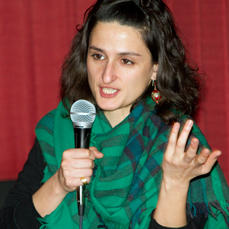
Part intimate profile of two determined women, part revealing glimpse into life in Iran, and part pulse-pounding sports film, Kick In Iran follows 20-year-old Taekwondo sensation Sara Khoshjamal-Fekri and her trainer Maryam Azarmehr as they train and fight for Olympic gold. Documentarian Fatima Geza Abdollahyan shoots these two fascinating women in their homes, in gender-segregated gyms, at prayer and play, and finally to the Olympic games in Beijing. Even though Iranian women are still discouraged from high-impact athletics, Sara’s success becomes its own agent for change.

Novelist Russell Banks has been publishing books for nearly 40 years, but in terms of film he’s still something of a newcomer. In 1997, when he was well into his 50s and long suspicious of the business of movies, two of cinema’s most renowned auteurs, Paul Schrader and Atom Egoyan, involved him in the process of adapting his novels Affliction and The Sweet Hereafter, respectively. Both films were critically acclaimed, and Banks has remained active within the world of independent film ever since.

The final days of the Sundance Film Festival see packed, final screenings of the more talked-about films. For David Michôd, director of Animal Kingdom, it was a bittersweet moment. “I’ve been overwhelmed by the response,” he said.

The Filmmaker Lodge was packed with people—and possibilities—as all nine filmmakers from this year’s inaugural NEXT section gathered together for the first time. With Sundance Film Festival’s newly minted Festival director, John Cooper moderating, the conversation was lively, insightful, and frequently silly.Cooper began by explaining the genesis of NEXT, citing the need to “carve out” a protected space in the Festival program for the burgeoning low- and no-budget filmmaking scene.