



By Jessica Herndon
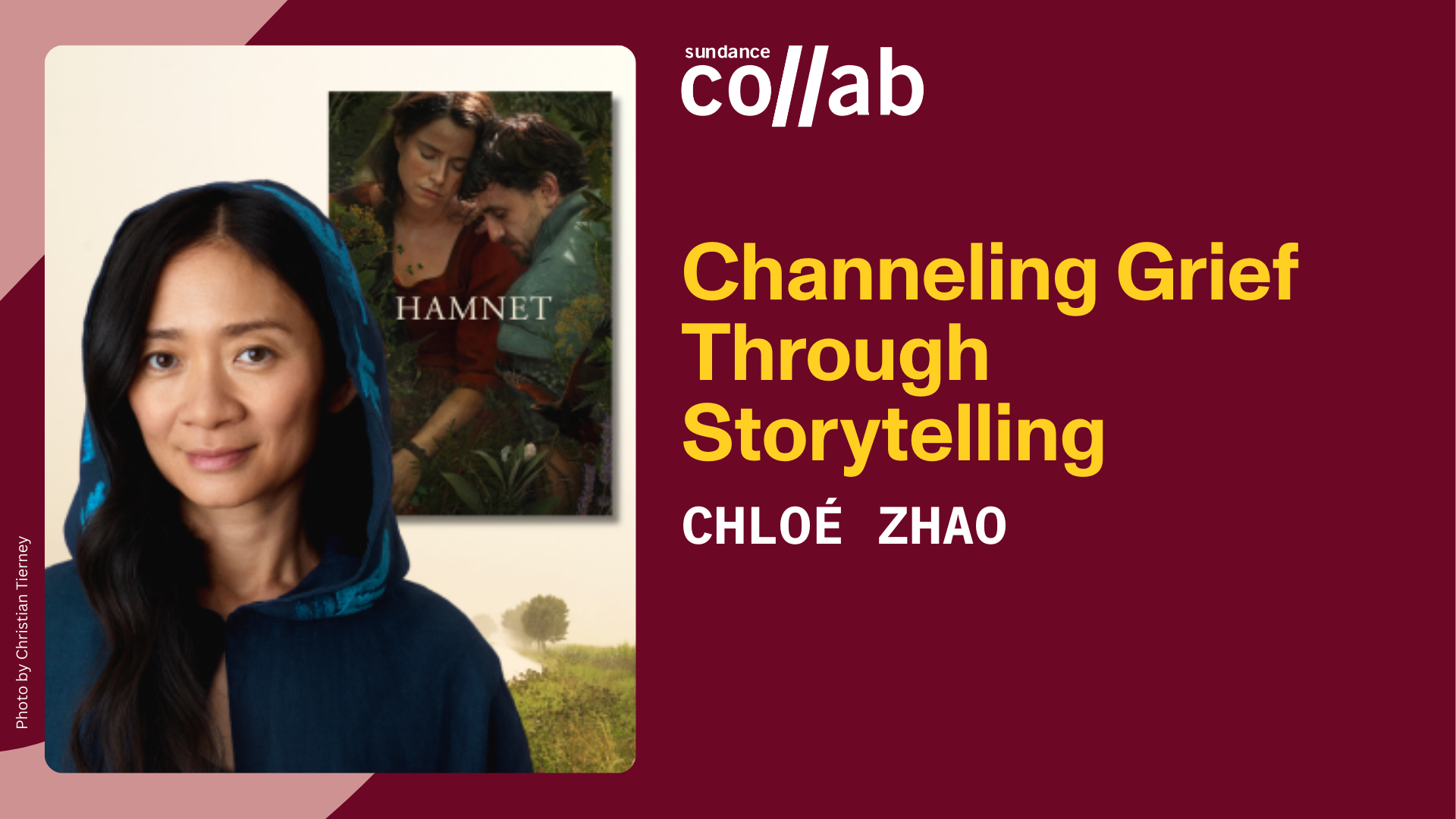
Filmmaker Chloé Zhao has a singular way of channeling poetic and visceral energy, both on screen and off. It’s nearly impossible to watch Hamnet, her sweeping adaptation of Maggie O’Farrell’s novel about the love and grief that inspired William Shakespeare’s Hamlet, and not wonder how she constructed such a stunning world that inspired deeply affecting performances from the film’s stars, including Jessie Buckley and Paul Mescal.
Zhao recently pulled back the curtain on the making of Hamnet, which has earned eight Academy Awards nominations, including Best Picture, Directing, and Writing (Adapted Screenplay), and has already claimed the Golden Globe for Best Motion Picture – Drama. During the Sundance Collab spotlight event Channeling Grief Through Storytelling with Chloé Zhao, the filmmaker offered insight into her creative process.
From her close collaboration with O’Farrell to how she cultivated a deeply imaginative environment on the Hamnet set by incorporating dream work, the practice of interpreting dreams to draw insight from the unconscious, Zhao let us in on how she creates such captivating work.
A Sundance Institute Labs alumnus, Zhao developed her debut feature, Songs My Brothers Taught Me, through the Institute’s Feature Film Program. It was at the labs that Zhao began to fully trust her artistic instincts. “The biggest lesson I learned was to not be too rigid in the vision that you had for your film,” she reflected during a Sundance Collab conversation. “It is a living organism that has a life of its own, and listening to what is around you is equally as important as speaking from your own mind so that you don’t choke the mystery when you’re setting the container of a screenplay.” For Zhao, rigidity on set can drain the process of its magic. “Being at the labs, having that space to explore allowed me to understand what excites me.”
Letting instinct and emotion guide the creative process has defined Zhao’s career. As she puts it, “Make decisions from the feeling place instead of from intellect.” With The Rider and then Nomadland, for which she became the first woman of color and only the second woman in history to win the Academy Award for directing, Zhao established herself as one of cinema’s most essential storytellers. Now, she returns to the Oscars conversation with Hamnet. Read on for five highlights from the Sundance Collab conversation and watch the full spotlight event on demand.
What it was like collaborating with author Maggie O’Farrell on the Hamnet script.
When we first started, we discussed what was the most important thing for the film, because we can’t keep everything from the book… For me, this film was about two people who are so different and whose differences allowed [them] to see each other in ways that they have never been seen before… But their differences, which is what made them attracted to each other, is also what became an almost impossible gap for them to cross when big life events happen… Then the entire thing leads up to them seeing each other at the Globe Theater. Not just literally seeing each other, but seeing each other and understanding their perspective through the creativity. Through the creation of a play… Once we knew that’s the most important thing, we knew we had to bring William Shakespeare into the script more. He’s a lot less in the book. And we also know we had to write in a lot of the play, which in the book is only in the first scene. So with those things in mind, we went to work. And the way Maggie described it so well is that it’s like an hourglass. When you do adaptation, you have to distill the book down to its essential level — what you want, what’s the most important to you — and then leave again. Leave space to allow the making of the film to reveal it.
On how she cultivated a collaborative environment on the set of Hamnet.
The biggest thing for me is to think about your day as a ceremony, some kind of ceremony. I’m sure all of you have gone to some kind — it could be a football game. It could be a meditation or yoga class. …There’s always an opening and an ending and a closing, meaning that there is always a ritual to cross the threshold. …But I promise you, if you open your day properly — you take your time and then you set a container, close your day so your whole company knows they’re headed to that closing — what is going to happen in the middle is that in the opening, you’re able to vibrate your entire company to the same energy… We don’t come to set saying try to save every minute to produce, produce. We’re like, sometimes an hour or two into the day we’re not shooting. We’re just really setting the mood. And sometimes the actors were bringing music and we would play that music on repeat and then eventually the whole cast and crew starts again to the same pace. And then you’re creating as a group and you’re really unstoppable.
How the creative process on the set of Hamnet was informed by dream work led by dream coach Kim Gillingham.
In the dream work, what we do is we write down our dreams the next morning and we come bring the dream to the facilitator. And she would drop us in — that means to guide you through a form of a meditation to allow you to get to such a relaxed state that you’re sort of between waking and sleeping, you’re between consciousness and unconsciousness. That is where you want your actors to be, by the way, when they come to set to work. You want them to just be on the edge between knowing and not knowing. That’s where presence is.
And so you sort of get to that present state and then you start to tell her about the dream. You sort of like work the facilitator through the dream. And she will ask you questions. And at some point she might say, “You said there’s a storm.” And then she might watch your reaction and you would have a tiny little reaction… And she will ask you, “What is the storm? If I’m an alien from another planet, what is the storm?” And then you start talking about what a storm is, right? And then she might even ask, what’s the opposite energy of the storm? So you’re trying to understand what is in my life that I associate with the storm…
More often than not, you realize by embodying different parts of your psyche, what you think the dream’s about is never what it’s about. And imagine doing that to your scene. You can look at your scene like it’s a dream… And so every morning Paul and Jesse were bringing their dreams, and I’ll bring mine and then there is this interpreting the dreams. And then that will inform the scene on the day.
Zhao’s tips on working at your own pace in the film industry.
When you don’t have something, it always means you have something else, right? So, if you don’t have money, what you have is freedom and time to do whatever the fuck you want. With the time you have, no one’s watching you and no one even cares that you need to make the money back. So, then you go like, oh, then I’m not going to compete with the people who have $10 million, right? You can have $100,000. What can I put on screen that the people with $10 million or $100 million couldn’t, because they had to obey so many things? That’s what you have to do.
How to cope when you’re in a creative slump.
When you have, say, a period of your career or your life when it feels like you have a massive creative block, that nothing is working and you feel this hollow emptiness because I’m not creating anymore… I have learned that that period of emptiness, it is the most juicy period you can have as a creative person because what it is is that your chalices emptied — something died in your life… And now you’re sitting in this empty, dark, fertile soil and it feels extremely uncomfortable. But just please sit in it and wait because what is going to come through is going to have the energy of the whole planet helping you grow. And you’re in a way reborn. Something mysterious is going to want to speak through you because you took care of that. You created the empty space to be filled. That is what we don’t do very much. We don’t create that empty space to be filled. So we keep producing things we don’t even know what they are for. So just, you know, take a nap.