
By Kristin Feeley, Director, Documentary Film & Artist Programs
“… the memories of your elders … [are] a scaffolding for you to build your identity on — and they will not always be accessible to you.” — Emma Fulenwider
Most Sundance Institute labs begin in a circle. Participants share a little about their backgrounds, often their families and the motivation for their work. It’s a way of breaking the ice and bringing other people, places, and motivations into the room. Our past and the stories that define it help create a picture of who we are. Facing massive cultural and technological shifts, a new generation of documentary filmmakers are addressing, with more urgency, questions of how our history is not only preserved but transmitted. They are mining existing archives while simultaneously creating new spaces and ways of protecting and sharing both personal and cultural history. The work of creating community archives is time-consuming and patient, happening over years, which is not dissimilar to making documentaries.
Time is a key element of nonfiction storytelling; it is what opens the cinematic space and defines a film’s “present.” Meaning is created by the subtle, and sometimes dramatic, changes in people’s lives as they evolve over time. Taking time and space during the edit of a film, allowing the director and editor to step back and assess whether the project is communicating change authentically, is essential. However, this is not always possible when budgets are tight and there is pressure to complete projects that typically take three to five years to make.
This is especially important for emerging artists who are navigating the making of their first features. The financial, creative, and logistical pressures can be overwhelming. Amid this backdrop, we launched the Documentary Edit Intensive: an opportunity for two film teams to be in residence for a week of restoration and experimentation from June 21–26 at the All-Movie Hotel in Peachtree City, Georgia. The directors and editors of each team will work intensively with talented and generous advisors Andrea Chignoli (Igualada), Blair McClendon (Union), and Terra Long (Feet in Water, Head on Fire). We’re excited and deeply grateful to embark on a new partnership with the team at Francis Ford Coppola’s All-Movie Hotel.
The films supported through this initiative are embracing new forms of storytelling and finding new language to express personal truths. We believe that nonfiction should encompass a range of genres and approaches, especially during a time when we need a wide range of stories and a plurality of voices to help make sense of the world.
The following are this year’s selected artists and their films:
2026 Documentary Edit Intensive Fellows:
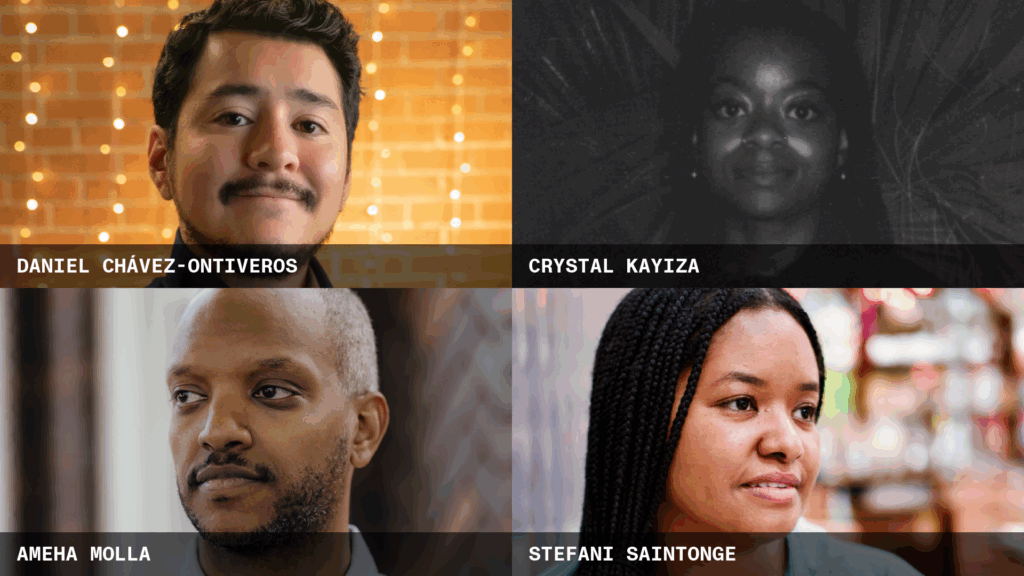
Higher 15 (U.S.A.): When Ethiopian American filmmaker Ameha Molla discovers his uncle was a revolutionary during Ethiopia’s Red Terror — and later helped bring a suspected war criminal to justice in the U.S. — he begins an intimate investigation into a family history long buried in silence. Higher 15 moves between Denver and Addis Ababa to explore the lasting impact of war, migration, identity — and the freedom found in finally confronting the truth.
Ameha Molla (Director) is a creative and marketing professional with experience across production, advertising, and brand strategy. Molla directed six short films while working in marketing at Genentech, a biotechnology company, where he was responsible for creating story concepts, directing animation and motion graphics teams, and managing on-set cast and crew. From February 2020 to November 2025, Molla worked on Apple’s marketing team, where he created content for one of the world’s most respected brands. He is a Sundance Institute Documentary Film Program | Stars Collective grantee, a BAVC MediaMaker Fellow, and a fellow of the Black Public Media 360 Incubator program.
Daniel Chávez-Ontiveros (Editor) is a Mexican filmmaker recognized for his award-winning work as a documentary editor. His feature American Pachuco: The Legend of Luis Valdez premiered at the 2026 Sundance Film Festival, winning the Audience Award: U.S. Documentary and the Festival Favorite Award. His editing credits include 499, Sansón and Me, and Unseen. These films have received awards at festivals such as Tribeca, Hot Docs, Sheffield DocFest, and True/False. He has been recognized as one of DOC NYC’s “40 Under 40” emerging documentary filmmakers, a Karen Schmeer Editing Fellow, and a Gloria Schoemann fellow. Drawing from his experience as a Mexican immigrant living in the U.S., Chávez-Ontiveros focuses his editing on showcasing stories about immigration, the Mexican American experience, and social justice, aiming to inspire and empower his community.
The Gardeners (U.S.A.): As keepers of one of the oldest Black cemeteries in Mississippi, The Worthy Women of Watkins Street nurture the liminal space between past, present, and future. The labor of these aging world-builders becomes a blueprint to navigate memory, legacy, and mortality, revealing the divine spirit residing in their daily lives.
Crystal Kayiza (Director-Producer) is a Ugandan American artist and filmmaker raised in Tulsa, Oklahoma. A member of the New Negress Film Society, she is a recipient of the Guggenheim Fellowship, Creative Capital Award, Jerome Hill Artist Fellowship, Film Independent Amplifier Fellowship, and Sundance Institute Ignite x Adobe Fellowship. Her film Rest Stop won the Short Film Jury Award: U.S. Fiction at the 2023 Sundance Film Festival. Her shorts have screened at BlackStar Film Festival, MoMA, and the Toronto International Film Festival and featured by The New Yorker, NOWNESS, and PBS. Named one of Filmmaker magazine’s “25 New Faces of Independent Film,” Kayiza is currently in post-production on her first feature film.
Stefani Saintonge (Editor) (she/her) is a Haitian American filmmaker, educator, and editor. As an editor, she’s worked with acclaimed filmmakers and artists, including Solange Knowles, Julie Dash, Simone Leigh, Deana Lawson, Bradford Young, and Jason Moran. Her edited works have screened at the Sundance Film Festival, Berlinale, Guggenheim Museum, and PBS. She edited the feature film The Debutantes, which premiered at Tribeca Festival in 2024. As a member of the New Negress Film Society, she co-created their annual Black Women’s Film Conference. She’s received support from the Ford Foundation, Rooftop Films, SFFILM, Jerome Foundation, and Bronx Council On The Arts.