



Boots Riley Unpacks His Vision of Power, Style, and Time at Sundance Institute’s “I Love Boosters” Denver Screening

By Jessica Herndon

The line wrapped around the building outside Denver’s Landmark Mayan Theater, a steady hum of anticipation building as nearly 400 guests filed in for a sold-out, early look at I Love Boosters, Boots Riley’s latest film hosted by the Sundance Institute. Inside, the energy was electric. Fans who had just met Riley moments earlier during an intimate pre-screening meet and greet settled into their seats to experience the film before its theatrical debut on May 22. By the time the credits rolled, the room erupted in roaring applause.

Set in a landscape shaped by global capitalism, I Love Boosters follows a crew of stylish shoplifters navigating a world where fashion, labor, and power collide. The film stars Keke Palmer, Taylour Paige, Naomi Ackie, Poppy Liu, LaKeith Stanfield, and Demi Moore. Like Riley’s breakout Sorry to Bother You, the film fuses satire, science fiction, and social critique into something wholly its own. Uniquely Riley, the film presents a cinematic language the filmmaker has been refining since his days as a Sundance Institute fellow.

Riley was workshopping that language within the Sundance Institute labs, attending the Creative Producing Summit, Screenwriters Lab, and Catalyst Forum in 2015, followed by the Directors Lab in 2016, where he developed Sorry to Bother You ahead of its 2018 Sundance Film Festival premiere. That spirit of experimentation is still embedded in his work, and in Denver, it felt like a full-circle moment as the filmmaker drew a packed house ahead of the Sundance Film Festival’s move to Boulder in 2027.

Following the screening, Riley joined Sundance Institute Senior Programmer John Nein on stage for a conversation that unexpectedly culminated in an impromptu photo shoot Riley orchestrated, in which Nein supported the filmmaker in a handstand.

John Nein assists Boots Riley in a handstand at a screening for “I Love Boosters” at the Landmark Mayan Theater on April 14, 2026 in Denver, Colorado. (Photo by Devon Wycoff/Sundance Institute)

Spontaneous snap aside, Riley discussed everything from what moves him creatively to his writing style following the screening. When asked about his inspirations, Riley pointed to a sonic muse: “Parliament Funkadelic — how there will be different textures and different genres laid on top of each other.” That layered ethos carries through the film’s soundscape, crafted in collaboration with Tune-Yards. “They did an amazing job. They were making music when I was 20 pages into the script. But there are some songs that I produced that Keke [Palmer] sings that my daughter wrote.”

Riley’s background as a lyricist also shapes how his characters speak. His dialogue zigzags and lands with impact. “I thought about what I do with lyrics,” he says. “I’ll take the thing that is kind of like the set-up line sometimes, and I’ll make a connection that jumps over all of this other connected logic to this other thing that jumps over this swath of theory and makes this connection. When you put it together, you feel you’re heightening the idea, the contradiction. And that’s what makes people go, ‘Oh, that’s a bar,’ because it’s something they know, but hadn’t thought about it that way.”

It is also instinctual for the filmmaker to conjure a visceral connection through his visual storytelling. “I want to make stuff where people are feeling what the characters are going through,” says Riley. “Not just knowing that it’s a good performance. Not just having heard it through exposition, but visually making you go through stuff.” That philosophy pulses through I Love Boosters in its bold use of color or the inventive solutions Riley finds when working within indie constraints.

“With [I Love Boosters], I’d written a paragraph where you go, this is a montage where they’re using the teleporter in different stores, and they’re changing in the van,” he explains. “Then we had to figure out a way where we could just have one angle… this one angle made for a cool beat inside the montage and them coming out of the van.” When he emphasized in a hushed tone that “this is how you hide what’s going to be expensive,” the crowd laughed. “So that was solving a problem, like how do we not get inside the van and not have to show these different angles.”

Even when he can’t execute a dream shot, like “the zolly Martin Scorsese thing,” as he puts it, Riley pivots. He finds fresh ways to execute his vision with the help of his creative team, including production designer Christopher Glass, cinematographer Natasha Braier, and costume designer Shirley Kurata. “[I Love Boosters] is a result of figuring stuff out and working with amazing heads of departments.”

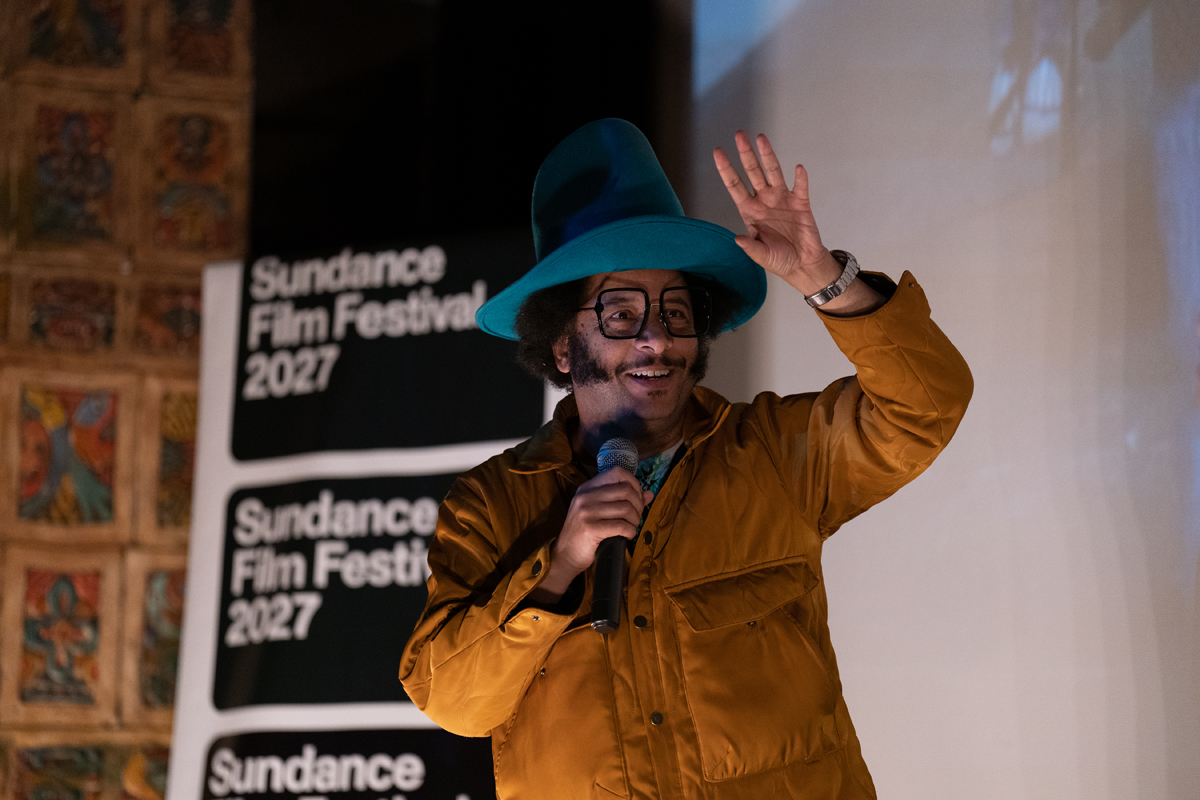
Boots Riley attends a screening for “I Love Boosters” at the Landmark Mayan Theater on April 14, 2026 in Denver, Colorado. (Photo by Devon Wycoff/Sundance Institute)

At its core, the film is rooted in big ideas, including Riley’s interest in the philosophers Karl Marx and Friedrich Engels, whose dialectical materialism views time as something we’ve been conditioned to believe in. “I started thinking about how, in science fiction, we have these devices that we have heard talked about so much that we actually think the theory behind it is real,” says Riley. “Like time. Scientifically, there is no time. There is only right now. But when I say it, it sounds like I’m a hippie. We’re only remembering the past. It doesn’t exist. The future doesn’t exist yet. But because of science fiction and what we see in these time machines, the past still exists, and you can go to it. We’ve taken that theory that has very little basis, and incorporated it into our lives… So, I was like, ‘What if I take some of these ideas that I’m already using in the film and put them into this machine?”

Riley adds that he wrote I Love Boosters in a way that he hopes won’t throw audiences off. “Dialectical materialism is definitely something that I have used and that radicals have used to make revolutions, and that I have used to analyze things and where they’re going. This whole movie is me trying to accelerate the situation.”

That global perspective also shapes the film’s setting. “There is a relationship between production and commodity that has a lot to do with China. I think the way that I have it on film is very representative of what that relationship is between the factories that are working for companies here. Since there is a lot of talk about country versus country, I wanted it to be about the working class having unity.”

If the Denver audience’s reaction was any indication, Riley’s message landed. The film is as stylish as it is humorous and radical. And ultimately, he hopes it sparks something beyond the screen: “I want you to engage with it as a piece of art and come to some conclusions, and hopefully it inspires you to go out and help make a mass, militant, radical labor movement… We need to try to get control of the wealth we have created with our labor.”

News title Lorem Ipsum

Donate copy lorem ipsum dolor sit amet

Lorem ipsum dolor sit amet, consectetur adipiscing elit. Ut elit tellus, luctus nec ullamcorper mattis, pulvinar dapibus leo. Lorem ipsum dolor sit amet, consectetur adipiscing elit. Ut elit tellus, luctus nec ullamcorper mattis, pulvinar dapibus leo. Lorem ipsum dolor sit amet, consectetur adipiscing elit. Ut elit tellus, luctus nec ullamcorper mattis, pulvinar dapibus leo. Lorem ipsum dolor sit amet, consectetur adipiscing elit. Ut elit tellus, luctus nec ullamcorper mattis, pulvinar dapib.