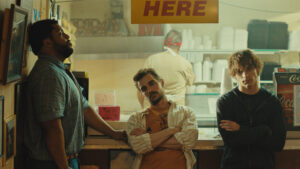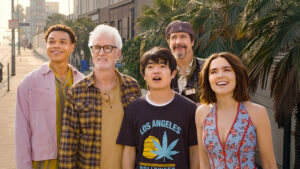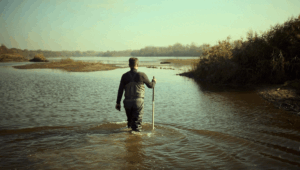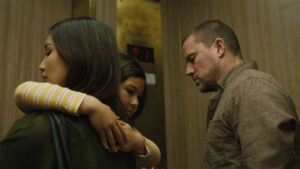




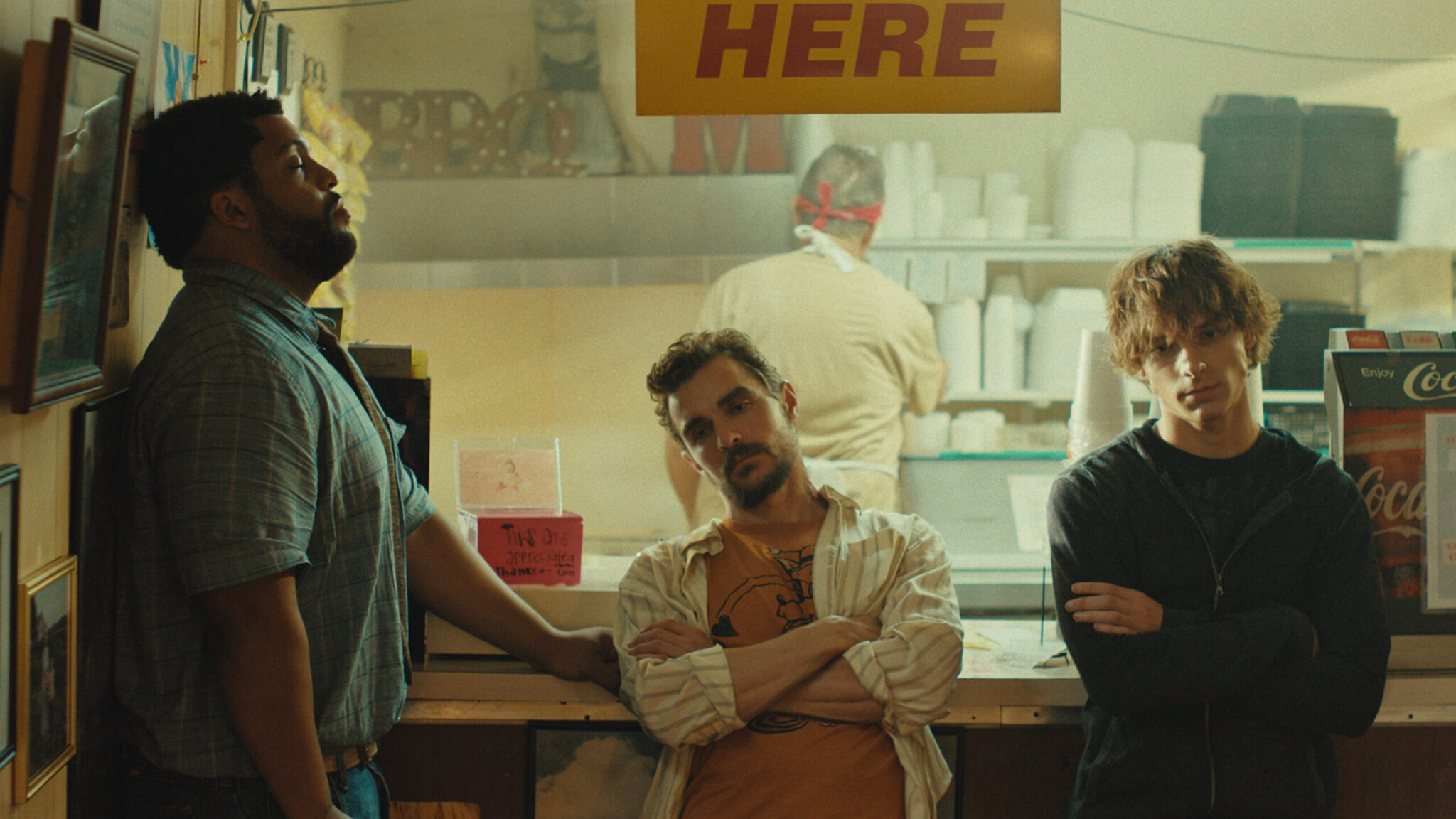
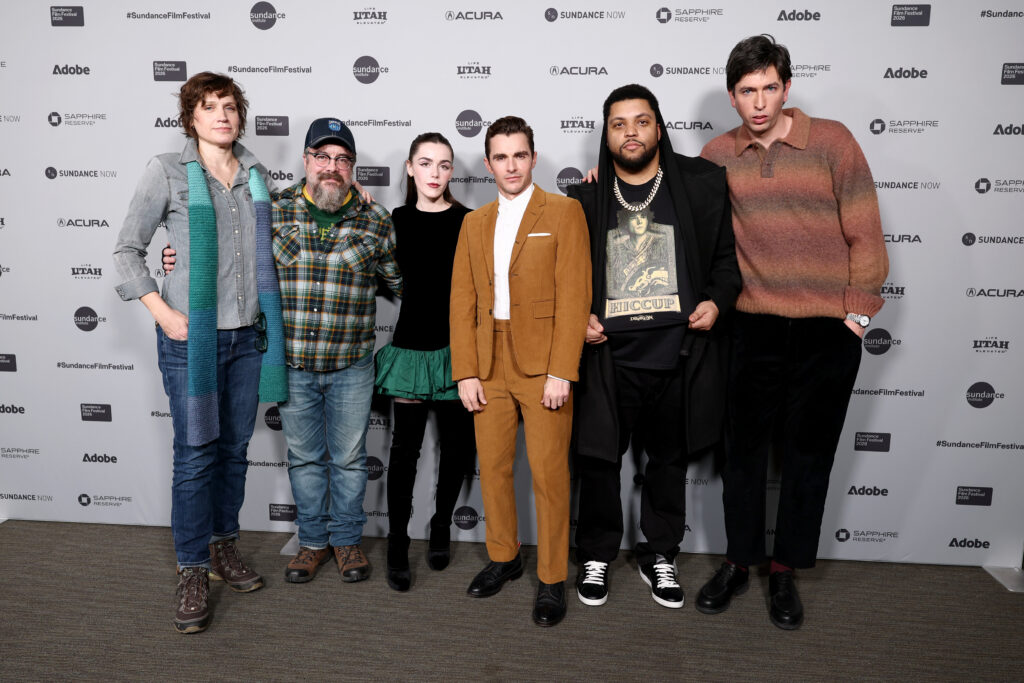
O’Shea Jackson Jr., Dave Franco, and Mason Thames appear in “Idiots” by Macon Blair, an official selection of the 2026 Sundance Film Festival. (Courtesy of Sundance Institute)
By Ramona Flume
“Party people.”
That’s Macon Blair’s answer, without hesitation, when asked whom he’s hoping to reach with Idiots, his rowdy road trip comedy that premiered at the 2026 Sundance Film Festival and opens in theaters August 28.
“We talk about it in terms of wanting people to feel like they’ve been to a really great rock show,” adds Blair (The Toxic Avenger, i don’t feel at home in this world anymore.) during a recent Zoom interview about his latest film. “It’s not gonna reinvent the wheel. But it is meant to be a really fun 90 minutes at the movies.”
Idiots’ plot hits that fast-moving target, too. A wildly unqualified and contentiously mismatched, accident-prone pair of misfits is hired to transport an ultra-wealthy, highly problematic teenager to rehab, turning a seemingly straightforward road trip into chaos, full of shock-and-awe and gut-wrenching laughs, all powered by a stellar, side-splitting ensemble of lead actors — Dave Franco, O’Shea Jackson Jr., and Mason Thames — plus scene-stealing support from Peter Dinklage, Nicholas Braun, and Kiernan Shipka. All to say, it’s a ride-until-the-wheels-fall-off type of good time.
The making of the film, though, wasn’t exactly a party. Blair and producer Alex Orr spent years trying to get the project finalized, financed, and off the ground. A fully cast version collapsed in pre-production at one point and the pair shelved the project for nearly a decade before reviving it. “As much of a bummer as the first version falling apart was, in a weird way I’m kind of glad it happened,” Blair says. “Because I think this version of the movie is the one that was meant to be.”
Below, we learn more about Blair, the unique chemistry that makes Idiots such a captivating watch, and what else went into this cinematic labor of love that is finally getting its theatrical release.
Tell us about the moment you found out Idiots would be premiering at the Sundance Film Festival.
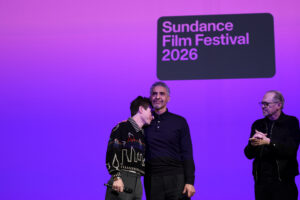
We shot the movie on a tight time frame and cut it very quickly, but we were still in the middle of finishing the movie when I got the call inviting me to the Festival. I sent a text to Dave and Alex, the two producers, trying to be all casual: “We’re going to Sundance.” But they thought I was just doing positive visualization. They wrote back, “Hell yeah we are.” And I was like, “Nah, man, we’re going to Sundance.” And they said, “That’s right, baby, let’s keep working.” It took like eight back-and-forth messages before I got through: “Guys, listen to my fucking words.” They finally got it and everybody was thrilled, but it was funny because at first they just thought I was psyching everybody up.
The chemistry between the actors was palpable onscreen — and offscreen at the 2026 Festival premiere. Everyone seemed like they were having a blast together. What was the vibe like on set?
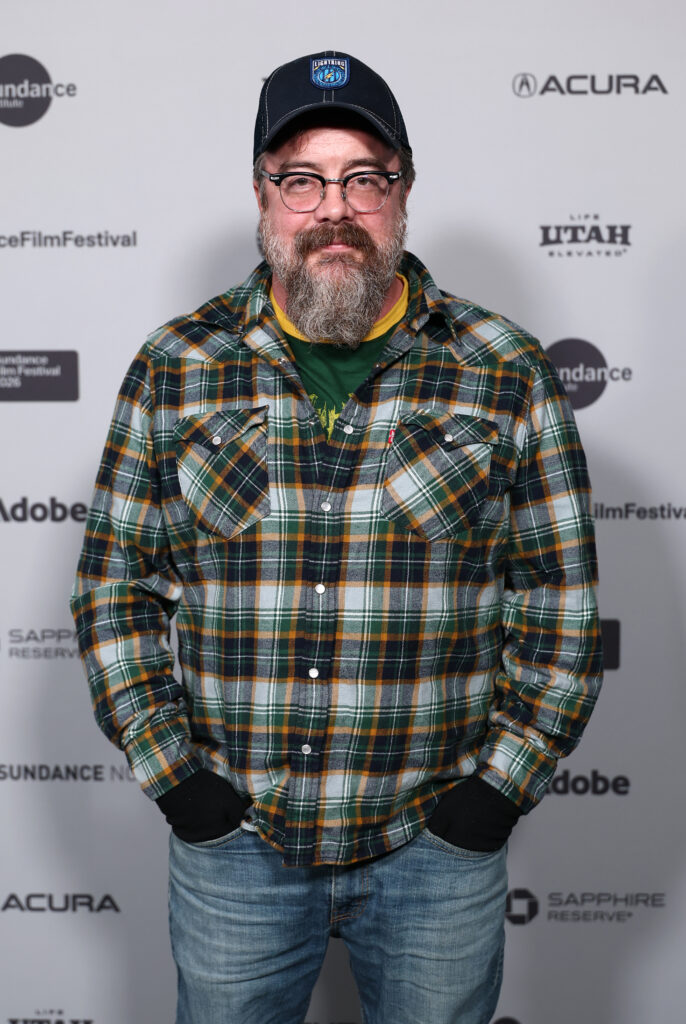
Everyone was absolutely having a really good time. Some days were hard, but it was all grounded in everybody having a lot of fun with each other. There’s still a text thread with the cast going, everybody checking in and hyping each other up. Whatever friendships developed — or were already in place — have hung together. My memory of [set] is simultaneously very blurry, because we were moving so fast and I was thinking about the next setup, but at the same time I was always aware of how grateful I felt to get to make a movie at all. But especially this one, where I’d had it in my hands for so long and wasn’t able to get to do it, and there were moments of looking around like, “This scene Alex and I were talking about 12 years ago — we’re actually getting to do it now, with really great actors and a great crew.” I felt very fortunate throughout the whole thing and tried to take time to always acknowledge that to myself.
The sparks of dialogue in certain fast-paced scenes felt so natural. Was everything kept strictly scripted or was there room to improvise?
I think there was a little bit of both. We tried in a lot of cases to stay tight to the script, because everything was organized to get us to the next beat. But I also knew I’d be foolish not to take advantage of these actors, because they’re all so good at spontaneously adding things, and it reflects well on the whole movie. The middle section is a bit of a detective story, so we didn’t have a lot of room to veer into far-off tangents, but since the whole movie is basically the two guys arguing, letting them just argue was a big part of it. That texture is almost impossible to script. It’s got to be people talking over each other, sputtering, not saying their words correctly, being messy and a little incorrect. I tried to make sure they had space to try stuff like that, and a lot of it ended up in the movie.
I really like movies where the dialogue is going so fast that you almost feel like you might have missed something, and it’s kind of OK if you did. It’s not necessarily about the words being said — it’s more about the vibe in the room of two people shouting over each other. When Dave and O’Shea get into their first big fight in the hotel room, I would just let them go, because they’d keep finding new ways to one-up each other and insult each other. You only really hear about 60% of it, but it’s still so charming and funny, because it’s two guys who can’t relent, so they keep trying to have the last word. “Well, you did___,” “Well then you did___,” and it keeps going like that. The sound of their voices is the payoff, not the words themselves.
Dave Franco and O’Shea Jackson Jr. really are dynamite together. What was that casting process like?
Dave was the first one we went to, and he immediately said, “I just worked with O’Shea; you should go check with him.” I loved O’Shea in Straight Outta Compton and Ingrid Goes West, and I thought he’d be great as the stern one to Dave’s goofball. What I wasn’t prepared for was how vulnerable he can get at the drop of a hat. There was a scene where his character is in a lot of trouble and feels bad. I gave him the set-up, he said, “Got it,” and we rolled, and he instantly started crying. I was like, “What is going on?” That happened about four other times during the shoot — he just had layers going on I wasn’t aware of, and we saw them happen in real time on set. As soon as that started happening, everybody got really excited, like, “Oh, it’s a real movie.” Dave and O’Shea were a great pair, and because they were buddies who knew each other, they had real chemistry — the whole movie is them bickering, and if that hadn’t worked, the movie wouldn’t have worked. The whole thing was riding on them, and we got very lucky.
How did you get into filmmaking?
I wasn’t really ambitious in any direction other than movies. That came from my parents taking me to the movies when I was very little — it made a huge impression on me, starting to understand that it’s not just pictures on a screen, that there are people writing the words, doing the makeup, figuring out the costumes. I’d get little kids’ books like Movie Magic, and that was mesmerizing to me. Around that same time, home video cameras started to be available, so a buddy’s mom got one and we got our hands on it and made our own movies. That dominated a lot of growing up — getting the group of friends together on weekends to make movies. At some point it was just, “Oh, this is what I want to do for a job.”
I didn’t have a precise strategy, and I was interested in a lot of things — I really liked acting, but I also loved writing, because I could just sit down at my desk and do that without having to audition. Making my own movies felt very far away — something I could get to eventually. It was kind of like, “I’ll take anything that’s movie-adjacent.” My friends and I moved up to New York around the same time, and I got jobs as a production assistant while Jeremy [Saulnier] was starting to work as a director of photography, and little by little we were trying to figure out how to own that and make our own projects. It took a while and a lot of resets, but that was always the goal from a very young age.
My mom, by the way, was very supportive, especially when we were little. She put a huge amount of emphasis on creativity, always telling us to get out of the house and go do something creative. I think that’s probably part of it. But she was also a mom, and when I was getting to be in my late 20s, early 30s and still basically a PA with no health insurance, she was kind of like, “What the fuck are you doing?” And I was always like, “It’s just a few more years and then we’ll figure something out.” But there wasn’t really a backup plan.
Who are some of your creative influences?
There was a moment in time when I happened to see Blue Velvet, and Wild at Heart came out in theaters, and Twin Peaks came on TV — all around the same year — and it really got into my brain. I became a huge fan of David Lynch’s work, and his ideas about creativity and inspiration have continued to be something I think are really special. I also went through a phase of realizing movies could be made by your friends in your own backyard. The first Toxic Avenger movie was hugely inspirational to me. I never had any idea about remaking it, but watching that — seeing there were no stars in it, that it seemingly happened on the street in front of their house but was still so entertaining and over the top — was huge for me. And all the Monty Python–style comedy that we stole from shamelessly in the movies we made as kids.
What was the last thing you saw that you wish you would have made?
Jeez, man. Love Lies Bleeding blew my fucking hair back. I tend to go into movies assuming I’m gonna love them, so it’s rare for me to dislike something. But every now and again there’s something where I’m like, “Oh, that was imprinted on my brain — they made that specifically for me.” That was one where I felt like they mapped my brain and made it specifically for me.
What is something that people might not know about you?
I’d assume, honestly, a fucking lot, since I keep a pretty private life. But maybe, as the director of a movie like Idiots, people would be surprised that I actually like people — I’m not as misanthropic as the movie might suggest.