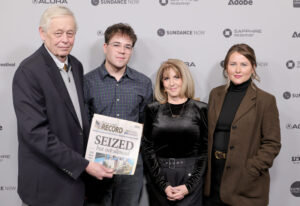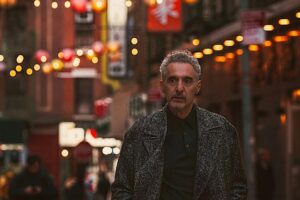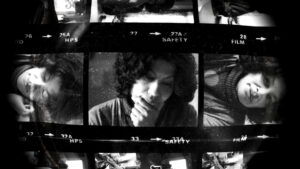





(L–R) Alex Gibney, Salman Rushdie and Rachel Eliza Griffiths attend “Knife: The Attempted Murder of Salman Rushdie” Premiere during the 2026 Sundance Film Festival at The Ray Theatre on January 25, 2026, in Park City, Utah. (Photo by Neilson Barnard/Getty Images)
By Adam Silverstein
The request before the screening is unusually direct. Standing onstage at The Ray Theatre, Alex Gibney tells the audience he normally doesn’t say anything ahead of a film, but asks one thing this time: Please stay through the credits. “There’s something special at the end,” he says. No one in the room yet knows how much they’ll need that note of care.
Knife: The Attempted Murder of Salman Rushdie, screening in the Festival’s Premieres section, is a harrowing, intimate documentary that confronts the 2022 attack that nearly took Rushdie’s life — and refuses to look away. Told largely in Rushdie’s own words, the film traces the stabbing itself, the brutal aftermath, and the long, uncertain road back. It is unflinching, at times graphic. You can feel the audience brace as it unfolds.
Director Gibney structures the film around Rushdie’s recovery — physical, psychological, creative — using previously unseen footage captured by Rushdie’s wife, poet and photographer Rachel Eliza Griffiths. What begins as private documentation slowly becomes something else. Rushdie admits during the post-screening Q&A that he never imagined showing so much of his body on camera. “I’m a novelist,” he jokes. “I thought she’d taken a couple of snaps on her iPhone.” Instead, a film emerged.
That intimacy is what gives Knife its power. The camera stays close — to wounds, to frustration, to moments of fear and unexpected humor. We watch Rushdie relearn basic movements, wrestle with what happened, and gradually reclaim his voice. Griffiths explains that she wouldn’t let him see the footage for weeks, worried it would be too much, too soon. “She was right,” Rushdie says.
The room is quiet — unusually so — during the screening. When violence is depicted, it’s met not with shocked gasps but with a kind of stunned stillness. Yet Rushdie, who has spent much of his life under threat, emerges as someone fiercely committed to joy and freedom. The act of continuing — of writing, loving, laughing — becomes its own form of resistance.
During the Q&A, Gibney speaks about how violence unleashed by political authority can spread quickly, dangerously. Rushdie interjects: “I don’t know who you’re talking about.” The room breaks into uneasy laughter. “It’s a good moment for a film like this to be out there,” Rushdie adds. “This is what art is for, isn’t it? To help.”
Griffiths talks about vulnerability — how you can’t offer it halfway when telling the story. Her and Rushdie’s trust in Gibney meant giving everything to someone who would treat it with care. That trust is evident in every frame.
When the credits roll, Gibney’s request makes sense. At the very end, the room is surprised with something tender and human — footage of Rushdie blowing out the candles on his birthday cake. There’s a release in the theater, finally.
Then Rushdie and Griffiths walk onstage. The entire Ray Theatre rises. The applause is heavy with emotion. Rushdie thanks the audience, visibly moved. “I experienced the worst side of human nature that day,” he says, referring to the attack. “And the best side too. The first people who saved me were the audience.”