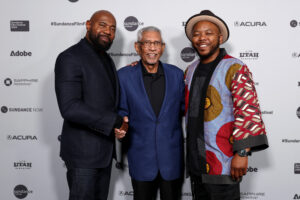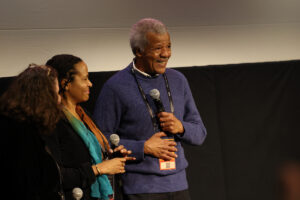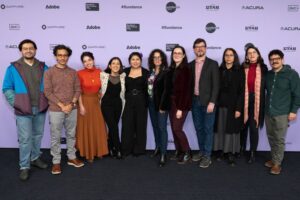




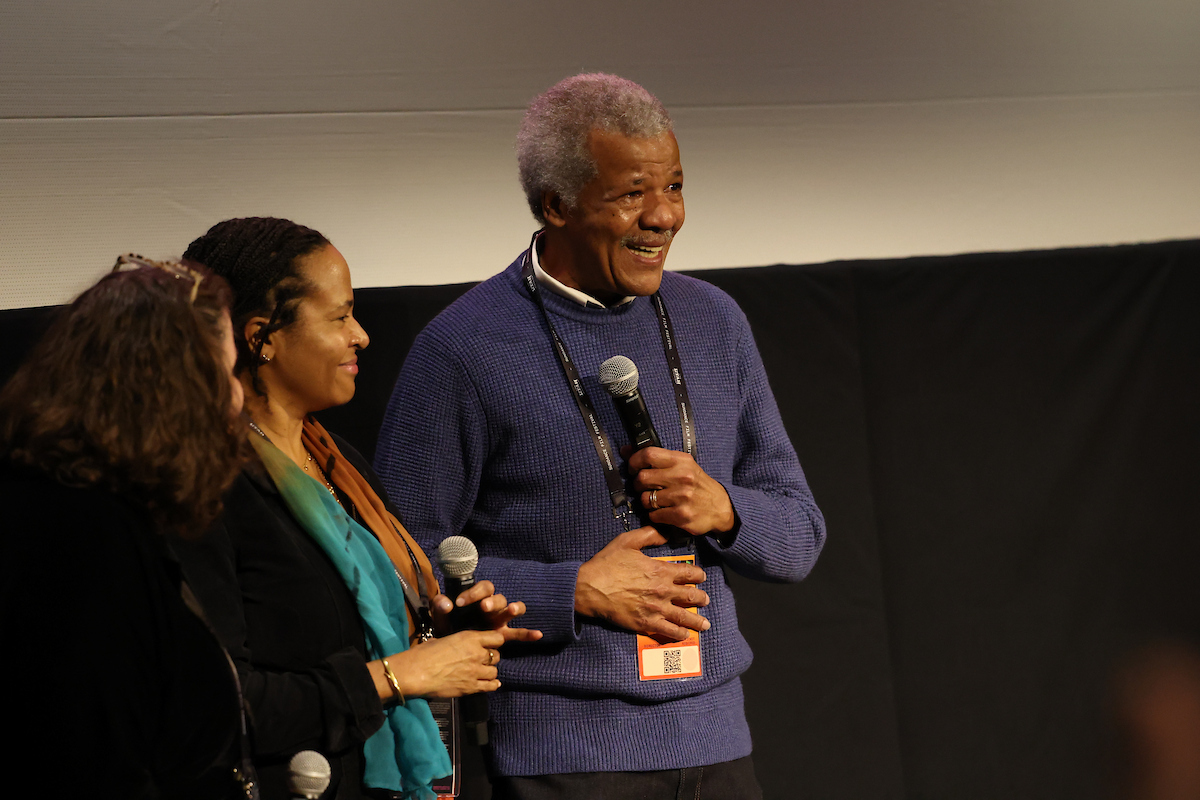
Anne de Mare, Liani Greaves, David Greaves, and attend the premiere of “Once Upon A Time in Harlem” at The Yarrow Theatre on January 25, 2026, in Park City, UT. (Photo by Stephanie Dunn/Sundance Institute)
By Jessica Herndon
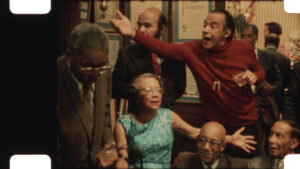
Once Upon A Time In Harlem unfolds like an invitation you can’t refuse. The film, debuting in the Premieres section at the 2026 Sundance Film Festival, opens by ushering us into an intimate gathering in 1972 at the Harlem home of Duke Ellington, where artists of the Harlem Renaissance come together for an afternoon of reflection and connection. What begins as a cocktail party quickly becomes something more: an archive of memory, debate, and the wisdom of a generation that helped define Black cultural identity in America.
The gathering was orchestrated by the late William Greaves, whose career consistently influenced cinema and cultural perception. Greaves, who gave us the bold Symbiopsychotaxiplasm: Take One at the 1992 Sundance Film Festival, Ralph Bunche: An American Odyssey at the 2001 Fest, and Symbiopsychotaxiplasm: Take 2½ in 2005, recognized the importance of preserving these voices while they could still speak for themselves. The conversations in the film span joyful reunions, unresolved tension, historical evaluations, and plenty of personal stories, allowing lived experience to transform into recorded history.
Co-directing alongside his father is David Greaves, who was also behind the camera during that pivotal afternoon. Together, the Greaveses capture the essence of artists who understood that their ways of shaping culture were a form of resistance, identity, and survival. “They filmed it so that you would have something to look to,” says David’s daughter, Liani Greaves, following the premiere of the film. “They wanted for us to see what it looks like when you’re really in tune with your infinite creativity and what can be created from that. And I’m so thrilled, honored to be able to share it.”
After an audience member thanked David for his beautiful portrait of a cultural movement, they asked if the filmmaker would share any lessons he learned, from those who appear in the film or otherwise, that we can use to navigate our current turbulent times.
“I think it was the ability of the artists back then to collaborate and to come together, to create something,” says David. “Their artistic reaction was to collaborate, and in that collaboration, find the strength to combat. I think that today, as we’re going through so much turbulence in the nation, etc., that in coming together, you can find that strength to overcome adversity. And so, it was through their collaboration that they found strength.”
Adds Liani, “I often talk about this film as a recipe for an awakening or a renaissance in that you saw that there was this, as my dad was saying, this collaboration. You found that the poet was sitting for the sculptor and the sculptor was sitting for the painter, so there was this great collaboration. And this film is that, right? This film is very much a co-creation. It’s a co-creation across time and across generations, including the present.”
Editor Lynn True and editor and producer Anne de Mare pieced the film together from nearly 60,000 feet of film. “I got jealous, while working on [the film], of the community that they had,” says de Mare. “This film really taught me a lot about service and collaboration and that we have to look at what collectively we need to accomplish, not individually what we want to accomplish. This film has very much been a collaborative effort from way, way back. It’s powerful.”
Viewed today, Once Upon A Time In Harlem resonates with urgency. As conversations around whose histories are preserved and whose are sidelined continue to intensify, the film stands as a reminder of the power of telling our own stories. By letting the architects of the Harlem Renaissance speak in their own voices, the film serves as both documentation and declaration that cultural memory is not only worth protecting but also essential to understanding who we are now.