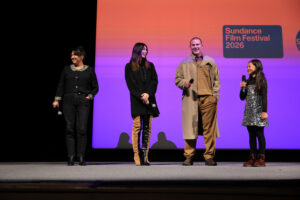




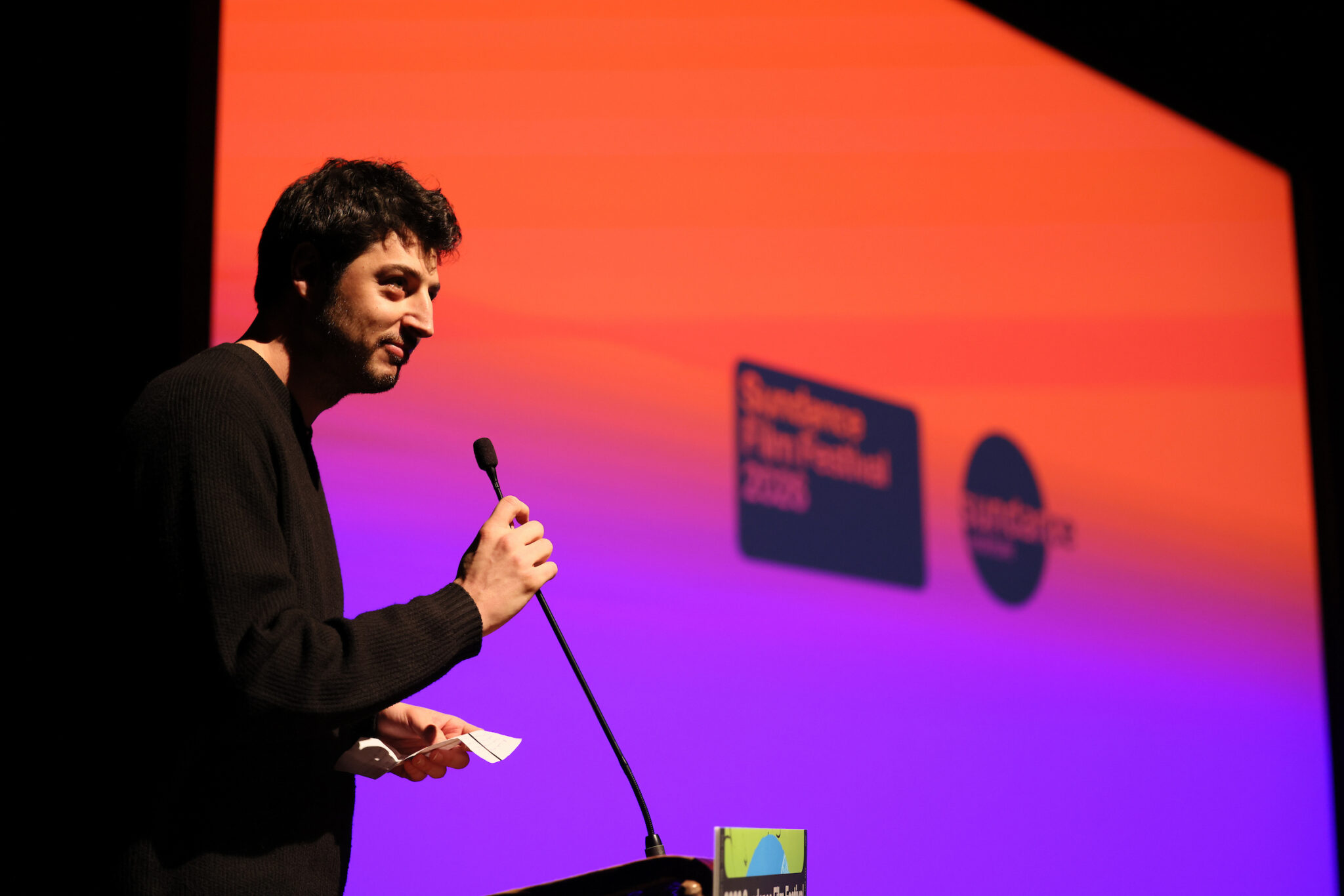
Adam Meeks attends the premiere of his film “Union County,” an official selection of the 2026 Sundance Film Festival. (Photo by Jemal Countess/Sundance Institute)
By Lucy Spicer
Union County is a quiet film. It’s also a remarkably honest one.
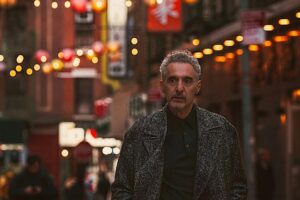
Set in the shadow of the opioid epidemic in central Ohio — where writer-director Adam Meeks lived until he was 6 — the film stars Will Poulter as Cody, a man taking life one day at a time as part of his county-mandated drug court program. He goes to meetings, finds a job, and tentatively wades into the community when he reconnects with foster brother Jack (Noah Centineo). And though we eventually become witness to the cyclical nature of recovery when Cody backslides, Union County is not one to get lost in a sea of sensational stories about drug addiction.
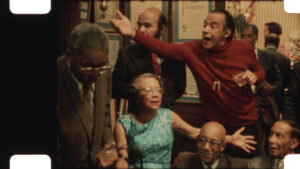
An expansion of Meeks’ 2020 short film of the same name, this understated and hopeful work premiered January 25 at Eccles Theatre as part of the 2026 Sundance Film Festival’s U.S. Dramatic Competition. Poulter is compelling as Cody, whose story lives alongside real testimonies by nonactors who share their progress in drug court and addiction support meetings that Cody attends. Some of the film’s participants, like the beloved therapist Annette Deao and Judge Braig, are playing versions of themselves, but all other individuals in those settings are real people sharing real progress and goals.
“Anybody who’s speaking besides Will and Noah’s character — anybody who’s speaking in the courtroom or sober support meetings are all folks in recovery who were in attendance that day and interacting in real time,” reveals Meeks during the film’s post-premiere Q&A. “None of that is scripted, and our actors were in the room in character and would step up to the podium when called.”
Conversations about — and depictions of — the opioid crisis don’t often include hope in recovery, so when Meeks returned to Ohio in adulthood, he was floored by the community that had taken root. “My extended family started telling me about the way that the opioid epidemic at that time was affecting friends and loved ones,” he says. “And it was intense at that time, and my uncle actually introduced me to the drug court judge at the time, a previous judge, and he invited me to sit in on a meeting. And I sat in on this first meeting and it just blew me away. It was just so full of hope and humanity and empathy, and it was this kind of immediate counternarrative to what I had been hearing about and what I think most of us were hearing about in terms of the bleakness and the tragedy and the overdose statistics.”
What Meeks saw was people healing and getting their lives back. And Deao and her team were a big part of the process — in fact, the writer-director calls Deao “the heart and soul of this community and the heart and soul of this film.” When he was putting together his short film, he asked Deao to be part of it.
“He was such a gentle spirit, and I loved — of course — his ideas,” says Deao during the Q&A. “And I said, ‘Sure, how could I help?’ It didn’t take long before he said, ‘Well, we’d just like you to play yourself.’ And I’m like, ‘OK, I guess I can do that,’” she continues as the audience laughs.
“So we had a great time with the short. I felt like he was so sincere about telling this story of recovery. I’ve worked in this field for 38 years — 22 in recovery courts. And to have someone from the outside come in and see what Adam has a vision for was just so special.”
As we hear real people’s testimonies of healing among the community in the film, so too do we see Cody’s character learn to lean on others for support. And, like the director, Poulter’s performance was informed by the time he spent with the locals before the shoot. “I think for us as actors, the waters were very warm and welcoming coming in, and it made our job easier, I would say,” says Poulter during the Q&A. “I think sometimes the biggest challenge was that all the participants are giving a far better performance than you’re able to give.”