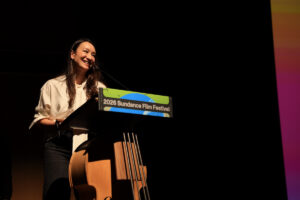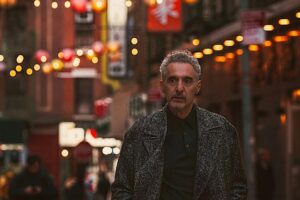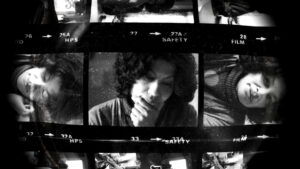





(L–R) Jennifer Robinson, Selina Miles, Catalina Ruiz-Navarro, and Brittany Higgins attend the “Silenced” premiere during the 2026 Sundance Film Festival at The Ray Theatre on January 24, 2026, in Park City, Utah. (Photo by Arturo Holmes/Getty Images for Sundance Film Festival)
By Lucy Spicer
It takes courage for women to speak up about sexual harassment and assault that has been committed against them at the hands of men. They risk retaliation, public scrutiny, being labeled as liars, and more. And, historically, they know that the man who assaulted or harassed them is unlikely to face legal consequences. The #MeToo movement created a community of solidarity that encouraged more women to come forward with their personal stories, but subsequent backlash from powerful men has led to yet another consequence that women have to consider before speaking out: defamation lawsuits.
In Selina Miles’ Silenced, which premiered January 24 at The Ray Theatre in Park City as part of the 2026 Sundance Film Festival’s World Cinema Documentary Competition, the director examines how women across the world are being threatened with litigation after they dare to speak up about abuse and misconduct against them. Anchoring the film is human rights lawyer Jennifer Robinson, whose book How Many More Women?, co-written with Keina Yoshida, served as the jumping-off point for the documentary’s production.
“I always wanted to make this book into a documentary film as I believe so much in the power of storytelling as an entry to empathy, to raise awareness, to create change,” says Robinson at the film’s post-premiere Q&A. Even so, it took a lot of convincing to get her to appear in the film. “I was deeply uncomfortable about actually being in it because I wanted the voices of the women to be at the forefront,” she says. Thankfully, Robinson and Miles were on the same page in that respect.
“I think what quickly revealed itself was that the heart of the film was the firsthand testimony of our participants,” says Miles. “I hope audiences feel the way I feel. It’s just incredibly, incredibly compelling and powerful to hear these women tell these stories in their own words, and I hope that this can be a tool for empathy and understanding. So that was really our guiding star throughout this whole project.”
Among the film’s participants are Amber Heard and Brittany Higgins, both of whom faced high-profile defamation lawsuits. Robinson represented Heard when she was forced to provide evidence in the defamation case brought by her ex-husband, Johnny Depp, against News Group Newspapers Ltd after British newspaper The Sun published an article alleging abuse. The court rejected the claim against the newspaper publisher, but a second defamation case brought directly against Heard in Virginia had a different outcome. Higgins, who alleged that a political staffer raped her in Australian Parliament House, also had defamation suits brought against her after her case ended in a mistrial. Both of these women continue to endure a media circus.
But Higgins encourages women to fight on in spite of it all. “I think a problem we don’t talk about is a problem we can’t solve,” she says during the post-premiere Q&A. “So as a result, you’ve seen the horrors of my lived experience, but what you kind of didn’t see was as a result we have affirmative consent in Australia in most of our legal jurisdictions, and there’s now anti-stealthing laws, so that’s also now criminalized. We changed the culture of Parliament; there’s now new rules inside Parliament House. Sometimes doing the right thing takes a personal cost, but I think there’s a net benefit. And one day, hopefully, when I’m a little old lady, I’ll look back and I’ll feel a lot better.”
Catalina Ruiz-Navarro, a Colombian journalist who also appears in the film, recognizes that an upward trend of judicial harassment has the potential for disastrous implications regarding free speech. Ruiz-Navarro continues to face a barrage of legal complaints from filmmaker Ciro Guerra after her magazine published a story in which eight women accused Guerra of sexual harassment. “I want to say to all journalists here that what [Guerra] wants to attain with his lawsuit is to force us to reveal our sources through judicial action,” she explains to the audience at The Ray Theatre.
“If he succeeds, this precedent will be devastating for journalism in Colombia, in Latin America, and everywhere. And to every woman that has gone through this, and I believe that all of us has gone through some sort of harassment, even if it’s mild, harassment and sexual abuse are essentially an abuse of power. And that’s why it is done by powerful men. So every time a woman speaks, she’s punching up, and she’s speaking for all of us, and that needs a lot of bravery.”
And Robinson assures the audience that the impact of these women’s stories will continue to reverberate. “There’s so many things I want to do with this film,” she says. “In writing the book and in doing the film, we want to create legal change. We want better legal protections, we want anti-SLAPP laws everywhere that better protect journalists and women who speak out. We’re gonna be showing this film in parliaments around the world, at the U.N., advocating for change. We also need cultural change. But I also want to use the film as a resource to support the women here with me.”