



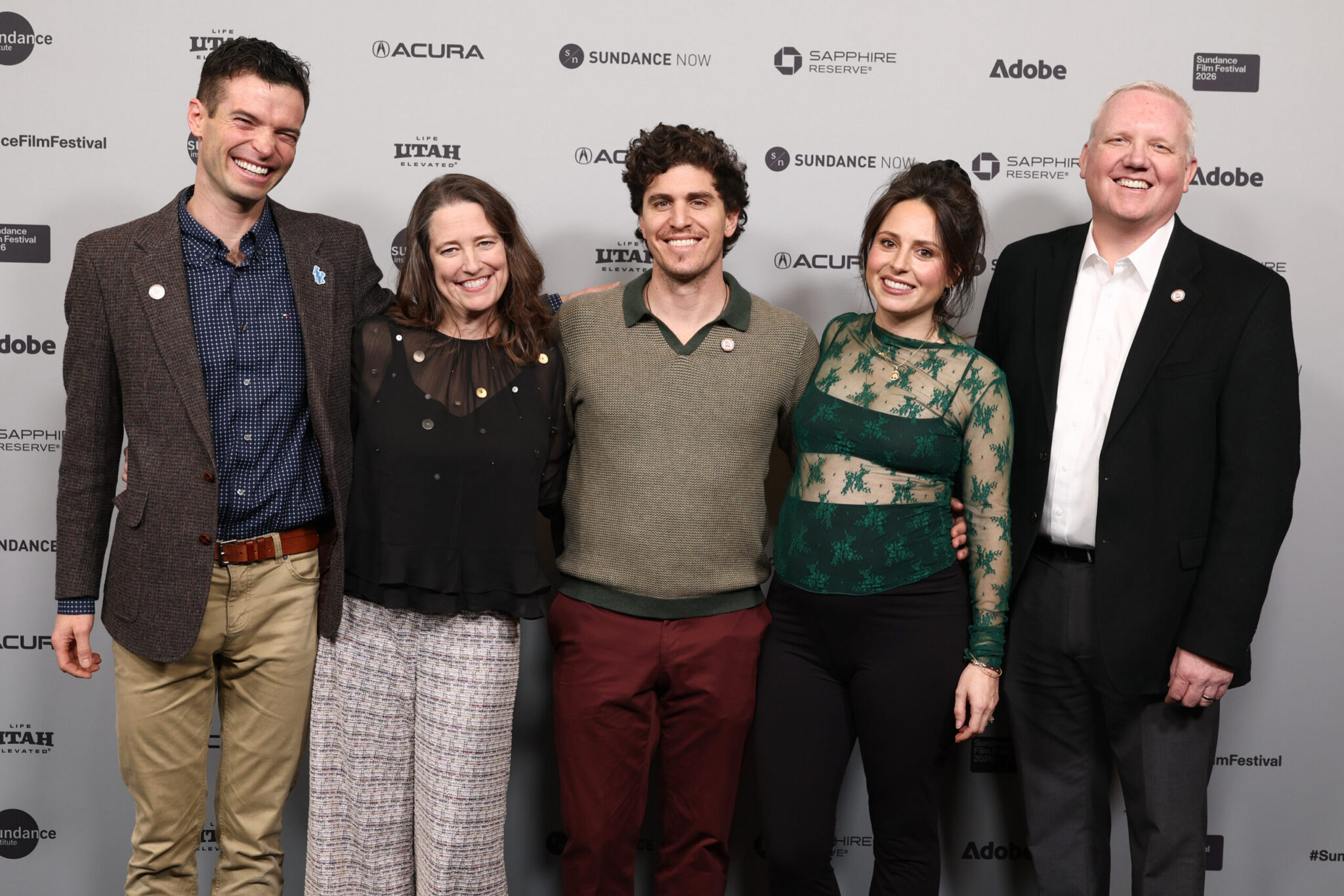
(L-R) Ben Abbott, Bonnie Baxter, Fletcher Keyes, Abby Ellis, and Brian Steed attend “The Lake” Premiere during the 2026 Sundance Film Festival at The Ray Theatre on January 22, 2026 in Park City, Utah. (Photo by Cindy Ord/Getty Images)
By Gina McIntyre
The urgent new documentary The Lake premiered at the 2026 Sundance Film Festival with an opening day screening at Park City’s Ray Theatre — elevating one of the most pressing ecological crises in the United States to the world stage.
Greeted with resounding applause from the Festival audience, the film from native Utahan Abby Ellis, which is screening as part of the U.S. Documentary Competition, chronicles efforts to stem and reverse the shrinking of the Great Salt Lake, which has been likened to an environmental nuclear bomb in terms of its potential harmful impacts. The exposed lake bed contains toxic minerals that are blown across the landscape in clouds of billowing dust; at the same time, vital habitat for numerous migrating birds is being lost.
Yet as Ellis took to the Ray Theatre stage as the end credits rolled, her message was one of hope — that her film might bring renewed attention to the decline of the lake and the efforts to bring it back to life. “Having spent so long in rooms with important people working on this, I have a lot of faith in them not giving up, and I was also pleasantly surprised to learn that you can’t judge people based on their political affiliation as to whether they care, for example, about the environment,” Ellis says. “I think Utah’s pretty special that way.”
The Lake arrives at the Festival with major weight behind it: Among its executive producers are Leonardo DiCaprio, as well as Jimmy Chin and Elizabeth Chai Vasarhelyi, the Oscar-winning directors of the 2018 documentary Free Solo. (Producer Fletcher Keyes was on hand for the Festival premiere.) But the film itself foregrounds the tireless efforts of everyday citizens — microbiologist Bonnie Baxter, ecologist Ben Abbott, University of Utah atmospheric sciences professor Kevin Perry, and Great Salt Lake Commissioner Brian Steed — as they grapple with the realities of the accelerating depletion of what was once the largest saline lake in the Western Hemisphere.
Ellis’ sobering documentary tracks their effort to convey the catastrophic damage that will occur if the body of water, which sustains millions, vanishes from the landscape. Watching the film, it’s abundantly clear that inaction is not an option, yet nowhere in the world has a salt lake been revitalized once it has begun to die out.
Baxter, Abbott, Perry, and Steed joined Ellis after the screening to offer their assessments of the lake today and to reflect on the potential impact of the new documentary. “Three decades of working on the lake, it feels like you’re watching, you’re waiting up until this moment where everything crashes,” Baxter says. “I just have felt for the last 10 years like we were on a precipice, and I tried to do things to get the public’s attention. I wrote an obituary for the lake years ago and tried to call attention to it a little differently than maybe scientists would ordinarily do. So, to see this artwork come together and bring the story to the world this way, I’m just really impressed and excited.”
Ensuring that the issue remains squarely in the public eye is critical to making continued progress, the experts agree. “It depends on us, everyone in this room, everyone in this watershed, everyone in this country,” Abbott says. “It really matters what we do next. The lake doesn’t respond directly to money or podcasts or even films — it responds to water. So the question that’s open is are we able to translate the feeling that we have right now of solidarity and hope into water.”
“Ben’s right — money won’t fix the lake,” Steed adds. “But what money can do is acquire a lot of water. Last year, the federal government committed $50 million for the Great Salt Lake. They did so because everyone sees that this is more than just a Utah problem. This is a national and international problem. What we’ll be pushing for is to try to get more of those resources to bear in order to acquire as much water as we can. What I’ve loved about working on this project, I’ve gotten to know a lot of people who care so passionately about it and are willing to pony up money where their mouth is when it comes to this.”
The goal, Abbott says, is to recover eight feet of water in the next eight years — a prospect made all the more complicated by the fact that three feet of water are lost every summer through natural evaporation.
Still, despite the tremendously high stakes involved, Perry suggested that he’s cheered by the groundswell of support he’s witnessed over the last decade. “This is too big of a problem to let it die,” Perry says. “It matters to every single one of us, and I don’t think the people of Utah are about to let their leaders fail to lead on this issue.”
For filmmaker Ellis — a Peabody- and Emmy Award–nominated filmmaker and journalist whose documentary Flint’s Deadly Water tracked the deaths and disease that resulted from the contaminated water consumed by the unsuspecting residents of Flint, Michigan —The Lake is a true call to action.
“I hope people realize we have power,” Ellis says. “I think we’re living in a time where we feel like we have no power and it’s so overwhelming. But we have power and a lot of our problems are caused by us. We’re the solution.”