




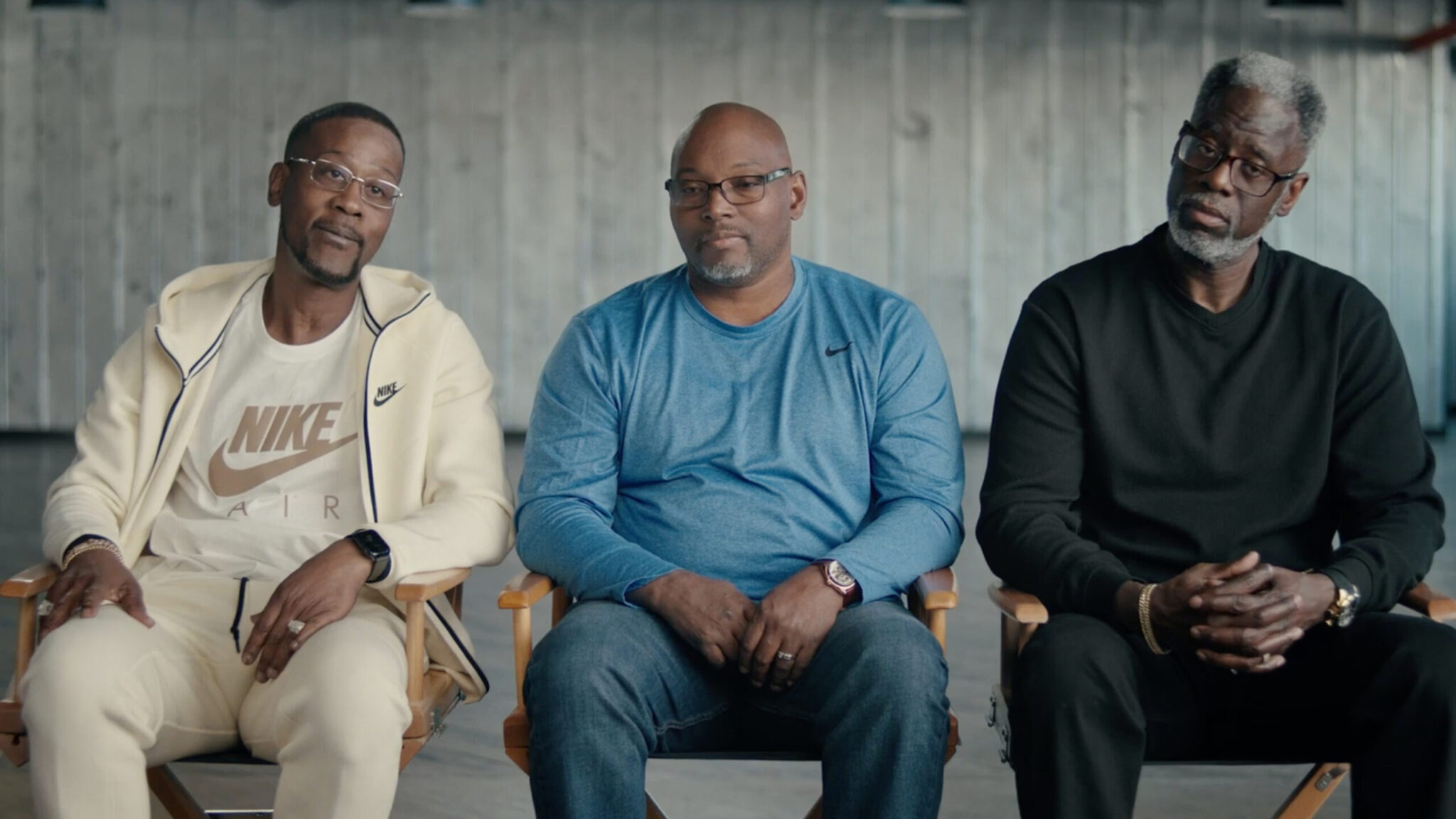
A still from “When A Witness Recants” by Dawn Porter, an official selection of the 2026 Sundance Film Festival. Courtesy of Sundance Institute | photo by Bryan Gentry
By Jessica Herndon
Before the premiere of her documentary When A Witness Recants at the Library Center Theatre in Park City, director Dawn Porter poses this warning to the audience: “You might want some tissues if you have some tissues.” It’s real talk. The film is extremely emotional, triggering, and heavy. But Porter also assures “there’s a lot of joy” in the film.
In 1983, 14-year-old DeWitt Duckett was murdered inside Harlem Park Junior High, a Baltimore public school. It’s a crime that sent shockwaves through the community. Years later, author Ta-Nehisi Coates, who executive produced the film, revisits the case with Porter, chronicling the devastating truth: Andrew Stewart, Ransom Watkins, and Alfred Chestnut, three Black teenagers from Coates’ neighborhood, who came to be known as the Harlem Park Three, are convicted on coerced testimony and spend 36 years behind bars for a crime they did not commit.
Debuting in the Premieres section of the 2026 Sundance Film Festival, When A Witness Recants, to be distributed by HBO Documentary Films, traces how a system hungry for closure turns children into tools. Porter charts the arc from the men’s youth, playing in the streets of 1980s Baltimore, to their adolescence and adulthood spent in prison. Their eventual exoneration, after concealed police reports were finally released, brings relief, but Porter shows how the men are left to confront the psychological toll of incarceration and the disorientation of returning home after losing decades of their lives. The film also centers on Ron Bishop and Edward Capers, two of the child witnesses whose fabricated testimony helps seal their fate.
Based on a story by Jennifer Gonnerman for The New Yorker, When A Witness Recants, which features graphic animations by Dawud Anyabwile recreating the crime and surrounding events, interrogates the power, corruption, and failures of the criminal justice system.
As the film ends and Porter is invited to the front of the theater, the audience rises to their feet for a standing ovation. The crowd remains on their feet, cheering relentlessly as Watkins, Chestnut, and Stewart join Porter, standing beside her before the audience.
“When we came in to interview these gentlemen, we did not know how they would feel,” Porter says, glancing at the three. “You have to just be humble and let them take over. And I think you see how honest they are. These are hard things to share.”
Says Chestnut, “I’m thankful for HBO for putting this film together for all three of us and our family. HBO has given us back our dignity.” Adds Stewart, “I’m not gonna sugar coat, try to make things sound good. It ain’t good. It’s hard. We’re still behind, we’re struggling in life every day. But because we know we got people that believe in us, trust in us, and have faith in us, we are able to get up and look at ourselves in the mirror and say, ‘I love you. It’s gonna be all right.’ I can call my brother Alf. I can call my brother Ransom. We can talk to each other. We don’t have to be behind the bars. That’s a great thing.”
Watkins expresses what he hopes viewers take away from watching the film. “What I want people to get from this is that the next generation shouldn’t have to go through this,” he says. “I don’t want people to wait until this happens, and decide to get involved. I want them to get involved before this happens. And for the people that we vote for, we need to put something in place to punish them when they do this to us.”
The specific “them” he is referring to are Donald Kincaid, the former Baltimore Police Department lead investigator on the case, who coerced the then teenage Bishop and Capers into giving false testimony by threatening them with violence and imprisonment, and the trial judge Robert Bell. Neither of these men agreed to be interviewed for the film. “You have to realize, everybody that y’all saw in this film, from Detective Kincaid to Judge Robert Bell, nothing happened. [Kincaid] still has his pension. He’s still at home. So everybody came up but us. We all suffered, and they all went home to their families, watched their kids go to college, and everything.”
After Porter notes that an estimated 5% of convictions are wrongful, an audience member asks for action items to help ensure this doesn’t keep happening. “What we can do on a personal level is to ensure that we’re engaged in local elections,” says Marilyn Mosby, the former State’s Attorney for Baltimore who was instrumental in the exoneration of Watkins, Chestnut, and Stewart. “Prosecutors are one of the most important stakeholders in the criminal justice system. We decide who is charged, what they are charged with, what sentences to recommend, whether someone gets in or out of the criminal justice system in the first place — and that is something that we should be following.”
Returning to the Sundance Film Festival for the fourth time after her last Festival premiere, 2024’s Luther: Never Too Much, Porter delivers a meticulous investigation and a moral gut check, insisting that justice is not only about what happened, but about who gets believed and who pays the price when authorities are intent on getting the story wrong. “As difficult as things are today, I’m thinking we can be better,” Porter tells the audience. “We will do better. You all being here makes me believe that we will do better.”