



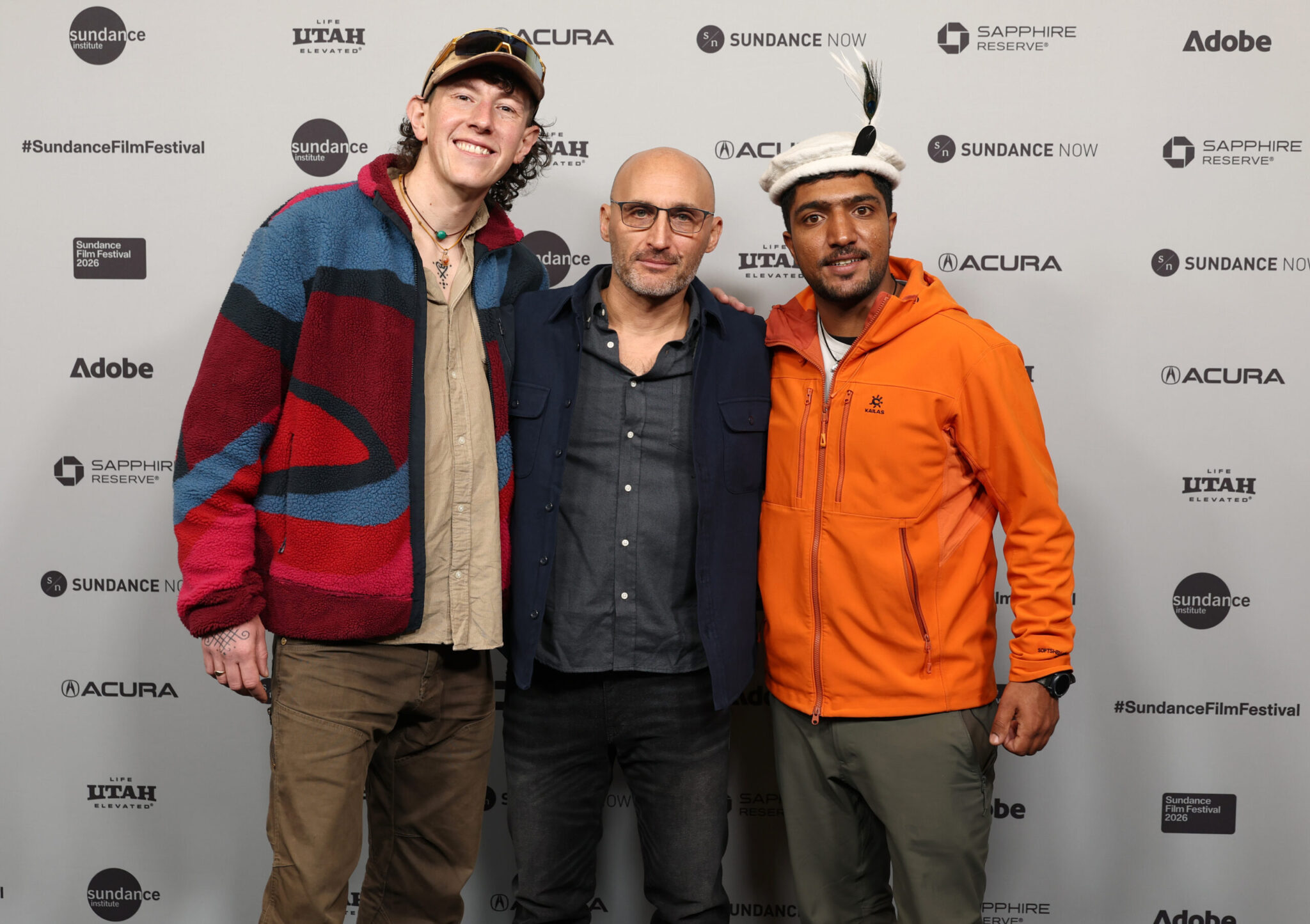
(L-R) Sandro Gromen-Hayes, Amir Bar-Lev, and Sajid Sadpara attend “The Last First: Winter K2” premiere during the 2026 Sundance Film Festival at The Ray Theatre on January 22, 2026, in Park City, Utah. (Photo by Cindy Ord/Getty Images)
By Cecilia Santini
There are 14 mountains in the world with summits over 8,000 meters above sea level. As of 2020, 13 of those 14 had been climbed in winter. Only one, K2 in Pakistan, the second highest mountain in the world, had never been summited in winter before. Notoriously dangerous, K2 had claimed many climbers’ lives over the years.
At the end of 2020 and the beginning of 2021, after Pakistan opened its borders to travelers during the COVID-19 pandemic, a group of mountaineers, athletes, and tourists descended on K2 from all over the world in an attempt to become the first climbers ever to complete the winter ascent. But brutal weather conditions, overcrowding, and tensions among the climbers led to tragedy. The Last First: Winter K2 chronicles the disaster and traces why it happened.
Director Amir Bar-Lev’s new film follows three overlapping expeditions. An Icelandic climber and two Pakistani climbers (a father and son) arrived at the mountain first. They were soon followed by a celebrity Nepalese mountaineer and his crew, as well as an expedition organized by a commercial company composed of climbers of varying levels of experience. Soon, the camps were swarming with people, and a race to reach the top was underway.
Returning to the Sundance Film Festival after documentaries like My Kid Could Paint That, Happy Valley, and Long Strange Trip, Bar-Lev shows what unfolded through a mix of incredible on-mountain footage taken by expedition participants and interviews with people who were there.
“It’s a gripping, riveting, competitive survival story,” Bar-Lev says, speaking after the film’s January 22 premiere in Park City. “We were blessed to have all these fantastic participants — and the participants don’t all have the same perspective. Sometimes, [they have] opposing perspectives. … We wanted to make a riveting story with no easy answers that’s the aggregate of all the different perspectives.”
The film thoughtfully examines difficult themes and asks hard questions as it looks at why the expedition went wrong. With the growth of social media, extreme outdoor sports have become more commercialized, and access to nature is increasingly treated like a commodity, with serious safety consequences. The film also touches on the colonialist history of mountaineering and the erasure of people of color from the sport’s history, and how the effects of that legacy played out on K2.
Why do people with families risk their lives in these ways? Why do they want to be first, and who gets to be first? When things go wrong, who is to blame? The Last First: Winter K2 raises numerous questions that Bar-Lev hopes will remain with audiences long after they watch the film.
“That’s what I always look for, a story with no easy answers, because then you’re kind of inviting the audience to figure out what they feel about it instead of hammering them over the head with your perspective,” he says. “Since my film that I had here, My Kid Could Paint That, this was definitely the film in which I didn’t know how to feel. And I felt really lucky because you can easily make mysteries in fiction, but in nonfiction, it’s very hard to do ambiguity, and [it’s] very fortunate as a storyteller if you have this degree of ambiguity.”