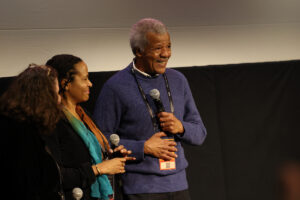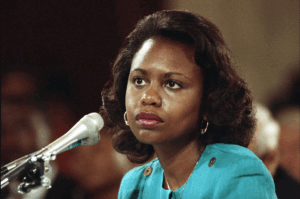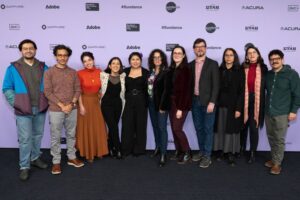



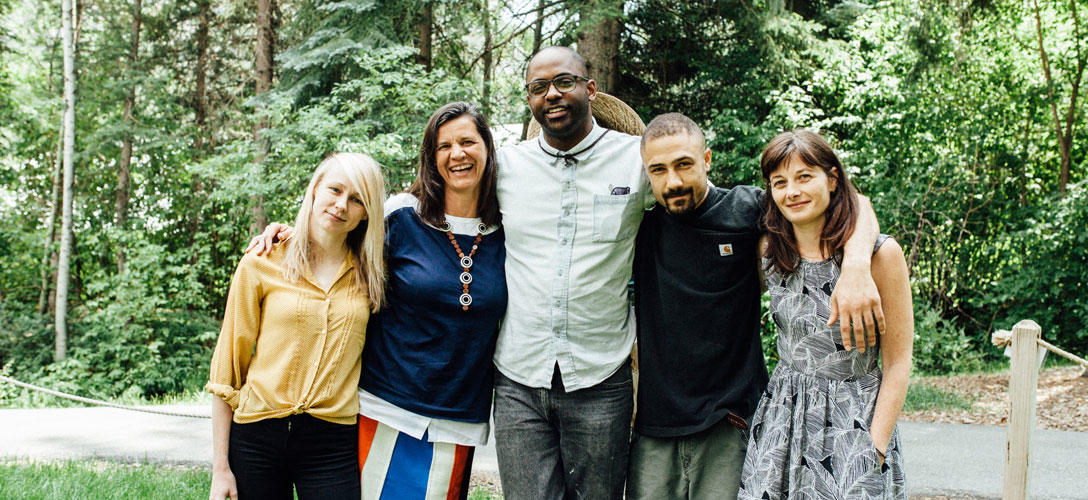
2016 Sundance Art of Nonfiction Fellows (L–R) Kitty Green, Kirsten Johnson, RaMell Ross, Khalik Allah, and Brett Story at the Sundance Resort. © 2017 Sundance Institute | Jennifer Fairchild
Eric Hynes
A lot can happen in a year. For the filmmakers chosen as the second-ever cohort of the Art of Nonfiction Fellowship—the founding pillar of the Sundance Documentary Film Program’s Art of Nonfiction Initiative—it was a year that started with being admitted to the fellowship; continued with retreats in Marfa, Texas, and Sundance Resort; saw various films reach completion, stir to life, and steadily develop; and ended with the five of them sitting around a table on a late summer day in New York.
The Art of Nonfiction Fellowship is a pointedly atypical initiative in that it isn’t project-based—there’s no demand or expectation in terms of a particular project. The fellowship exists to support nonfiction filmmakers as they focus on their process, their craft, their work/life balance—in a sense supporting the artist from the inside out, rather than driving them from the outside (“where’s your film?”) in.
Nevertheless, or perhaps precisely because of this, these five filmmakers were extraordinarily productive during their fellowship year: Kirsten Johnson’s Cameraperson was shortlisted for the Academy Award, won multiple Cinema Eye Honors, and was a fixture atop many year-end top ten lists; she also began production on her next feature, a project of great conceptual and emotional ambition.
Meanwhile, Kitty Green’s Casting JonBenet debuted at the Sundance Film Festival before reaching audiences worldwide via Netflix; she also began researching and developing her next film, working again with JonBenet producers Scott Macaulay and James Schamus.
Khalik Allah and Brett Story continued to travel the world in support of their first features, Field Niggas and The Prison in Twelve Landscapes, respectively; Allah also traveled back and forth from Jamaica, shooting and editing his next one, Black Mother, while Story filmed hers, The Hottest August, over the summer in New York City.
And finally, RaMell Ross spent the year completing his first feature film, Hale County This Morning, This Evening, toggling between photography and editing, researching and teaching, Alabama and Rhode Island.
Over the course of an extensive group conversation, the filmmakers reflected on their year together and apart, discussing how the Art of Nonfiction Fellowship inspired and challenged them—and how they inspired and challenged one another in turn—and contemplating how to further these conversations as the year came to a close.
On applying to the Art of Nonfiction Fellowship:
Khalik: I really didn’t know much about the program, or about the previous fellows, but there was this opportunity to apply, and the name sounded dope—“Art of Nonfiction”—so just off that I was kind of intrigued. But I was in Ecuador, and it was due the day that I was leaving, so I just recorded my application right there, saying what type of filmmaker I wanted to be, what I’m striving to achieve in my career. It’s a little weird for me, coming from where I came from. Because I was making films with nothing. I didn’t really have friends that were in the film world.
Kitty: I also was looking for community. I was moving here from Australia, where I have a support network—my family are all artists—but I don’t have that here. So part of what I needed was a group here that could support me, and it was ideal in that everyone was so brilliant. You never are starved for support.
Kirsten: It actually was the most useful application I’ve ever done. I believed them when they said it would be as free as possible, and you could do something different than what you would normally do with an application—you could use things other than words, you could talk or use images. So I had one of those weird euphoric moments of like, “I don’t even care if I don’t get it, I’m just so happy doing this thing.” I learned about myself during the application.
Brett: I remember being invited to apply and thinking, “Shit, I want this too much.” I don’t like wanting things too much. There were many levels to which my attempt to have a career in documentary film had been an alienating experience. I hadn’t recognized what I do in the central reward and appraisal systems that lead the way within documentary. To just hear about this initiative that was putting at the forefront the idea of nonfiction cinema as an art form, and recognizing that it has a place, was very exciting.
RaMell: The application process prompted me to think more critically about some of the stuff I was interested in—some of the ideas, some words I had been playing with—which was great because that opens up to potentially a path of logic that can be followed and applied to something more meaningful.
On being both unified and separate, and learning from one another:
Kirsten: I love the way we talk to each other. Each of you has been thinking about images, about the structure of films, in such specific and rigorous ways, and you all articulate it in your own really personal ways. When Khalik said ‘camera ministry’ to me, it blew my mind. I have so many negative associations with religion, so it’s great to feel the love and energy that he brings when he shoots and to have that be spoken as a ministry. It changed the way I thought about my shooting.
Similarly, the rigor with which RaMell chooses two words and puts them next to each other; meanwhile I’ve been saying mountains of words to get at that thing. Then you have a conversation with Kitty about the way she looks at a budget as a way to get into the creativity of her work. It was as if everyone was doing this parallel thinking but expressed it with different words, different energy, and applying it in different parts of the process. But I know exactly what they are talking about, I feel constant “aha” moments with everyone. There’s been a loneliness in doing a certain kind of work, and no one gets what you’re talking about. But everyone here understands what I’m talking about.
Brett: And there’s a difference between talking about the creative process and talking about the professionalization process. So many spaces become dominated by conversations of professional development and funding. To have a year to talk only about creative process was so phenomenal.
Kirsten: You realize how rare it is to have sustained conversations with people: we’re all on the festival circuit, but I would say we here are building on a conversation. We learn things about each other’s language, and then know how to ask different questions.
Brett: It takes time to become legible to other people. Friendship isn’t always the best way for that legibility to work. Sometimes you need creative relationships. If we had all just met and were thrown into feedback screenings with each other, I don’t think it would’ve been terribly productive. We need the time to learn how each other thinks, or at least how we approach the things we do, so that at the point when we’re making and looking for creative comrades to help us further our work, we can trust that we’re legible at some level to each other. And that just takes time. It wouldn’t happen if you were just drinking buddies or seeing each other on film festival circuits talking about fundraising. This gave us the opportunity to watch stuff, talk about it, show things to each other that we like to watch, talk about books that we read—that part of each other’s brains.
RaMell: To know someone is really hard. Like, I know myself, but it’s an evolving thing, and it’s important to know how people you know can participate in your craft.
Kitty: So you kind of get to know the group well enough that you know where they can really help you, where all of that will inspire and influence you, and where you need to do the thing in your weird little way and just be in your own little world.
Khalik: I was inspired by Kitty’s film [Casting JonBenet] when I saw it at Sundance. I was just sitting back and watching, and then I had to go and edit that night. It kinda sparked me.
Kitty: That was one of the best bits of feedback I got about my film: Khalik saying it made him want to go and work.
RaMell: I think everyone thinks they’re the outsider in the group. Everyone has their own, “I didn’t do things this way” or “this is where I came from.” It’s a group where you’re not trying to fit into the group. Which is the best thing ever.
Brett: There’s something about being within a group where people have totally different ways of creating and thinking. It means getting to talk about ideas and share challenges with like-minded people that do different kinds of work. You’re deeply interested even when it’s not what you do. You can absorb how they’re experimenting, which is totally different from how you’re experimenting. You see how rules get broken in ways other than how you would do it.
On experimenting and developing ideas:
Kirsten: I was coming off a project that took me years to make, so when I came into [the fellowship], I didn’t have a project to work on. I was just going to float around ideas, spend time with you all. Then, weirdly—I really do think it was the application. All of the clues to the project I would make are in the application. And they are very disparate ideas, but because I put them all together there, I think in some weird way it allowed the idea of the film to emerge—I wouldn’t have put those things together on my own.
The fellowship was encouraging for me to throw everything in, and not judge things. I’ve never experienced that—having an idea emerge. I realized I have a way of seeing the world, obviously. I just needed to start doing things with this idea. Whether it’s a university, or people you’re shooting for, or a corporation that wants a specific type of thing, you’re spending a huge amount of time responding to other people’s demands. I think I have left very little time and space to say what I am actually interested in, and these are my terms.
RaMell: It’s been interesting to see what people want and need, their desires to be challenged, their capacity to be critical and rigorous. To see how people are engaging with moving visual media. Knowing the way people are accepting things allows you to create something and have a better idea of how it will fit in the world. You add or subtract based on that, and based on your long-term or short-term desires for the film. Or for your image, or for your place in the world.
Khalik: Shortly after releasing Field Niggas on YouTube, I went back to Jamaica to start shooting this project Black Mother. I didn’t know it was that, though. I had shot a bunch. I was kind of in this middle land, this weird space, having released a film, it getting attention I didn’t expect, and then I’m part of the fellowship.
The main thing I had to do was remind myself to keep working, just keep working. Because a lot of this stuff was kind of overwhelming for me. I’m a filmmaker that needs to be hungry, I can’t be wrapped up in all these nice hotels and nice meals. At the end of the day I’m a visual MC. I’m Big Pun with visuals. That’s how I want to be. I don’t even think of it as filmmaking or photography, I just think of it like—what can I teach? What can I do to make the time that I’m passing in this dimension useful and meaningful?
It’s been a learning curve—it’s not easy, being in a group, showing people your work. I’m not the type of artist who shows people anything. But within this group I’ve screened my rough cut, even my super-super rough cut. That’s a level of trust and acceptance, but also a bit of a filter, mentally, of how I’m going to interpret the feedback that I get, trying to make the most of it, regardless if I register it as positive or negative. This person said something based off how they’re perceiving, and everybody’s understanding is valid, so just taking that and incorporating that into my work while still having that I-don’t-give-a-fuck mentality. Learn the rules to break the rules. Rules in the sense of what is accepted in documentary or what’s expected of me, and then flipping it.
Kirsten: Why didn’t I take this free fellowship money and take a vacation? I don’t know. Because it never feels like we can rest, because there’s one opportunity and you better make the most of it. I got the only good idea I’ve ever had in my life from this fellowship.
On asking and being asked questions:
RaMell: There’s almost nothing better in the world than to be asked a question. Basically, the entire year has been someone giving us a stage or giving us a microphone to speak to people who you respect about our own work and ideas. And the responses are critical. Not critical of each other, but interested. It forces us to push our ideas, or say something new about the same thing. Say it in a different way, and all those things become additive.
Brett: To be asked what you think about something, what your month has been about, what your relationship with your mother was like, what your childhood was like, and to have that recognized, is really productive and generative. You step up when you get asked the questions. An important part of the fellowship was being asked.
Khalik: Standing in contrast to different artists concretizes my own feelings of, okay, that’s who I am. Like, I see how they do it, and I would never do it that way. Or, I would do that. Knowledge of self is strengthened by being in a group, and not having to defend yourself. You talk about why you do things, what’s your motivation behind your approach, why do you hold the camera that way.
Kirsten: The idea that your life matters and relates to your art—that’s at the other end of the spectrum than your elevator pitch. It’s holistic. It’s the way you can swim and have your life be part of your work, and you can be tired and raise your kids and have three ideas that fail and out of them comes a fourth. It’s just nice to have the affirmation and recognition that that’s part of the process.
Kitty: I don’t need to be asked a question necessarily. It’s not all question based. Sometimes it’s just how people respond to certain points. Sometimes you show people three different things, and the third thing everyone will be talking about for the next hour. You feel there’s an energy around a certain idea.
RaMell: Obviously the questions you ask say more about you than they do about—whatever you’re going to get. But imagine you had close proximity to five of your favorite writers for a year—you’d have a different purchase on reality. You’d have a different purchase on writing. You’d have a different worldview. Yet somehow, also identical to your own. That’s what happens.
You see the way Khalik makes films, Kitty, Brett, KJ, and then you realize there’s a reality as profound as yours, yet you’re in tune with a reality as profound as your subjectivity. And that just opens up the way you see the world. I would love to be able to speak 13 languages. Right now I feel like I can almost speak four more. I can’t actually speak them cause I can’t do it, but I understand it when I see it or when I hear it. I know a little Spanish, and I move differently in the world and in the U.S. because I speak Spanish. So I think this has that kind of effect on our visual field and on our relationship to being a person.
Brett: Yeah I think we need to take seriously the homogenizing effect of joining forces in documentary, just like other art forms. And the way that it’s a reward system, of rejection and acceptance, according to rules of those homogenizing forces. I just respect the part of the fellowship where you get to be a gang of weirdos. The affirmation of what you’re doing is there because you’re doing it. But you’re also not obliged to fit in. I really like that formulation. A communion that’s not about sameness.
On keeping their fellowship alive:
Kirsten: Over the course of the fellowship, we’ve done these things that kind of put us on stage. We talk in front of each other. And even like this, listening to all of us, I learned a bunch of new stuff about everybody. That experience I think I would like to find some way to continue. It’s different than just staying in your own head or just writing a paper or just filming things. There’s this moderately safe space where this is being recorded and will be edited, thought about, before it is put out into the world. That space is really rare—it’s becoming more rare. And I think it’s really useful. So I would move forward thinking how could I build that for myself in some kind of way.
Kitty: I still feel quite insecure, even amongst the group. I still haven’t gotten over that. I felt it the first day we stepped in—like, how much of myself do I give, have I given too much, do I stay back. I’m quite introverted, so it’s odd for me to be in a group. I feel like oftentimes it’s more productive when I leave the group. I take in all of this, then go into my own little room and do my own thing, and that propels me forward. So it’s amazing and incredible, but also terrifying, this space and these conversations. There is that constant struggle of “do I fit in” and “should I fit in?” It’s ok not to fit in. But you find yourself struggling with it all the time. I don’t think that will ever go away, but that’s part of the beauty of it. Being vulnerable and being allowed to be vulnerable—that’s important in what we do.
Brett: In some ways [the fellowship] eradicated insecurity. And I think duration was necessary for that. You know a particular gathering isn’t going to be the last, you know there will be another—there’s a way that helps organize things differently. It relieves pressure. [It gave us] togetherness, proximity, openness, duration. And money.
RaMell: That’s a good equation. That’s a hell of an equation.
Kirsten: In a weird way that’s how Sundance has organized itself. It’s ongoing. It’s been ongoing in my life. They get you in, and then you stay in and become part of the community, and you talk about things in that semi-public way. And it brings up all the issues you’re all talking about, Kitty. Do I fit in? Does my work fit in, is my work valued?
RaMell: If someone can make something that interests you, being able to have access to whatever they’re doing for a period time is almost universally desirable. Apply our own sense of the world into things, and then talk about those things. Because it’s how you think about the world that I’m interested in.