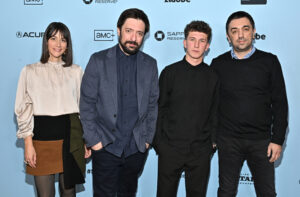




Andy London, Carolyn London, Grace An, Martín André, Josefina Montino, Don Hertzfeldt, Nicolas Fong, Kate Renshaw-Lewis, Rami Jarboui, and Saidah Russell attend the Animated Short Film Program premiere at the 2026 Sundance Film Festival. © 2026 Sundance Institute | photo by Lauren Hartmann
By Erik Adams
“I think every animator has a very unique relationship to time,” says Paper Trail director Don Hertzfeldt following the debut of the 2026 Sundance Film Festival’s Animated Short Film Program. Hertzfeldt and the seven other directors on hand at The Yarrow Theatre have been asked about their shorts’ inspirations, and his answer contains all of the insight, existential angst, and blunt humor that Festival audiences have come to expect from the guy behind Rejected, It’s Such a Beautiful Day, and World of Tomorrow.
“It’s not unusual to be sitting in a screening like this and something goes by in 10 seconds that took you six months to make,” Hertzfeldt says. “Inevitably, through the years, you start to think, where did all the time go?”
As for the arc of Paper Trail — which traces (pun intended) one man’s life across the doodles, homework, handwritten letters, and signed documents left in his wake — that’s personal, too.
“I’ve had to sign these art prints of my work before,” Hertzfeldt says. “It’s, like, [a limited] edition: One out of 250, two out of 215. You just sign your name over and over on these things. And inevitably, I’m gonna start thinking about what it would look like if it was moving. And then, maybe I could tell the story just through someone’s signatures, just through their artifacts. And can we see someone’s soul get flattened as their signature gets flattened over the years? I’m always thinking about sad things like this.”
Those on the receiving end of Paper Trail, however, face no risk of soul flattening. The same goes for the seven other shorts preceding Hertzfeldt’s bittersweet coda. They’re a bounty of inventive premises and varied techniques, including the rotoscoped memoir of 1981, the fully printed anatomical Rube Goldberg contraptions of Busy Bodies, or the psychedelic chain of embraces that makes up HUGS. Mangittatuarjuk (The Gnawer of Rocks) and Sorrow Doesn’t Sleep at Night make chilling use of folklore in stop-motion; Cabbage Daddy and The Bird’s Placebo take surrealist views of blending cultures. All but Mangittatuarjuk were represented by their directors during the Q&A.

Asked how he determined what elements of The Bird’s Placebo should be 2D and which should be 3D, director Rami Jarboui points to his background in conventional filmmaking, which he harnessed by shooting with live actors and rotoscoping their performances. There were practical considerations as well: “Of course, I couldn’t direct a bird, so I had to use 3D,” Jarboui says.
“But if I could find a bird [like that],” he adds, “I would direct it.”
HUGS director Nicolas Fong is similarly straightforward about his inspirations. “My previous project was a complicated story,” Fong says. “For this one, I told myself, go straight to the point: I like to animate hugs. Just make hugs.”
Fong is distributing free calendars inspired by his short at the Festival, and is also selling screen-printed HUGS posters. He’s one of several directors contributing a sense of show-and-tell to the premiere: Anyone interested in Busy Bodies’ production can check out a sheet of prints that Kate Renshaw-Lewis brought to Park City, and 1981 directors Andy and Carolyn London are handing out vintage-style ringer T-shirts emblazoned with the title of their short.
At the end of the Q&A, an audience member asks about the theme of connection that runs across several of the program’s shorts. The question sparks something in Jarboui.
“That’s a very common theme, and I think it’s normal because we live in such an alienated world, with technology and everything,” he says. “We are losing that little touch of magic, of being together without it being such a performance. Just being us.”
And with that, the souls within The Yarrow go utterly un-flattened.