




Will you share more anecdotes about casting or working with your actors?
Integral to my process is working with real people and collaborating with them on the storytelling. This meant that our initial approach was to street-cast talent. This entailed flyering around parks and beaches, posting on Instagram and Facebook, and combing through profiles on Actor’s Access and Backstage.
Once we had a strong pool of candidates, we embarked on a rigorous process of chemistry testing in order to gauge what pairings of actors worked best. During the casting process, I abandoned all preconceived ideas about how I wanted the characters to look and behave. My only criteria was that they have that authentic New York flavor familiar to me. I kept an open mind, in other words, and that’s how I eventually came across Juan, who instantly impressed us with his charisma and sense of humor. And later on Destiny, whose TikToks/Reels, where she lip-synched to scenes in popular films, really struck us.
Yohanna was a longtime collaborator, although her profile in New York had been growing and we were worried she’d be unavailable to work with us. But the silver-lining to the actor’s strike was that most actors at the time were out of work and therefore, Yohanna was available. Yohanna, being of Dominican background too, instantly understood the role, channeled her inner-Latina and brainstormed with me ways of bringing more nuance to her character.
We found Sally through more traditional means. Something about her playfulness and demeanor reminded me a lot of my sister, and her commitment to her character was next level. It was a no-brainer. We rehearsed at Ghetto Film School in the Bronx, together dissecting, breaking, and rewriting scenes until we were happy with them. It was a fun process.
What was your favorite part of making Mad Bills to Pay (or Destiny, dile que no soy malo)?
Production was my favorite part of making the film. It was at times daunting, at times serendipitous — all expected when shooting in a guerilla style in a dynamic place such as New York City, where the brief also entailed being stealthy and evading authority. We rolled with the punches and tight schedule, and although relationships and morale were tested, it was a bonding experience in the end for us all.
Our guiding ethos was to be present with each other and with the Bronx in all aspects of the concept, to listen and to respond to one another and to our environment. We were all tuned into the same wavelength and I think that in mix with the urgency we felt to make our days is what contributed most to the film’s success. After a while, things became automatic; we didn’t have to communicate with words as much. We could look at one another and just know what to do. The solidarity I felt among the crew and cast, in other words, was truly heartwarming by the end and I’m proud of what we were able to achieve considering the limited time and resources. It’s a testament to the professionalism and talent of everyone involved. We also played hard in our downtime, and that made the experience feel a little more human, a little less industrial.
There’s a romanticisation around making films with little resources and small crews as being more organic and liberating. This is, of course, true to an extent. But also true is that working with such limited resources often entails having to make a lot of compromises and it may demand an even more industrial approach so that you’re able to stretch your resources as far as they can go, and beyond. It’s hard making films in this way. But I love it, too. I thrive in that middle space of having to be resourceful and flexible. As the screenwriter, Artlette Langman once said in reference to her long-time collaborator, Maurice Pialat, true mastery is being able to make the film that’s in front of you (not the one on paper, nor the one in your head).
What was a big challenge you faced while making Mad Bills to Pay (or Destiny, dile que no soy malo)?
The biggest challenge I faced while making the film was balancing the organic treatment — improvisation/minimally scripted scenes — of an ambitious story and my deep work with actors with the sobering reality of little resources and time for production. The way I mitigated this was by committing to limiting the variables on the production side of things as much as possible: reducing the number of set-ups to one, the shooting ratio, as well as on-set lighting. This allowed us to cover the story quickly while protecting the integrity of rehearsal time and still maintaining a high aesthetic standard. On average, we covered roughly 10–12 script pages per day, or worked at a pace two-to-three times that of the standard production. We shot 100 scenes over the course of 16 days. Although the approach with actors and story was very exploratory, we balanced it with rigid precision on the production side of things.
Films are lasting artistic legacies. What do you want yours to say?
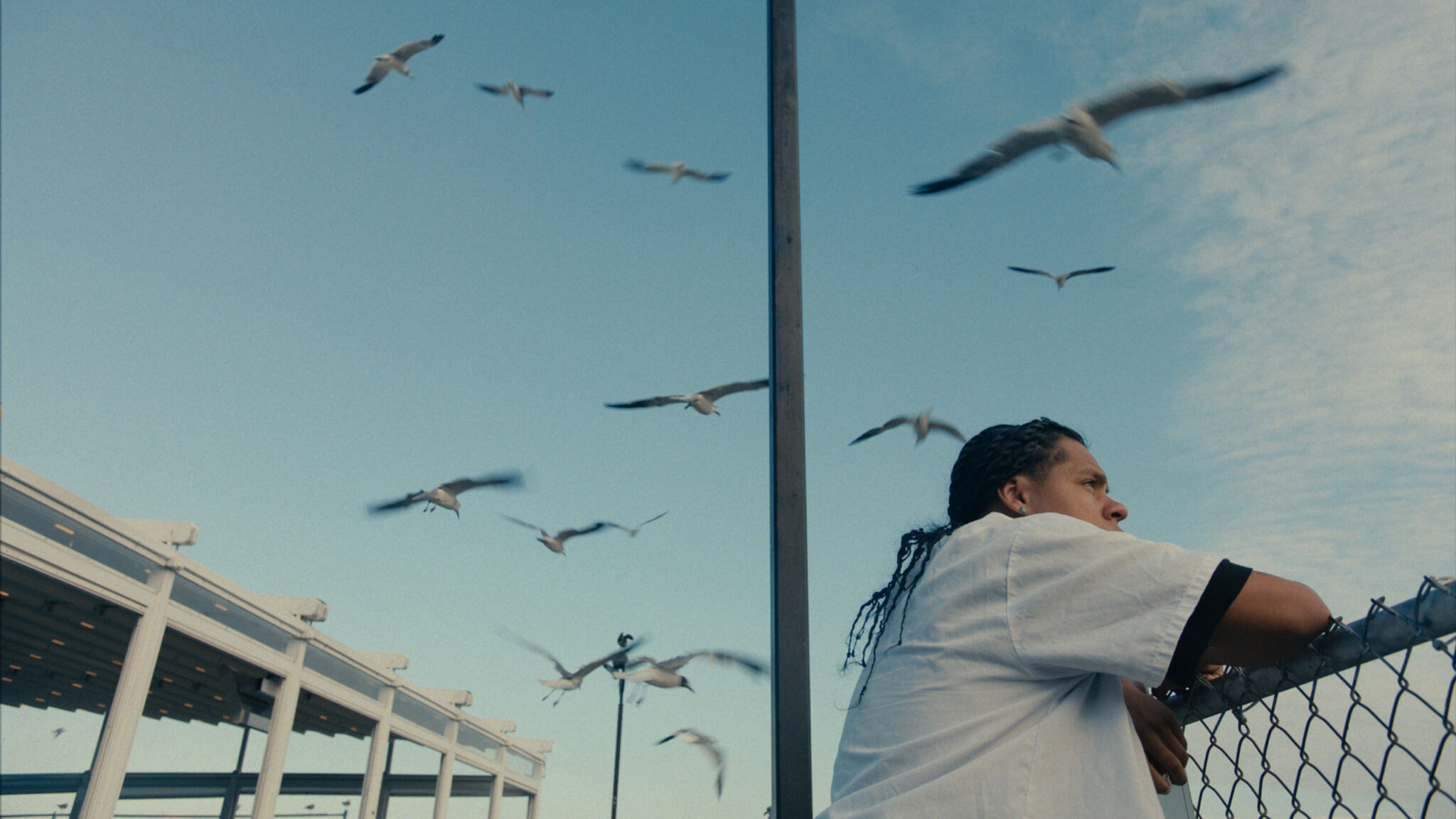
I rarely approach my work from the perspective of wanting to say something. I know that I want my film to exist as a product of an exploratory, hybrid process and as a document of the Dominican diasporic community in the Bronx in 2024–25 who are seldom represented on film and TV three-dimensionally and authentically. I want audiences to go on the journey with Rico and Destiny as they navigate their situation, and to grapple with the film’s complexity during and after viewing the film.
Describe who you want this film to reach.
We want Mad Bills to Pay to reach the Dominican diasporic community in the U.S. primarily, as the film’s nuances will most be understood by them, specifically young men and women who identify with the young characters in the film. After them, we want the film to reach other Latin American communities in the U.S. and beyond. Lastly, because of our film’s elliptical and open-ended form, we want our film to reach those viewers who approach life more sensitively and analytically, who are comfortable with experiential films or with watching more actively — with having to connect the dots, in other words.
Why does this story need to be told now?
I’ve been thinking a lot about this question and the inspiration behind Mad Bills to Pay being young men of color left to navigate masculinity in a landscape dearth of positive male role models, where men are frequently caught up in cycles of generational trauma and often, remove themselves or are removed from the home/community by the criminal justice system, for example. There is a crisis in the U.S. as it relates to young men of color from low-income backgrounds. Young men of color are significantly less likely to graduate high school than their young women peers. And as we’ve known for a while, there is a correlation between education and teen pregnancy.
These issues are obviously compounded by poverty where young people face constant pressure to take on more responsibility than what they might be ready for. This means that these boys must quickly become men, in socially defined terms, despite not knowing yet what that means for themselves. For the privileged in society, there’s often a period in life, usually one’s 20s, where one is given license to explore and negotiate their identity. Young men of color from low-income backgrounds are too often denied this essential stage of adulthood and that, as we’re coming to understand, has long-term consequences.
Tell us why and how you got into filmmaking.
I fell in love with movies from an early age. My introduction was through film’s my older brother would bring home from our local Blockbuster, such as Martin Scorsese’s Italian-American classics. I was struck by how raw and honest some of those films felt, standing out from everything else I remember watching at the time. They reminded me of my neighborhood life in the Bronx and some of the “characters” I grew up around. But I also loved how the art form could transport you to different worlds, real and fantastical, and how it could bridge me to different people and experiences, even if they were far removed from my own, on the basis of our shared humanness. It broadened my horizons and made me aware of the world beyond my immediate surroundings [of] the Bronx,which could often feel like its own planet, in the same way that literature has done for many people. However, in my house we didn’t have many books; we had movies and TV.
When I was a teenager I bought my first video camera with savings I earned by working at a car wash one summer. I shot skate videos with my group of friends around my neighborhood. That evolved into music videos and fashion vlogs. We were a creative, ambitious bunch and wanted to emulate what Tyler, The Creator was doing on the West Coast with OFWG. So, my foray into filmmaking was through cinematography and in my 20s I trained as one. These skills are certainly useful to me now in my career as a director. [They’ve] given me a shorthand with DPs who appreciate that I can geek out with them about lens optics and camera formats, etc. Also, I am a visual thinker, so when I think about stories, I see them as images first.
While I was studying at USC as a graduate student, I took a gap year to study documentary filmmaking in London on a Fulbright and that experience changed the trajectory of my career, I feel. On graduating and returning to the U.S., I wasn’t as inspired by a career solely in cinematography. That ambition felt surface to me. I also didn’t want to return to USC or L.A. I decided to settle down in N.Y. after five years or so of living away.
Suddenly, I was back in my hometown, among my family and old friends and it was strange at first. But the silver lining was that I could see it in a new light, somewhat through the lens of a foreigner, and it became a place brimming with life and stories that I felt qualified to tell. I matured a lot in the time that I was away and could appreciate the uniqueness of my experiences, of growing up in the projects in the the Bronx, for example, and those of my family who had immigrated to the city in the 1960s from the Dominican Republic whose stories coincided with so many pivotal moments in New York City history. I realized it was a fertile and underrepresented landscape I wanted to understand better through my work as a filmmaker. Also, the election in 2016 happened and suddenly, the value of people of color and immigrants was being questioned and I felt more urgency to advocate for communities like mine through my work.
Why is filmmaking important to you? Why is it important to the world?
Films are important because they can bridge us to others, their communities, and their experiences, regardless of how disparate their realities are from our own. Films connect us to one another on the basis of our shared humanness and emotional understanding of the world. This is its true power. But with that power, as the uncle of a famous super hero once said, comes great responsibility.
I’m very suspicious of films that try to “say” something, as that intention can easily veer into propaganda. It’s a slippery slope. The world is a complex place and I think the duty of a filmmaker, of an artist — if one can say there is one — is to grapple with that complexity as three-dimensionally as possible. To approach the world in front of the camera with openness and without judgement. I’m sure my documentary background has something to do with why I feel this way.
My approach aims to portray the world with nuance and fluidity, as a massive grey-area, full of imperfect situations and people, not as a black-and-white space. I’m comfortable with ambiguity and open-endedness in my films. I would deem my work a success if it engenders conversation and invites viewers to savor its aftertaste. To quote a term used by Wong Kar-wai, to figure it out for themselves, like a great teacher would encourage, this is how we can maybe heal from the divisiveness of reductive narratives and propaganda so ubiquitous in society today.
What is something that all filmmakers should keep in mind in order to become better cinematic storytellers?
I’d say keep things loose. Don’t commit yourself too rigidly to your ideas. It’s a collaborative art form. Leave room for others to bring their genius to the collaboration. Don’t try to be the smartest person in the room. For directors, you’re a matchmaker and a facilitator foremostly. Know when to shut up and step back. Take a grassroots approach, not a top-down one. Ask for help. Also, take care of your emotional well-being. Practice self-care: exercise, journal, meditate, see a therapist — work on your communication and emotional resilience to be a better leader.
Creatively, I’d say try to be aware of off-screen space. It’s as important, if not more important than on-screen space, as it is the space wherein audiences are invited to participate in the storytelling, to project their consciousness onto the work. Don’t neglect the power of that narrative tool.
Who are your creative heroes?
My creative influences come from all over. They include literary giants like James Baldwin, musical innovators like Miles Davisr, and visual storytellers like Bruce Davidson. From the poetic realms of cinema, I draw inspiration from Terrence Malick, Carlos Reygadas, Nicolás Pereda, Chantal Akerman, and Pedro Costa. Among the naturalists, I deeply admire Gianfranco Rosi, Roberto Minervini, Maurice Pialat, John Cassavetes (the GOAT), the Dardenne brothers, and Andrea Arnold. The masters of the craft also hold a special place: Edward Yang, Larisa Shepitko, Steve McQueen, Elia Kazan, François Truffaut, and Spike Lee. Honestly, this list could go on forever — each name a beacon of creativity and artistry in their own right.
Which of your personal characteristics contributes most to your success as a storyteller?
I think I’m a disciplined person. I try to follow a rigorous daily routine that consists of researching, writing, reading literature, and watching films. I think it’s important to show up for work every day, even on days when I’m not feeling very inspired. I think it’s useful for my brain to not put filmmaking and film-related work on a pedestal — to treat it like any other daily task. It helps with my procrastination and keeping the pressure off. Although some tasks may seem intimidating and insurmountable at first, the compound effect of small goals over time is always surprising. In our line of work it’s also important to live, to find the balance. It’s all research. Have fun with it and make it low-stakes, is what I try to remind myself of.
Tell us about your history with Sundance Institute. When was the first time you engaged with us? Why did you want your film to premiere with us?
I don’t have much history with the Sundance Institute. I’ve never submitted a film to the Festival so being invited to premiere at the Festival on a first application with my first feature feels very significant and special. Stars are aligning in the universe somewhere for me. I’m very grateful. Sundance, with its rich history, domestic and global significance for independent film, feels like the ideal platform on which to launch me as an emerging talent in film and likewise introduce my debut feature to the world. The sky’s the limit now.