





Give Me the Backstory: Get to Know Itab Azzam and Jack MacInnes, the Directors of “One in a Million”

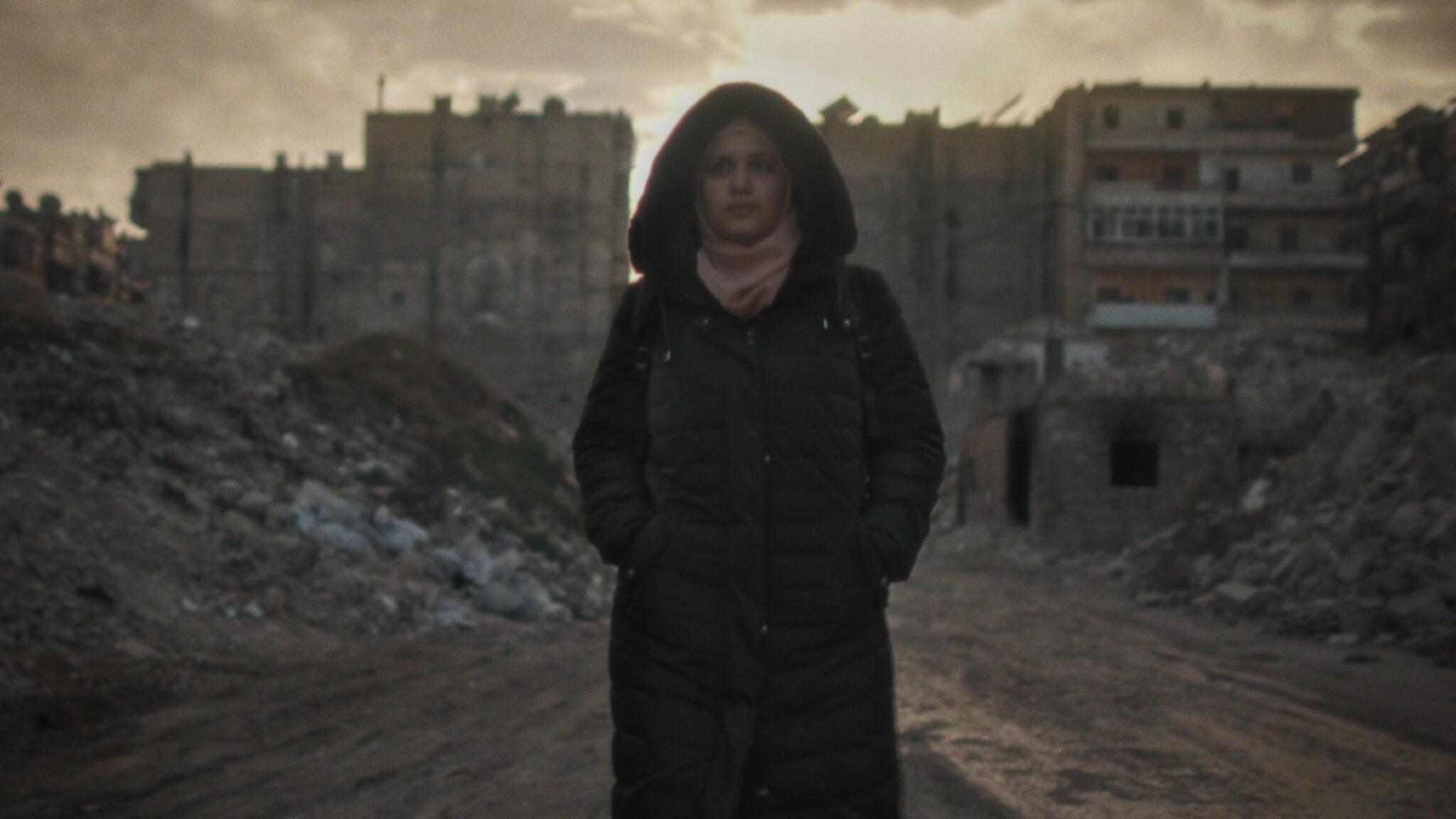
Isra'a Kassas appears in One In A Million by Itab Azzam and Jack MacInnes

By Ramona Flume

One of the most exciting things about the Sundance Film Festival is having a front-row seat for the bright future of independent filmmaking. While we can learn a lot about the filmmakers from the 2026 Sundance Film Festival through the art that these storytellers share with us, there’s always more we can learn about them as people. We decided to get to the bottom of those artistic wells with our ongoing series: Give Me the Backstory!
“Documentary filmmaking is fundamentally about asking people to walk in somebody else’s shoes for a couple of hours,” director Itab Azzam says. And with One in a Million, she and fellow director Jack MacInnes ask audiences to walk in one girl’s shoes for a decade.

The directors first met Isra’a in 2015, when she was 11 and selling cigarettes with her father in Izmir, Turkey, after her family fled Aleppo, Syria. Their cameras followed as the family crossed the Aegean Sea in a smuggler’s dinghy, sought asylum in Germany, and weathered the strain of adapting to a new language and culture. Eventually, Isra’a returned to a Syria she struggled to recognize. Part coming-of-age story, part portrait of a family pulled between tradition and new freedoms, the film illuminates the complexities of the refugee experience with tenderness and nuance — and won the Directing Award: World Cinema Documentary and the Audience Award: World Cinema Documentary at the 2026 Sundance Film Festival.

Below, Azzam and MacInnes share how they kept a 10-year shoot going through a pandemic, why they’re relieved one candid dance party never made it into the film, and how their project ended up capturing a remarkable turning point in Syria’s history.

Describe who you want this film to reach.
This is a film for everyone, really. We’d love people to see it who have never met people like Isra’a or thought too deeply about Syria or the refugee crisis. We hope it’s a film that resonates universally as a coming-of-age story and a story about family.

Your favorite part of making the film? Memories from the process?
Definitely the relationship we built up with the family in the film. Playing football with the kids, etc. I remember one night when we put down the cameras and ended up filming ourselves dancing around the sofas with the family to Boney M. Fortunately, we lost the footage!

Why is filmmaking important to you? Why is it important to the world?
We live in a world in which the media we consume is increasingly tailored to our own prejudices. Films like this one and the others at the Festival, which present the world, unvarnished as we find it, but with empathy, are hopefully an antidote to that.

“One In a Million” directors Itab Azzam and Jack MacInnes on stage accepting the Audience Award: World Cinema Documentary. Photo by Stephanie Dunn

What was a big challenge you faced while making this film?
The hardest thing about making this film has been the sheer logistics of returning to the story over such a long period of time and balancing the film with other projects and life. When we started out, we were a childless couple in our early 30s. Ten years later, we’re middle-aged parents. 

We had to negotiate the global pandemic and how to get away to film Isra’a and her family with a baby in tow. Sometimes key events happen and one of us is on the other side of the world filming for another project, or you’re filming in Germany and you’d love to stay to film that one extra scene, but you have to get back for other commitments. It’s been really hard!

Why does this story need to be told now?
Our timing with this story turned out to be in sync with pivotal events in Syria. We began at the height of the refugee crisis in 2015 and ended with the fall of the Syrian regime. It’s a key moment for the country now, as Syrians and the rest of the world are watching to see if it does become the safe country Isra’a and everyone else wants it to be.

But in a wider sense this is a moment when the world has taken its eye off the humanity of refugees, which we all saw with such blinding clarity in 2015, when more than a million people were trying to get to Europe. Immigration is dominating the political conversation in Europe and the United States. And there needs to be a lot more nuance in the debate. We feel it should be possible to show that there are difficulties that come with arriving in a country to which you are not acculturated and that those difficulties need to be acknowledged and addressed with humanity and empathy.

Film subject Isra’a, producer Raney Aronson-Rath, and directors Jack MacInnes and Itab Azzam attend the 'One In A Million' Q&A. Photographer: Lauren Hartmann


If you weren’t a filmmaker, what would you be doing?
MacInnes: My first love before documentaries was theater, so I always wonder about returning to that. And, of course, making narrative feature films.

Azzam: Besides filmmaking, I run an NGO that helps refugee women use art and film for therapy and self-expression.

Who are your creative heroes?
MacInnes: Bob Dylan has been my hero since I was a child. I’m in love with his ability to use not just words but phrasing to conjure meaning in a way that defies analysis, but also with the creative push-pull of cynicism and idealism throughout his career. As a filmmaker, I love the work of Nuri Bilge Ceylan, who can create tension out of the most understated cinematography and editing.

Azzam: We called our son Rumi after the Persian poet, so [Rumi] is a big inspiration. He sees art and love as forms of healing, resistance, and courage, which is what I fundamentally believe in.

What was the last thing you saw that you wish you made?
MacInnes: Dreaming of You: The Making of The Coral, an incredible documentary about the Liverpool band, The Coral, which I love.

Azzam: Return to Homs [directed] by Talal Derki is breathtaking.

One thing people don’t know about me is _____.
Azzam: I love cooking, and I even wrote a cookbook connecting storytelling and food.

Which of your personal characteristics contributes most to your success as a storyteller?
MacInnes: Itab has incredible powers of empathy and an ability to connect with people.

Azzam: I think Jack is a perfectionist and never gives up.

Isra’a, Itab Azzam, and Jack MacInnes attend the “One In a Million” premiere at 2026 Sundance Film Festival. (Photo by Dia Dipasupil/Getty Images)

Who was the first person you told when you learned you got into the Sundance Film Festival?
The rest of our team at KEO Films. At times this has been a lonely journey making a 10-year film, and our producers, Will [Anderson], James [Bluemel], and Andrew [Palmer], have been a massive support.

News title Lorem Ipsum

Donate copy lorem ipsum dolor sit amet

Lorem ipsum dolor sit amet, consectetur adipiscing elit. Ut elit tellus, luctus nec ullamcorper mattis, pulvinar dapibus leo. Lorem ipsum dolor sit amet, consectetur adipiscing elit. Ut elit tellus, luctus nec ullamcorper mattis, pulvinar dapibus leo. Lorem ipsum dolor sit amet, consectetur adipiscing elit. Ut elit tellus, luctus nec ullamcorper mattis, pulvinar dapibus leo. Lorem ipsum dolor sit amet, consectetur adipiscing elit. Ut elit tellus, luctus nec ullamcorper mattis, pulvinar dapib.