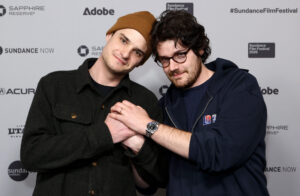




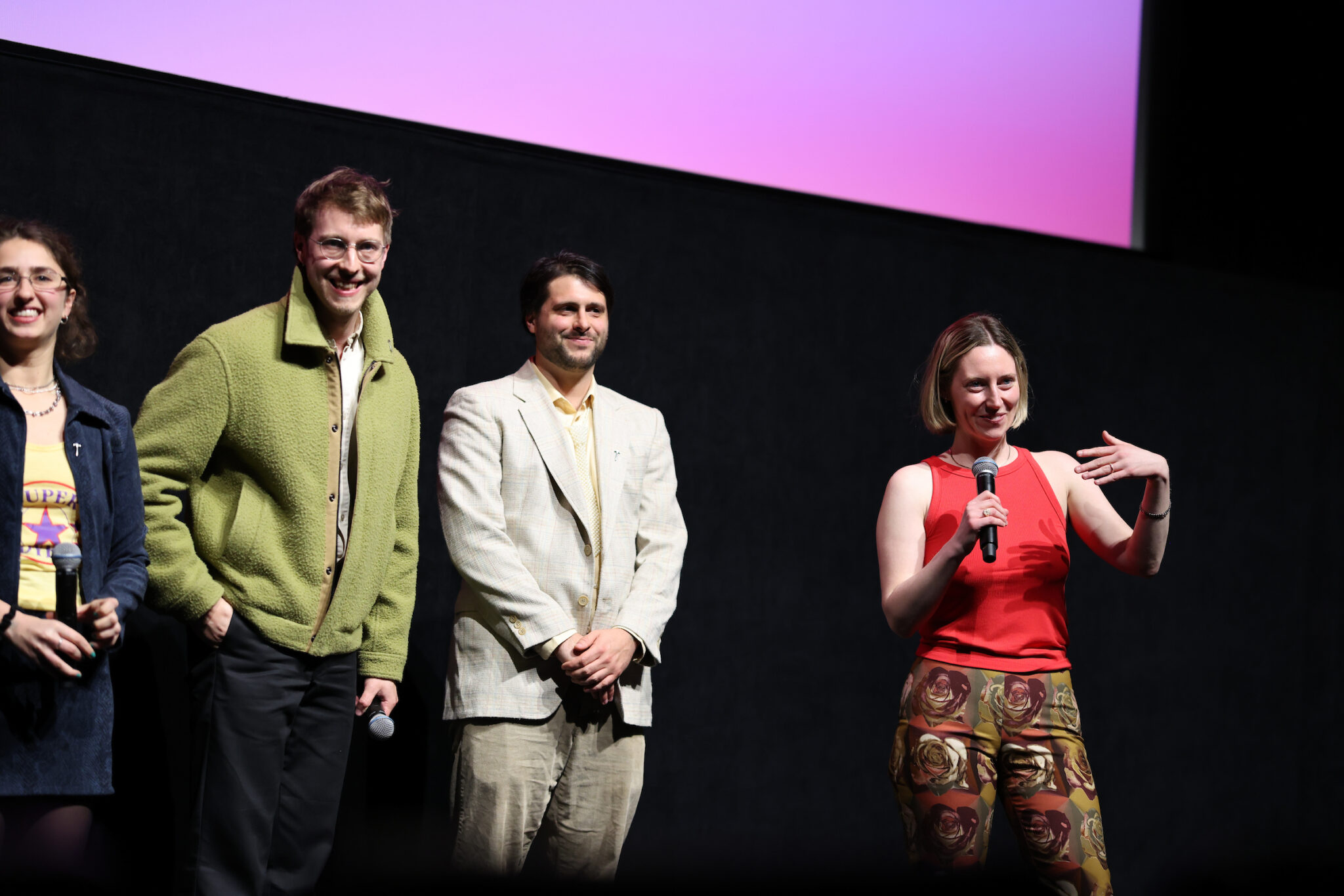
(R-L) Brydie O’Connor, Matt Hixon, Elijah Stevens, and Claire Edelman attend the Q&A for “Barbara Forever” by Brydie O’Connor, an official selection of the 2026 Sundance Film Festival. © 2026 Sundance Institute | photo by Gabriel Mayberry
By Erik Adams
When Barbara Hammer premiered Nitrate Kisses at the 1992 Sundance Film Festival, it marked a new chapter in her prolific career. Hammer had been making movies since the 1960s. She ushered in a wave of lesbian cinema that was starting to crest when her first feature-length project came to Park City. Yet, according to director Brydie O’Connor, it was at this moment that Hammer “finally felt like she made it.”
O’Connor is introducing her own debut feature, Barbara Forever, which premieres in the U.S. Documentary Competition at the 2026 edition of the Festival. Throughout the documentary, we hear the late Hammer — in her own words, and in those of her spouse, Florrie R. Burke — hope that her large body of work will grant her a sort of immortality. That wish comes true in Barbara Forever, a film that functions as a rousing introduction to Hammer’s restless creativity, a memorial to a woman who genuinely changed an artform, and the realization of her desire for posthumous collaboration.
“We had to distill her life’s work down to an hour and 40 minutes,” says O’Connor during the post-premiere Q&A at The Ray Theatre. “That was our job, and we had a guiding principle: this question of why Barbara constantly put the camera on herself and her lovers and her surroundings and just her life.”
One of the most memorable segments of Barbara Forever finds Hammer giving a crash course in experimental film to a third-grade class. (It goes over better than you’d think.) O’Connor doesn’t do much handholding, either: The names of Hammer’s peers and the art movements they participated in are referenced with the assumption the viewer already knows them, or wants to learn about them later. After getting us acquainted with Hammer and Burke, Barbara Forever dives head first into biography — landing not at the start of Hammer’s life, but when she’s finding her artistic voice and true sexuality.
“Like Barbara says with her work, ‘an experimental lifestyle deserves an experimental form,’” says O’Connor. “A documentary on Barbara Hammer could not have been the traditional, chronological, birth-to-death story. It was the biggest creative challenge for me — we knew we wanted to have that element of living in Barbara’s vision for the future. And I was so excited about starting with the lesbian birth.”
“Touching another woman changed my life,” Hammer says in the documentary. “It had to be shown.” And Barbara Forever demonstrates how many ways she showed it. Her earliest films focus on sensuality and the female body — most often her own. She wanted “the screen to be tactile,” and O’Connor obliges with Hammer-shot close-ups of women’s skin and body hair. As Hammer’s work evolves, we see her experiments in layering images upon images, splashing paint into her frames, or making scratches in the negative.
After Hammer is diagnosed with ovarian cancer, she finds new and more radical ways of turning the camera inward: X-rays, endoscopic cameras. Her collaboration with protégé Joey Carducci forms the basis for an award-winning short film. Barbara Forever leaves little doubt that Barbara Hammer was an artist who used every attribute of cinema to its fullest potential.
As Sundance Institute senior programmer and New Frontier curator Shari Frilot says in her intro to Barbara Forever, Hammer never got her full due while she was alive. But at this year’s Festival, her influence is felt even when it isn’t directly acknowledged. Big Girls Don’t Cry and The Brittney Griner Story might not have happened if Hammer hadn’t centered lesbian stories on film at the dawn of second-wave feminism. Her experiments in sound and visuals are echoed in the likes of zi and Tuktuit : Caribou. Her ever-present camera and people-on-the-street interviews connect her to John Wilson and The History of Concrete.
And she’s present at the Barbara Forever premiere, thanks to those who carry her legacy forward — O’Connor and her team as well as Carducci and Burke, who join them for the Q&A. Burke says Hammer would’ve loved the documentary, and notes this is the second time she’s seen it: A week before the premiere, O’Connor flew to California to give her a sneak peek.
“Thank goodness she did,” Burke says, “or I would be on the floor.”