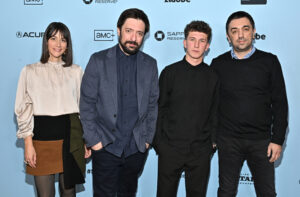





(L-R) Jin Ha, Kogonada, Michelle Mao, and Haley Lu Richardson attend the zi premiere during the 2026 Sundance Film Festival at The Ray Theatre on January 24, 2026 in Park City, Utah. (Photo by Arturo Holmes/Getty Images for Sundance Film Festival)
By Erik Adams
Jin Ha is astonished. He just saw the final cut of zi for the first time, and he’s bowled over by what he, director Kogonada, his castmates Michelle Mao and Haley Lu Richardson, and a small group of behind-the-scenes artisans were able to pull off.
“I mean, shit y’all,” Ha says after zi’s premiere in the NEXT section of the 2026 Sundance Film Festival. “We made this shit in October.”
The feeling in The Ray Theatre is mutual. How did they do it? How did the director of Columbus (2017 Sundance Film Festival) and After Yang (2022 Sundance Film Festival) get zi to Park City a mere four months after he had a different movie, A Big Bold Beautiful Journey, in theaters? And with such limited time and resources, how did the tale of one momentous day in the life of Zi Wong (Mao) turn out so entrancing, affecting, and downright epic?
It didn’t hurt that Kogonada and cinematographer Benjamin Loeb have been wanting to make a movie this way since they were working on After Yang.
“This conversation started many years ago between K and I,” Loeb says, using the zi crew’s nickname for the director, “[about] trying to make something without any expectation or construct of the machine of filmmaking.”
The next step: Making a list of five cities that inspired them and narrowing it down to the one that would serve as their setting and base of operations. After choosing Hong Kong, they assembled a team of trusted collaborators who were willing to spend three weeks abroad making a movie whose full scope and shape would only reveal itself after a few days of guerilla filmmaking.
“In order for this to happen, it was like a heist,” says Kogonada. “I thought, I need to have six people who can do everything. So even though we say everyone is producers, everyone took on multiple roles. They were their own costume designers. I saw Michelle every morning doing her laundry to get ready for the next day.”
Some of the finer points of zi are better left undisclosed. Suffice it to say, the film revolves around Zi, an accomplished violinist living in Hong Kong. In dreamlike interludes, she sees glimpses of her future, which set her on a winding trek through the city, ultimately crossing paths with American expat Elle (Richardson) and Elle’s friend Min (Ha).
The more we learn about Zi and what she’s experiencing, the clearer the team’s vision for the material becomes. Zi’s reveries have the gauzy texture of snapshots from a vintage point-and-shoot camera; as particular images recur, they reveal their true nature, and how Zi’s newfound friends — Elle especially — factor into what she’s experiencing. The unfussy, run-and-gun aesthetic makes it feel like we’re right alongside the characters as they drift through the streets, markets, and transportation hubs of Hong Kong.
The blurring of yesterday, today, and tomorrow in the story is matched to the scenery, where modern Hong Kong often collides with its past. True to Kogonada and Loeb’s initial brainstorm, zi often feels like a love letter to the city, a sprawling, romantic panorama that explains what brings people like Zi, Elle, and Min — and the people making the movie about them — there in the first place.
With each successive question in the Q&A, the zi team’s affection for one another is more apparent. Kogonada compliments Mao for her knowledge of film history — high praise from someone who first made a name for himself by channeling deep cinephilia into arresting video essays. Richardson laughs through a memory of having to “force feed” a hyperfocused Kogonada during production. Ha’s description of making zi turns poetic.
“It was theatrical, but it was on screen,” he says. “It was prepared, but it was completely unprepared. It was all real, and in real time, but also so ethereal.”
The last word on the zi experience belongs to first-time actor Valerie M. Richardson — or, as she’s known to a beaming Haley Lu Richardson, “my mom!” The elder Richardson has The Ray in the palm of her hand as she describes the past 98 minutes of her life.
“I have not been in a film before,” she says. “So I’ve always had the perspective of how art, film, affects me as an audience [member]. But this experience showed me how it affects the people who make the film. And the risks you take, and the joy that you have — it’s just beautiful. I’m just so excited to be part of it.”