



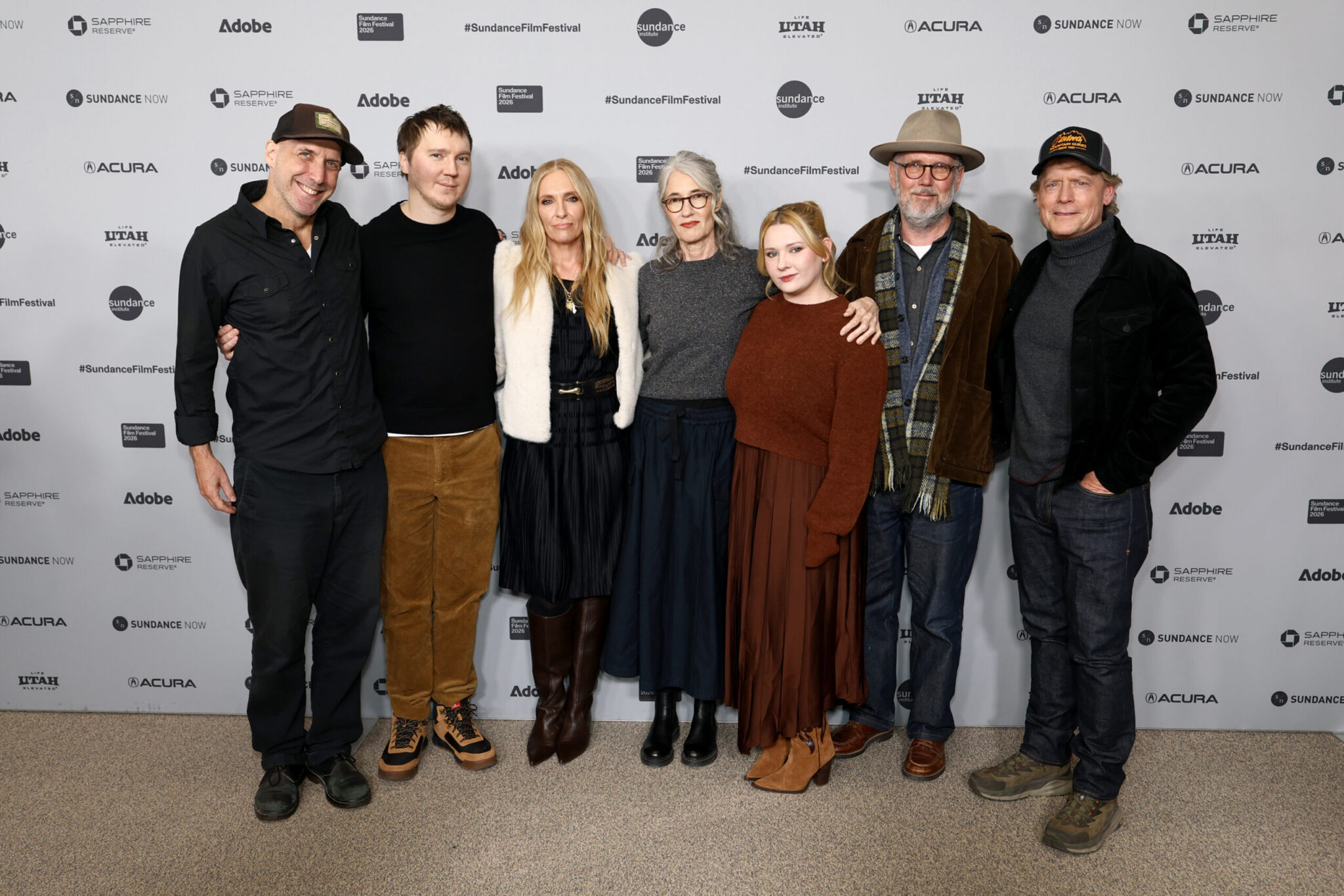
(L–R) Michael Arndt, Paul Dano, Toni Collette, Valerie Faris, Abigail Breslin, Jonathan Dayton, and Greg Kinnear attend the Park City Legacy program screening of “Little Miss Sunshine” during the 2026 Sundance Film Festival at Eccles Theatre on January 28, 2026, in Park City, Utah. (Photo by Arturo Holmes/Getty Images for Sundance Film Festival)
By Lucy Spicer
“There’s two kinds of people in this world: There’s winners, and there’s losers.” This misguided philosophy is the basis of a nine-step motivational plan that Richard Hoover (Greg Kinnear) is desperately trying to sell to kick-start his career as a life coach in Jonathan Dayton and Valerie Faris’ feature debut, Little Miss Sunshine. But when we meet them, the Hoover clan doesn’t appear to be full of winners.
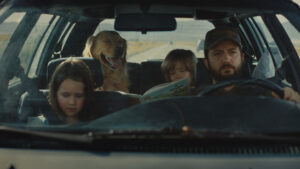
Richard has put all his money into this nine-step plan that’s convincing no one. His wife, Sheryl (Toni Collette), secretly smokes cigarettes to cope with the pressure of keeping the family together — including her brother Frank (Steve Carell), who has come to live with them following a suicide attempt prompted by unrequited love and the success of a rival Marcel Proust scholar. Richard’s foul-mouthed father, Edwin (Alan Arkin), is also living with them after getting kicked out of his retirement home for snorting heroin. Dwayne (Paul Dano), Sheryl’s morose teenage son from a previous marriage, has taken a vow of silence until he can become a fighter pilot. And then there’s 7-year-old Olive (Abigail Breslin), a sweet but awkward-looking girl who has recently become obsessed with beauty pageants.
The family’s eventful road trip from New Mexico to California in a yellow Volkswagen microbus so that Olive can compete in the Little Miss Sunshine pageant has been making audiences laugh and cry since the film premiered on January 20 during the 2006 Sundance Film Festival. And now, almost 20 years later to the day, members of the cast and crew reunite at Eccles Theatre in Park City to celebrate one of the most beloved films to ever come out of the Festival.
“When it landed at this Festival, its impact was, from a film perspective and a Festival perspective and a business perspective, rather seismic,” says Festival director Eugene Hernandez to a packed audience on January 28, ahead of a restored screening of the film as part of the 2026 Sundance Film Festival’s Park City Legacy program. “If you think back to how quickly it caught fire, how immediately it was talked about and celebrated, the success that the film went on to have was something that Sundance is still extremely proud of.”
“It’s an incredible homecoming,” adds Dayton. “We want to start by thanking all the people at Sundance. Our lives changed completely in this room 20 years ago, and it was something we never could have imagined. And Sundance has done this for so many filmmakers through the Festival and through the Sundance labs. There’s nothing like this organization, and we’re so happy that it seems to continue to flourish.”

After the screening ends to raucous applause from the audience — many of whom had never seen the film and some of whom had been present for its premiere in this very theater two decades ago — Dayton and Faris are joined onstage by Collette, Kinnear, Dano, and Breslin, as well as screenwriter Michael Arndt; producers Ron Yerxa, Albert Berger, Peter Saraf, and David T. Friendly; and executive producer Jeb Brody.
“I just love — even though I’ve seen it a million times — watching this cast perform,” says Dayton. “I just ride on every expression. And to have everyone together after all this time, this is a miracle.” The co-director is far from the only person onstage who enjoyed revisiting the film.
“Everything was just more!” exclaims Collette. “More moving, more joyous, and I noticed things that I didn’t notice 20 years ago. And I think 20 years of growth allows you a completely different perspective,” she adds. “There were so many moments that just blossomed even further than they did 20 years ago, so I’m so happy to be here. I’m jetlagged out of my fuckin’ mind, but so happy to be here!” Collette came all the way from Australia for the occasion. That’s a long flight for a screening of an independent film she was in 20 years ago. “So worth it,” she says.
“It’s such a lovely ensemble,” says Kinnear. “I remember Alan [Arkin] saying, ‘You know you don’t get so many great ensembles.’ And I thought, wow, it’s true, you know — movies that are true ensembles where every character’s affecting every other character and there’s a story in everyone — and it’s just amazing to watch.”
What follows is a discussion about the unique, unlikely, magical process that was getting this film from the page to the screen. “I had a little one-bedroom walkup in Brooklyn,” recounts Arndt. “I was unemployed, I didn’t have a manager, I didn’t have an agent, I didn’t know a producer. Nobody cared that I was writing this stuff. Like when I sat down to write this, nobody could have cared less. And I think that writing is a sort of act of faith.”
Arndt had never had a screenplay produced before, but somehow he got the script for Little Miss Sunshine to the right producers, who in turn got it to the right directors — though Arndt made 100 revisions along the way. And the right directors — Dayton and Faris — had worked extensively in music videos and commercials, yet this was the first feature for them, too. But once the dream creative team was assembled, the film’s trajectory hit some roadblocks.

“A lot of people wonder what it’s like to try to get a movie made; they think it’s easy. It’s very, very hard to get any movie made,” says Friendly. “It was particularly hard to get this movie made. Pretty much every studio and every specialty division of the first go-around passed. I have all the letters to prove that. What was great about this is every person up here believed in this material in their hearts, in their guts,” he says, gesturing to everyone onstage. “And that’s what it takes to get something made. And to get it made well, you need a team like we have here. And it’s a great team, and a family was formed here. The fact that we’re all still speaking to each other 20 years later is very unusual for the movie business.”
It’s hard to imagine now, but according to the producing team onstage, this film was full of red flags for distributors back in the early 2000s. It was an R-rated comedy, an ensemble without a big lead actor, and the final act took place in a setting nowhere but the U.S. would understand — a children’s beauty pageant. The only way to make this film would be to do so independently.
Clearly, it was worth the risk. “The truth is this place lit up the first time the bus got pushed. It was insanity in here, and it was an incredible thing to behold,” recalls Brody. “The movie touches every base. People love it, critics love it, it got awards, it made money, and the people who made it, as everybody has said here, have stuck together. There was a family, there was a love that made the entire experience truly, truly fantastic, and it shows up on the screen every time you see it.”
Family is a through line here: the family on screen, the family onstage, and the family in the audience, too. “I think it’s important that you know that you’re all part of this family,” notes Dayton in his introduction to the film. “Your enthusiasm when you watch a movie means so much to the filmmakers and the actors, but it also helps sell a movie. It helps show that there’s potential out there, so you’re a big part of what has made this such a great place with people to see movies.”
There are many lessons the audience could take with them from this 20th anniversary screening, but one of the biggest may be to lean on family, whatever that looks like to you. And if you’re searching for a creative family, find one that believes in your story as much as you do.
“To all the filmmakers out there, stick with it,” says Dayton at the close of the discussion. “Our agent’s assistant was getting promoted; he was telling the new assistant about all the projects that his agent was working on for different clients. He said his whole pitch, and he ended with, ‘And just remember, Little Miss Sunshine will never get made.’ That was his note to his successor. So don’t give up. It can happen.”