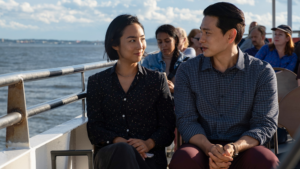




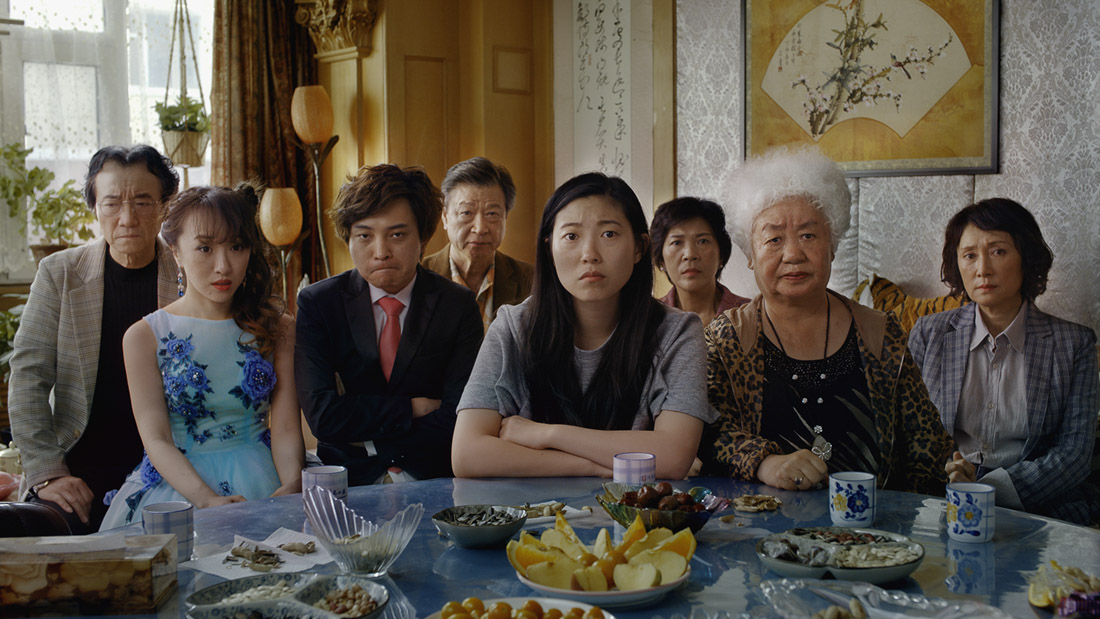
A still from “The Farewell” by Lulu Wang, an official selection of the U.S. Dramatic Competition at the 2019 Sundance Film Festival. (Courtesy of Sundance Institute | photo by Big Beach)
By Lucy Spicer
Back in November, the Sundance Film Festival programming team compiled a watchlist as a crash course for anyone who wants to familiarize themselves with the Festival’s history. Comprising a whopping 101 features spanning 41 years, such a list might look daunting to a viewer testing the indie film waters. But taking that list one double feature at a time? That sounds doable for anyone who’s got time for a movie night! So we’re bringing you ideas for Sundance Film Festival 101 Double Features, with film pairings inspired by genre, style, theme, and more.
Two films that revolve around an elder matriarch, with family members across generations coming together from far and wide for a banquet that could be their last all together. For our second 101 Double Feature, we’re recommending Julie Dash’s Daughters of the Dust and Lulu Wang’s The Farewell. The first film directed by an African American woman to receive a wide theatrical release, Daughters of the Dust follows a Gullah family on one of the Sea Islands of South Carolina as they gather together for a meal with their matriarch before the majority of the family move to the mainland. In The Farewell, Chinese American aspiring writer Billi reunites with her maternal grandmother in China for a family wedding in light of her grandmother’s recent terminal cancer diagnosis.
Though the stories differ in form and in genre, Daughters of the Dust and The Farewell both take inspiration from real family stories to create cinematic portraits that compel audiences to examine themes of immigration, ancestry, generation gaps, grief, otherness, and community. Accompanied by stirring musical scores, both films feature characters from various generations who must process the fact that their matriarch could soon be gone from their world, resulting in nuanced, mesmerizing performances by full casts.
Writer-director Julie Dash’s Daughters of the Dust premiered at the Sundance Film Festival in 1991, but the project was conceived long before, inspired by family histories and Dash’s desire to see representation on screen that differed from the blaxploitation films that had proliferated in the 1970s. Daughters of the Dust won the Excellence in Cinematography Award: Dramatic at the Festival, a fitting honor for a lyrical film full of evocative imagery. Set in 1902, Dash’s narrative feature debut centers on the Peazant family on Ibo Landing in South Carolina’s Sea Islands. While Nana Peazant (Cora Lee Day), the community matriarch, continues to live by her ancestors’ old beliefs and rituals, most of the family has moved to the mainland or plans to do so imminently, intent on embracing a different way of life. As multiple generations gather on the beach for a final dinner together, we learn the stories of individuals, like Eli (Adisa Anderson) and Eula (Alva Rogers), Nana’s grandson and pregnant granddaughter-in-law who are experiencing difficulties in their marriage after Eula is raped by white man on the mainland. Other family members include Viola (Cheryl Lynn Bruce), who became a devout Christian upon her move to Philadelphia, and Yellow Mary (Barbara-O), an enigmatic free spirit whose return from the mainland provokes mixed feelings among her relatives.
Narrated by Eli and Eula’s unborn child, Daughters of the Dust eschews a linear narrative structure, and this atypical approach underlines the story’s poetic imagery. Dash’s influential film continues to resonate more than 30 years later: It was inducted into the Library of Congress’s National Film Registry in 2004, and in 2016 the film was re-released in theaters following renewed interest after it served as inspiration for parts of Beyoncé’s visual album Lemonade. Check here for viewing options.
When Lulu Wang initially set out to make a film inspired by her family and their decision to keep her Chinese grandmother in the dark about her own cancer diagnosis, the writer-director was met with little support. But when Wang’s story appeared on an episode of This American Life in 2016, interest from a producer spurred the project on. The Farewell premiered in the U.S. Dramatic Competition at the 2019 Sundance Film Festival and opened theatrically to critical acclaim later that same year. The film follows Billi (played by Awkwafina, who took home a Golden Globe for her performance) an aspiring writer living in New York who learns that her paternal grandmother (Zhao Shu-zhen) — whom she calls Nai Nai — has Stage 4 lung cancer. Fearing that it’s their last chance to see the beloved matriarch, Billi’s family — she and her parents from the U.S., others traveling from Japan — reunite in China for Billi’s cousin’s wedding, all having agreed not to reveal to Nai Nai that she has a terminal illness.
While the family plans for a wedding banquet and stubbornly keeps Nai Nai ignorant of her declining health, Billi navigates the cultural adjustments of returning to a country she hasn’t lived in for many years — in addition to witnessing the differences that span three generations of her relatives. Wang aimed to create an authentic portrayal of her protagonist’s Chinese American immigrant experience, including much of the humor and heartache involved. In fact, Wang was so dedicated to authenticity that she ended up casting her own great-aunt (Lu Hong) in the role of Nai Nai’s sister. Check here for viewing options.