


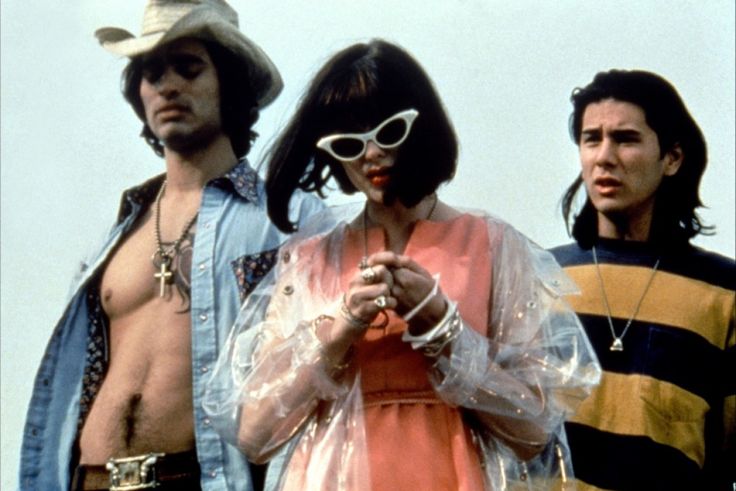
A still from “The Doom Generation” by Gregg Araki (Courtesy of Sundance Institute)
By Lucy Spicer
Have you checked out our Sundance Film Festival 101 list yet? We know that 101 titles might seem daunting to tackle, so we’re back with another watchlist lifted from those 101 pivotal films, and this one’s just in time to celebrate Pride Month — Sundance Film Festival 101, LGBTQ+ directors edition. Though language is ever-evolving, history has witnessed stories by and about members of the LGBTQ+ community since artists first started telling stories, and the medium of film is no exception. LGBTQ+ filmmakers have certainly been part of the Sundance Film Festival since the event’s humble beginnings, as the following watchlist shows.
Ranging from electric documentaries to poignant love stories to unnerving horror features and more, the films below reflect the incredible diversity of genres and styles that the Festival’s filmmakers have displayed for more than 40 years. Of course, the list of LGBTQ+ filmmakers who have screened projects at the Festival extends far beyond those on our 101 list — but the titles below are a great place to start for your Pride Month indie film watchlist.
The Times of Harvey Milk (1985 Sundance Film Festival; winner of a Special Jury Prize Documentary)
Director: Rob Epstein
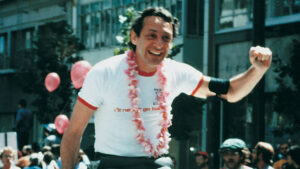
Through interviews, archival footage, and news clips, Rob Epstein’s essential documentary traces Harvey Milk’s career from neighborhood camera shop owner to LGBTQ+ activist to his status as the first openly gay man elected to office in California when he became a member of the San Francisco Board of Supervisors in 1977. The film also documents the assassination of Milk and Mayor George Moscone and how the aftermath affected the community. But evident — and crucial — throughout Epstein’s documentary is Milk’s invincible spirit and message of hope, a message that inspires repeat viewings of this powerful film. The Times of Harvey Milk would go on to win the Academy Award for Best Documentary Feature in 1985. Check here for viewing options.
Desert Hearts (1986 Sundance Film Festival; winner of a Special Jury Prize Dramatic)
Director: Donna Deitch
Set in 1959 and loosely based on Jane Rule’s novel Desert of the Heart, Donna Deitch’s film follows Columbia University professor Vivian Bell (Helen Shaver) as she travels to Reno, Nevada, to get a quick divorce. The straitlaced and elegant Vivian sticks out a bit at the ranch where she’s staying, especially next to free-spirited characters like Cay Rivvers (Patricia Charbonneau), who works at a nearby casino. The ranch’s owner, Frances Parker (Audra Lindley), disapproves of Cay’s unconventional ways and anyone who would encourage them, but Vivian and Cay are quickly drawn to each other. Check here for viewing options.
Hairspray (1988 Sundance Film Festival)
Director: John Waters
Writer-director John Waters adapted his “Pope of Trash” sensibilities for a broader audience with Hairspray. Set in Baltimore in 1962, the film follows Tracy Turnblad (Ricki Lake), a “pleasantly plump” teenager who’s got big dreams, big dance moves, and even bigger hair. Tracy’s dance skills and engaging personality land her a spot on The Corny Collins Show, and while she enjoys her popularity and a new romance, Tracy knows she can have it all and fight for racial integration, too. Featuring an ensemble cast also starring Divine, Ruth Brown, Jerry Stiller, Debbie Harry, and Sonny Bono, Hairspray has plenty of wackiness — like hypnosis, cockroaches, and a bomb-concealing wig — to make it a classic in the Waters canon. The film would go on to be adapted into a stage musical in 2002. Check here for viewing options.
Paris Is Burning (1991 Sundance Film Festival; winner of the Grand Jury Prize: Documentary)
Director: Jennie Livingston
For her directorial debut, Jennie Livingston spent years observing New York City’s ballroom subculture during the 1980s. Through insightful interviews and dynamic footage of ball competitions, Paris Is Burning turns the spotlight on Black and Latino individuals who found power, belonging, and artistic fulfillment among the various competing “Houses” of the time, even as their own birth families often rejected them for being gay men, trans women, or drag queens. But each House had an appointed Mother, creating a vital sense of family, just as the balls created a safe place for self-expression at a time in the U.S. when violence against members of the LGBTQ+ community was on the rise. Check here for viewing options.
Poison (1991 Sundance Film Festival; winner of the Grand Jury Prize: Dramatic)
Director: Todd Haynes
Writer-director Todd Haynes’ feature debut, inspired by Jean Genet’s novels, comprises three interwoven stories that together make a film that would become a significant addition to the New Queer Cinema canon. “Hero” plays like a sensational news segment, wherein a mother (Edith Meeks) claims her 7-year-old son disappeared after killing his father. “Horror” emulates a mini 1960s B movie in which Dr. Graves (Larry Maxwell) experiences monstrous side effects from accidentally drinking the essence of human sexuality. Finally, “Homo” follows an incarcerated man (Scott Renderer) who finds himself attracted to a fellow prisoner whom he recalls meeting previously in a juvenile facility. Check here for viewing options.
Go Fish (1994 Sundance Film Festival)
Director: Rose Troche
A landmark film in the New Queer Cinema movement, Rose Troche’s feature debut is a low-budget yet lyrical story of lesbian community in 1990s Chicago. Shot in black and white, the film revolves around Max (co-writer Guinevere Turner), a college student looking for love. Her friends scheme to set her up with Ely (V.S. Brodie), but the course of true love never did run smooth. In spite of the hurdles that appear in their way, the pair’s friends are determined to help both of them get the girl. Check here for viewing options.
The Doom Generation (1995 Sundance Film Festival)
Director: Gregg Araki
The second film in writer-director Gregg Araki’s Teenage Apocalypse trilogy, The Doom Generation stars Rose McGowan and James Duval as Amy and Jordan, a teenage couple who come across charismatic drifter Xavier (Johnathon Schaech) — whom Jordan nicknames “X” — on their way home from a club. After X accidentally kills a convenience store clerk during a late-night shopping excursion, the trio hits the road. But mayhem seems to follow them wherever they go, as they continue to run into unsavory types who claim to be former acquaintances of Amy’s. Meanwhile, the sexual tension building between the three threatens to erupt. Check here for viewing options.
Bound (1996 Sundance Film Festival)
Directors: Lilly and Lana Wachowski
In their remarkable directorial debut, writer-directors Lilly and Lana Wachowski (of The Matrix franchise fame) offer up a sultry, cheeky neo-noir thriller. When Corky (Gina Gershon), an ex-con hired to renovate an apartment in a high-class building, meets Violet (Jennifer Tilly), the alluring girlfriend of the mobster money launderer next door, the attraction is instant — and mutual. The two women hatch a plan to steal two million dollars from the Mafia, and what follows is an entertaining series of twists and turns. Check here for viewing options.
High Art (1998 Sundance Film Festival; winner of the Waldo Salt Screenwriting Award)
Director: Lisa Cholodenko
Syd (Radha Mitchell) is steadily trying to work her way up at a high-art photography magazine when a leak in her ceiling prompts her to meet her upstairs neighbor, renowned but retired photographer Lucy Berliner (Ally Sheedy). When Syd’s employers learn of her new acquaintance, more opportunities open up for her, provided that she can convince Lucy to submit some new work to the magazine. But as Syd and Lucy begin collaborating, the basis of their relationship gets blurry. High Art is writer-director Lisa Cholodenko’s feature debut. Check here for viewing options.
Hedwig and the Angry Inch (2001 Sundance Film Festival; winner of the Directing Award: Dramatic and the Audience Award: Dramatic)
Director: John Cameron Mitchell
In his feature debut, John Cameron Mitchell also stars as Hedwig — who used to be Hansel, a gay East German teenager who suffered a botched gender-affirming surgery after falling in love with an American soldier who convinced him that becoming his wife was the only way to escape to freedom. Later abandoned by her soldier in the U.S. and left with an “angry inch” from her surgery, Hedwig embraces her love of rock music and forms a band, refusing to let her spirit be dampened, even after a new protégé (Michael Pitt) double-crosses her and steals her songs. Supported by the 1999 Sundance Institute Directors and Screenwriters Labs, Hedwig and the Angry Inch is adapted from the 1998 stage musical of the same name. Check here for viewing options.
DIG! (2004 Sundance Film Festival; winner of the Grand Jury Prize: Documentary)
Director: Ondi Timoner
For her feature debut, Ondi Timoner spent more than seven years filming 1,500 hours of footage of indie rock groups The Dandy Warhols and The Brian Jonestown Massacre to create a portrait of two bands whose frontmen — Courtney Taylor-Taylor of The Dandy Warhols and Anton Newcombe of The Brian Jonestown Massacre — began as friends and ended as rivals when their careers took different paths. Timoner’s unflinching, dynamic doc places the audience in the middle of it all. Check here for viewing options.
Precious: Based on the Novel “Push” by Sapphire (2009 Sundance Film Festival; winner of the Grand Jury Prize: U.S. Dramatic, Audience Award: U.S. Dramatic, and a Special Jury Prize for Acting for Mo’Nique)
Director: Lee Daniels
Claireece “Precious” Jones (Gabourey Sidibe) has little going for her at 16 years old. Pregnant with her second child — the result of rape at her father’s hands — and stuck in an apartment ruled by a verbally and physically abusive mother (Mo’Nique), Precious can only find love and support in her daydreams. When a teacher at an alternative school (Paula Patton) helps her to learn to read and write, Precious begins to see potential within herself. Lee Daniels’ critically acclaimed Precious would go on to be nominated for six Academy Awards, winning two — Best Supporting Actress for Mo’Nique and Best Adapted Screenplay for Geoffrey Fletcher. Check here for viewing options.
The Maid (2009 Sundance Film Festival; winner of the Grand Jury Prize: World Cinema Dramatic and a World Cinema Special Jury Prize for Acting for Catalina Saavedra)
Director: Sebastián Silva
In his darkly comic commentary on the class divide, director and co-writer Sebastián Silva centers the action on Raquel (Catalina Saavedra), a maid who has worked for the Valdes family for more than 20 years. When the family hires additional maids to help Raquel after she begins to experience dizzy spells, their longtime employee takes it personally. Resorting to increasingly extreme measures, Raquel is determined to reassure the Valdes family that she’s the only maid they need. Check here for viewing options.
Pariah (2011 Sundance Film Festival; winner of the Excellence in Cinematography Award: U.S. Dramatic)
Director: Dee Rees
In writer-director Dee Rees’ lyrical coming-of-age film, 17-year-old Alike (Adepero Oduye) is caught between two worlds. In one, she secretly frequently clubs where she can comfortably embody the butch identity she’s growing into. In the other, she dons a mask of femininity to placate her conservative mother (Kim Wayans) at home. As tensions mount within her family and a new friendship shows signs of blossoming into something more, Alike faces choices that determine how she will move through the rest of her life. Based on her 2008 Sundance Film Festival short film of the same name, Pariah is Rees’ feature directorial debut and was supported by Sundance Institute’s Directors and Screenwriters Labs. Check here for viewing options.
Call Me by Your Name (2017 Sundance Film Festival)
Director: Luca Guadagnino
In 1983, 17-year-old Elio (Timothée Chalamet) is soaking up the summer at his parents’ villa in northern Italy. After the charismatic 24-year-old doctoral student Oliver (Armie Hammer) arrives to aid Elio’s father in his research, Elio and Oliver begin to develop the type of romantic feelings for each other that will change both of their lives forever. Luca Guadagnino’s film is based on the novel of the same name by André Aciman. Check here for viewing options.
Strong Island (2017 Sundance Film Festival; winner of the U.S. Documentary Special Jury Award for Storytelling)
Director: Yance Ford
In 1992, filmmaker Yance Ford’s brother, William, was shot and killed by a white mechanic at a body shop when a dispute about a car escalated. Though William was unarmed, the mechanic claimed self-defense, and the all-white jury declined to indict him for manslaughter. In this groundbreaking documentary, Ford traces how his Black family’s efforts to establish themselves in their Long Island suburb have been frozen by this senseless death, for which Ford continues to seek justice. Strong Island was supported by Sundance Institute’s Documentary Film Program and would go on to be nominated for the Academy Award for Best Documentary Feature. Check here for viewing options.
We’re All Going to the World’s Fair (2021 Sundance Film Festival)
Director: Jane Schoenbrun
For their narrative feature debut, Jane Schoenbrun played with form to deliver psychological horror in an age where lonely teenagers practically live on the internet. Casey (Anna Cobb) is one of those lonely teens, so she decides to engage with the online community by participating in the viral “World’s Fair Challenge” and recording her reactions in the following days. When Casey begins posting videos of herself exhibiting unusual behavior, a stranger reaches out — but their intentions are unclear. Schoenbrun has referred to We’re All Going to the World’s Fair as the first installment in their Screen Trilogy, with I Saw the TV Glow following at the Festival three years later. Check here for viewing options.
Sorry, Baby (2025 Sundance Film Festival; winner of the Waldo Salt Screenwriting Award: U.S. Dramatic)
Director: Eva Victor
In their feature debut, writer-director Eva Victor stars as Agnes, a literature professor at a liberal arts college in Maine who is attempting to navigate life in the aftermath of an assault. Her pet cat, support from her best friend (Naomi Ackie), and a budding relationship with a neighbor (Lucas Hedges) offer different types of help during a healing process that feels emotionally authentic — and far from linear. Check here for viewing options.