



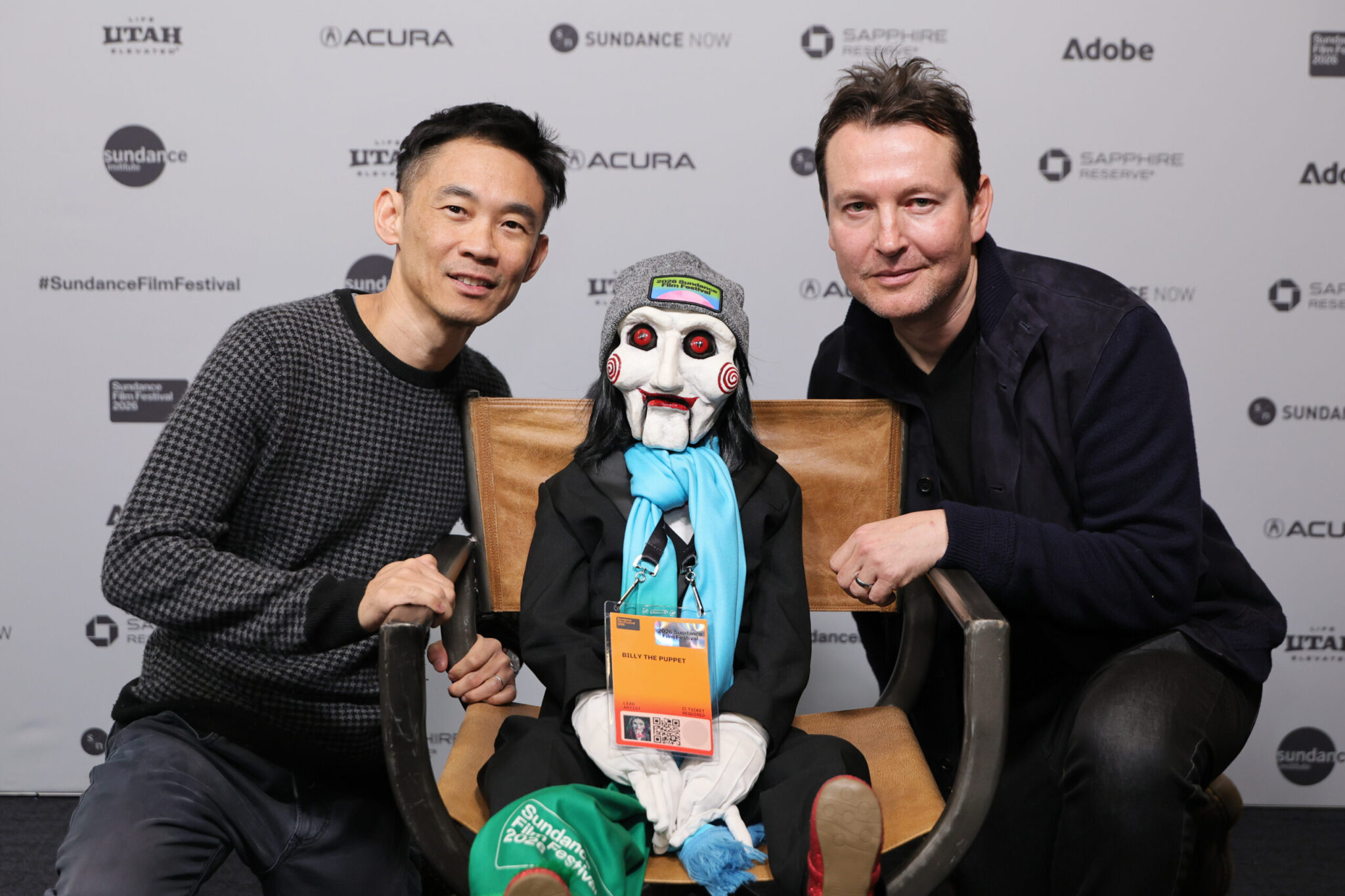
(L–R) James Wan, Billy the Puppet, and Leigh Whannell attend the Park City Legacy screening of “Saw” during the 2026 Sundance Film Festival at The Ray Theatre on January 29, 2026, in Park City, Utah. (Photo by Dia Dipasupil/Getty Images for Sundance Film Festival)
By Lucy Spicer
“Leigh and I sort of had a philosophy back in Australia that we would only wanna go to a festival if we have a movie to go there with,” says filmmaker James Wan at The Ray Theatre the night of January 29 during the 2026 Sundance Film Festival. “I came to Sundance with Saw, and I haven’t been back here until now. And so I have not been back to Sundance until I had another movie to bring back to Sundance. It just so happened it’s Saw again!”
It’s true — it’s been 22 years since James Wan and screenwriter Leigh Whannell were first in Park City debuting Wan’s sophomore feature in the Midnight section of the 2004 Sundance Film Festival. The film premiered January 19 at the Egyptian Theatre, but the creative duo didn’t watch a single frame of the first screening; they were pacing nervously in the theater’s lobby.
“I would put my ear up to the door and be like, ‘I think I heard them screaming,’” recounts Whannell. “We were just so nervous because we had this thing that was so personal to us, and that’s what Sundance does. It’s movies that don’t have giant marketing machines behind them. There are multinational corporations that can take a movie and shove it down your throat, right? Sundance is the place for the movie from the guy from Ecuador or Iceland or Australia or wherever who has just made something, somehow has put this thing together with spit and glue and passion, and now it’s in front of this audience. That was us, and we just were so nervous.”
Little did they know that their low-budget project would set off a sprawling horror franchise destined to become one of the highest grossing of its kind. And now the pair is back in Utah to present a 4K restored screening of Saw as part of the 2026 Sundance Film Festival’s Park City Legacy program. In his introduction, Festival programmer Ash Cook identifies why the film continues to resonate so strongly with audiences more than two decades after its premiere. “This movie rocks because it does what genre does best at its best: It holds a mirror up and shows us a little bit about what we’re most scared of,” he says.
“This film, and, I think, genre films more largely, do the community connecting work that we always talk about around those heartfelt dramedies and those hard-hitting docs. This does the very same thing, I think. This film reached me, and I think probably a lot of you, and it showed me that those of us who are maybe most interested in — or maybe even fixated on — the darkest part of ourselves and of humanity [are] not alone.”
The darkest parts of humanity are certainly on display in Saw, which opens on two men (played by Whannell and Cary Elwes) trapped on opposite sides of a dilapidated bathroom, each of them chained to a pipe. They soon learn that they’ve been ensnared by the Jigsaw Killer, who chooses victims he believes are taking life for granted before putting them through sadistic games to test their will to survive. While the two prisoners attempt to strategize their way out of the trap, a pair of detectives (Danny Glover and Ken Leung) try to track down the whereabouts of the serial killer himself. Known for its many surprising turns — including a final bombshell that’s among the best plot twists of all time — the film instantly cemented itself as a classic in the horror sphere upon its release.
Its success is made all the more impressive when one considers the limitations set by both budget and experience. “James and I met at film school,” recounts Whannell during the film’s post-screening Q&A at The Ray Theatre. “And after film school, we were greeted by the cold winds of an indifferent world, as all ex–film students are, when you realize, ‘Now that I’m outside this institution, nobody cares.’ So we decided we wanted to make a film with our own money, and we knew that all we could afford was basically two people in one room.”
The duo brainstormed as many configurations of a two-person, one-room scenario as they could before settling on the one that made the cut, but the compromise didn’t end there. The original vision wasn’t necessarily to make a horror film, but they figured it would be more feasible to break out within a genre where having a big-name lead was less of a requirement.
“I wanted to make a real Hitchcockian thriller. Very low-key, very brooding, and I ended up realizing that I didn’t have the resources or the time,” explains Wan. “We shot in 18 days; we didn’t have the correct resources to get all the equipment. I was so young and naïve. I did not know any better. I remember as we were filming it, I had to reconfigure my approach to how I did the film. And so I ended up just shooting from the hip, everything just hand-held, and just basically leaning and embracing the really gritty and industrial nature of it.”
“And that definitely impacted the way I edited the film as well,” he continues. “So much of the editing of the movie, the quick cuts and all that, it was out of necessity. Because if I held longer on some of the shots — I cringe every time I see Cary Elwes lean against the set. Because every time he leans against the pipe, I just see the pipe creaking! It’s supposed to be this solid bathroom, unbreakable set, but every time he leans against it, the whole thing would just shake. My scissors would be just right on the cusp of revealing too much.”
Two decades later, Wan and Whannell definitely have access to more resources — as well as a string of successful horror franchises under their belts. But their approach to filmmaking still burns with the independent film spirit. “It’s not easy, but a great idea is still the true currency of the film industry,” says Whannell. “Any time you’re writing a film, especially in the independent space, where you’re shouting to be heard, if you can come up with something you feel like you haven’t seen before, then you’ve got something.”
And the duo doesn’t take their place in the horror community for granted. “Horror fans are the best fans. I’m not just saying that. We’ve always said that,” adds Whannell — and some Sundance Film Festival staff would agree. After all, there’s no audience like a Midnight audience.