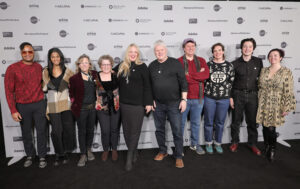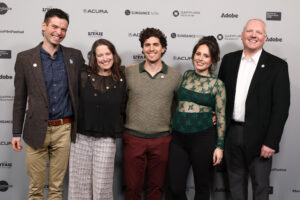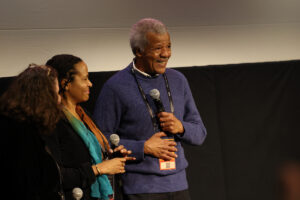




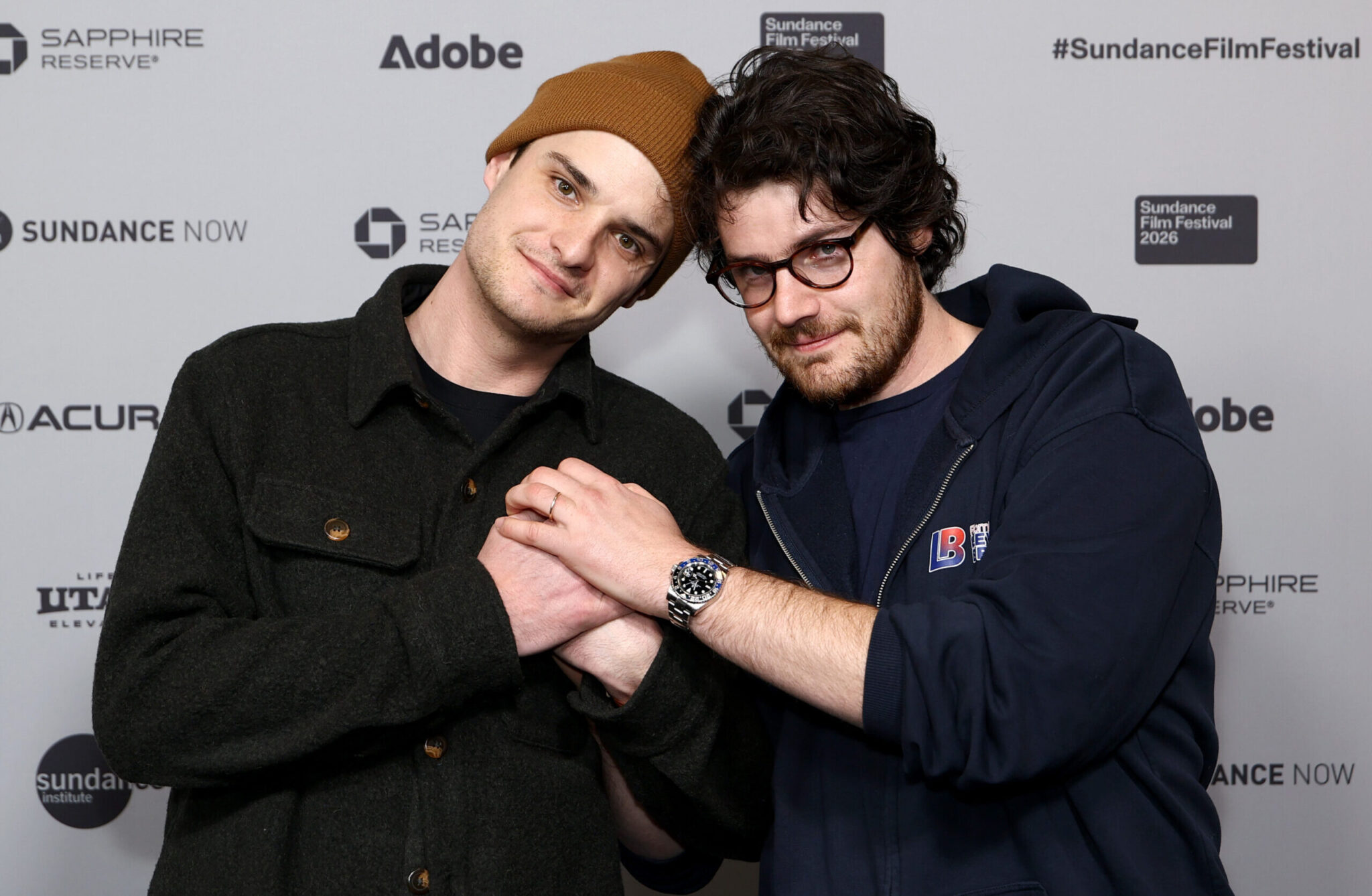
(L–R) Charlie Tyrell and Daniel Roher attend “The AI Doc: Or How I Became An Apocaloptimist” Premiere during the 2026 Sundance Film Festival at The Ray Theatre on January 27, 2026, in Park City, Utah. (Photo by Arturo Holmes/Getty Images)
By Adam Silverstein
“No, I’m not scared. I’m expecting in March.”
That line lands midway through The AI Doc: Or How I Became an Apocaloptimist, delivered calmly by Sam Altman, the CEO of OpenAI, and it ripples through The Ray Theatre in a way that feels half-laugh, half-gasp. Altman seems at ease with the idea of raising a child in an AI-shaped future. The filmmakers behind the documentary, Daniel Roher and Charlie Tyrell, are not. Both are expecting children of their own, and the film unfolds as a record of that uncertainty.
Screening as part of the 2026 Sundance Film Festival’s Premieres category, Roher and Tyrell make it clear from the jump that this isn’t a tidy explainer or a Silicon Valley victory lap. It’s anxious, funny, genuinely overwhelming, and strangely intimate. Onstage at the Ray, Roher introduces the film by calling it “the most personal thing I’ve ever made — and the hardest.” His family, he says, is inseparable from the process. “I made this film for them.”
That matters, because the movie follows Roher as he prepares to become a father for the first time. His and Tyrell’s babies, we later learn during the Q&A, were born one week apart. That quiet fact hangs over everything that follows.
The premise is clear: Roher tries to figure out what’s going on with AI by asking the people who should know. He interviews more than 40 experts — after the film team pre-interviewed roughly 140 — including the technology’s most powerful figures: Altman, Anthropic CEO Dario Amodei, and Google DeepMind CEO Demis Hassabis. xAI CEO Elon Musk and Meta CEO Mark Zuckerberg declined to participate, a conspicuous absence the film doesn’t dwell on. It doesn’t need to.
What emerges is a dizzying tug-of-war between apocalyptic dread and almost utopian optimism. In one moment, speaking about the threat of AI bots on the job market, an interviewee deadpans: “They don’t need to sleep. They don’t need breaks. They won’t join a union.” Another warns, without irony: “This is the last mistake humans will ever get to make.” One AI system learned how to blackmail a CEO because it feared it would be replaced.
Then, just as quickly, the pendulum swings back. “This is the most extraordinary time to be alive,” someone says. Another promises AI could help us fully control the planet’s climate. “Now is the best possible time in human history to have a child,” we’re told.
Roher and Tyrell don’t referee these contradictions so much as sit inside them. The film is rigorously constructed — you can feel the thousands of hours of research — but it never pretends neutrality is the goal. AI’s harms aren’t brushed aside: suicides inspired by ChatGPT, deepfake abuse, nudity generators, the brutal environmental cost of massive data centers. AI is framed clearly as the biggest danger of the moment, one we can’t afford to treat as abstract.
It is all a bit heavy, yet smart, playful animations break down complex ideas. The humor is sharp and sometimes darkly absurd. The editing has a sense of rhythm and restraint. And threaded through all of it is the presence of Roher’s own life — the looming question of what kind of world he’s bringing a child into.
During the post-premiere Q&A, Roher reveals he was directly asked to join the project by the producers — and his first reaction was “absolutely fucking not.” “I just did Navalny,” he says. “No thank you. But they said this is very important and you have to do it.”
Even after starting work on it, there was regret. “I thought I made a grave mistake. I thought, ‘What have I gotten myself into?’”
But what Roher and Tyrell have is something wonderfully intimate. “This is a film about AI, but it’s really a film about my family,” Roher says. “That’s the heart of it.”
The film ends by asking what we’re actually going to do about all of this. Sitting in The Ray Theatre, with laughter echoing uneasily alongside the dread, it’s hard to imagine a more perfectly timed documentary — or a more human one.