



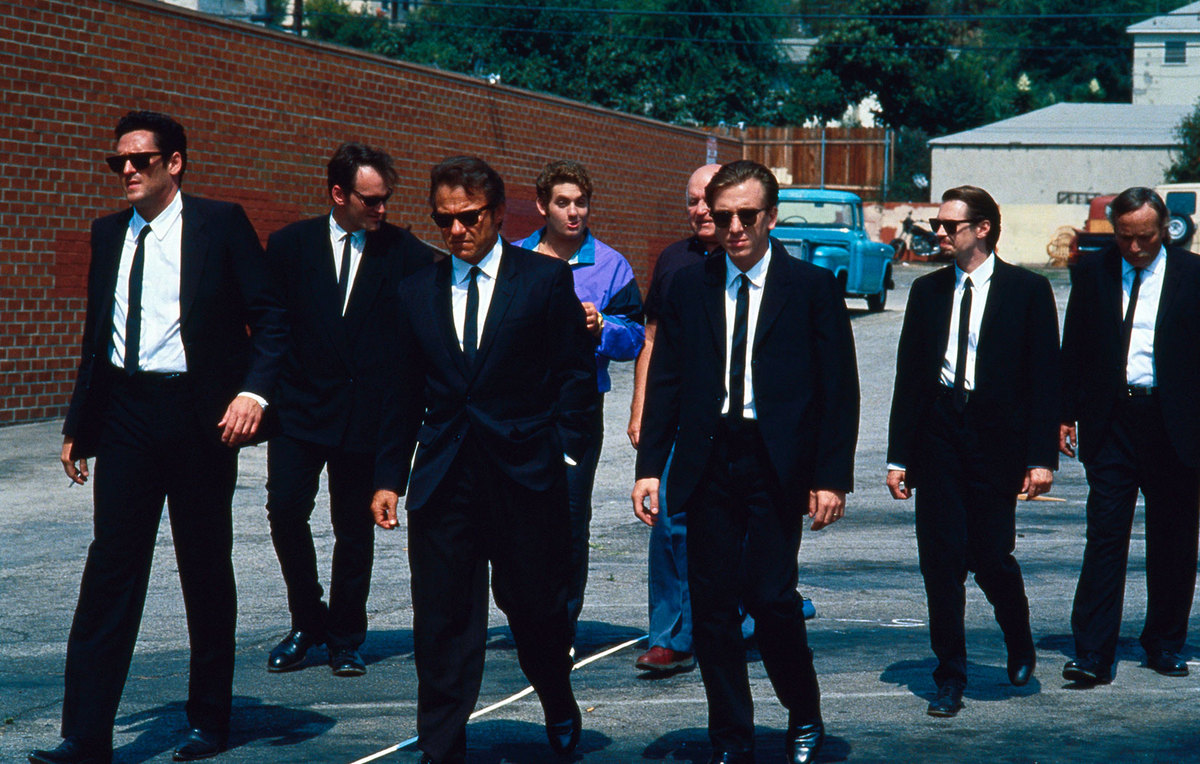
The cast of “Reservoir Dogs” during the film’s iconic slow-motion opening credits scene.
By Lucy Spicer
At Sundance Institute, we’re always in awe of the power independent film has to bring people together. That’s why we love asking filmmakers to name their favorite Sundance Institute–supported projects, both in our “Give Me the Backstory” feature series and through surveys like the top 10 feature films from the first four decades of the Sundance Film Festival. When a single film resonates with many filmmakers — from different backgrounds and with varying life experiences and artistic styles — a bond is created, rooted in a common love for independent film and universal stories. To commemorate some of our most-mentioned titles over the years, we’ve compiled responses from filmmakers who want to share their love for their favorite Sundance Institute–supported films.
What helps elevate a film to cult classic status? Every cinephile will have a different list of criteria, but writer-director Quentin Tarantino’s Reservoir Dogs checks a lot of boxes on a lot of lists. An unflinching yet quotable script? Check. Resonant — and breakthrough — performances by its actors? Check. Shots memorable enough to be mimicked (or parodied)? Check. Needle drops so effective that listeners will forever associate those songs with the film? Check.
It’s an impressive tally already to be sure, made only more impressive by the fact that Reservoir Dogs was Tarantino’s feature debut. Supported by Sundance Institute’s 1991 Directors Lab, the film was produced on a modest budget before premiering at the 1992 Sundance Film Festival. A theatrical release followed in October of that year, triggering a legacy that has manifested in countless homages and inspired a generation of future filmmakers — as well as cementing the choice for most prominently featured film poster on many a college dorm room wall.
A banter-filled, blood-soaked heist film that doesn’t actually show the heist, Reservoir Dogs follows a group of men tasked with executing a diamond robbery. We see these men having breakfast before the robbery — discussing such topics as the meaning of Madonna’s “Like a Virgin” and the ethics of tipping servers in the U.S. — and a few minutes later the audience realizes that the heist did not go exactly as planned. A couple players have disappeared off-screen, and those who have managed to reach the post-robbery rendez-vous point are left squabbling over the possibility of a rat in their ranks.
The film’s cast — whose characters largely sport color-coded aliases such as Mr. White, Mr. Orange, and Mr. Pink — comprises seasoned actors Harvey Keitel, Lawrence Tierney, and Chris Penn as well as breakthrough performances by Steve Buscemi, Tim Roth, and Michael Madsen, all of whom expertly deliver the razor-sharp dialogue that has become one of Tarantino’s many signatures.
Below, some of the Sundance Film Festival alumni who love Reservoir Dogs as much as we do describe in their own words why the film remains a favorite more than 30 years after its release. Beware, spoilers ahead!

“Thirty-four years ago, a script arrived like nothing I’d ever read.
Thirty-four years ago, I auditioned for Mr. Orange with Keitel and Tarantino.
Thirty-four years ago, my agent called to say her other client got the part.
Thirty-four years later I’m still recovering.” — Todd Field, In the Bedroom (2001 Sundance Film Festival)
“A heist film without a heist, a perfect first movie. Contained yet thematically vast. The most violent film you’ve ever seen where no real violence is shown. It only feels that way because of the song, because of the tone. Rififi, The Taking of Pelham 123, City of Fire, Madonna. But also Scorsese and Cassavetes. Tarantino fused high and low culture and spit it back at you as something feral, playful, and new. What made his debut unique was not just the references, it was his love of character, his ear for dialogue, his obsession with actors. He’s been copied endlessly since, but that’s where everybody else failed. No matter how violent, poppy, or quirky the attempt, they couldn’t make their characters human. Because Reservoir Dogs isn’t about a heist gone wrong. It’s about loyalty, love, and friendship.” — Carlota Pereda, Piggy (2022 Sundance Film Festival)
“Over the years, I’ve found myself revisiting Reservoir Dogs. It still blows my mind what Tarantino was able to achieve with so little. Of course he had a great ensemble cast, but it’s a true character-driven piece that was written on the page first. A constant reminder that budget constraints should never be a hindrance to narrative and form.” — C.J. Obasi, Mami Wata (2023 Sundance Film Festival)

“Reservoir Dogs was released in 1992. I was finishing college and pretty unsure what I was going to do with myself when I graduated. My film education at that point consisted only of one class on the Western in film and literature, which mostly involved screening films made between 1948 and 1962 in Berkeley’s Pacific film archive. I wasn’t sure what contemporary cinema was. But the class had inspired me to go back to the movie theater.
I saw Reservoir Dogs in a theater in Berkeley, one of the many theaters that has since shut down; it might have been the Shattuck or the California, or maybe the film was even part of a double bill at the UC theater. My recollection is that I saw it alone, which made for a more powerful and personal experience, quasi-religious. It was a movie in love with the movies — an alchemy of genre, with killer needle drops, shocking violence, a post-modern — or at least unconventional — structure, and brilliant ensemble performances (Tim Roth!). And it was slightly stagy, even theatrical, driven by character and dialogue as much as plot.
It’s hard to see back through the decades of Tarantino and the ways in which the film has been lacquered over time and appreciate how distinctive and radical it felt. There was no mistaking that it was a transmission from another universe — a transmission that I heard clearly. Furthermore, as we know, Tarantino was not a product of the studio system or nepo baby. He had worked at a video store. Could anybody make movies this brilliant? The answer is no. But I thought I would try. It took me a few more years to quit my conventional job and jump feet first into documentary, but I give Reservoir Dogs a little credit for inspiring me.” — Jesse Moss, Middletown (2025 Sundance Film Festival), War Game (2024 Sundance Film Festival), Girls State (2024 Sundance Film Festival), Boys State (2020 Sundance Film Festival), The Overnighters (2014 Sundance Film Festival; supported by Sundance Institute’s 2013 Documentary Film Program and Producers Program)
“Reservoir Dogs — I came of cinematic age in the mid-’90s, and I think the fact that this film was essentially banned from a home release in the U.K. by the BBFC meant I was hyperaware of it and desperate to see it for a couple of years before it was finally given a VHS release around 1995. I read everything I could in film magazines about this buzzy new director, I read about the infamous ear scene, and I knew about the walkouts at the Sundance premiere that included Wes Craven of all people. All of which was incredibly exciting for a film-obsessed teenager! I wasn’t disappointed when I saw it, and Sundance was firmly on my radar from that point on!” — Dylan Southern, The Thing with Feathers (2025 Sundance Film Festival)

“Stanley Kubrick’s The Killing was front of mind as I watched Reservoir Dogs at the 1992 Sundance Film Festival. And, as it turns out, it was for director Quentin Tarantino as well. Which is one of the great things about this Video Archives alum: He proudly and enthusiastically flies his influences freak flag at every opportunity. And now that he’s become an important influence for younger filmmakers, you can see that legacy carry on in diverse ways — including in one of the best television shows of the past decade: Reservation Dogs (created by two other Sundance alums, Sterlin Harjo and Taika Waititi).
I’d been tipped off by a producer for the Coen brothers to check out Reservoir Dogs, which was already in the cards for me, since Harvey Keitel was in it. This same producer would later grouse that Quentin should have been awarded SOMETHING at the end of the Festival, particularly for the film’s screenplay. And he was right. Rarely had I seen a film so readily oscillate between garrulous humor, edge-of-your-seat suspense, and outright horror. During the infamous ear amputation scene, accompanied by the rollicking music industry parody song “Stuck in the Middle with You,” you find yourself both horrified and amused, peering through your fingers aghast at the imagined gore while chuckling inside. (By the way, its victim is played by the film’s producer, good sport Lawrence Bender — fulfilling perhaps a dark, deep-seated wish-fulfilment revenge wet dream for all directors tormented by their producers.)
And that was another innovative element: Tarantino’s fine sense of irony mingled with misbegotten nostalgia in his choice of song cues, which would come to full-blown display in his next film, his masterpiece, Pulp Fiction. It was apparent that night that — fathered by an important new voice, slouching toward the snowy slopes of Sundance — a red-faced bastard wild child of Kubrick and Coen was soon to be catapulted onto the mean streets of America.” — W. T. Morgan, The Unheard Music (1986 Sundance Film Festival), A Matter of Degrees (1990 Sundance Film Festival; supported by Sundance Institute’s 1988 Directors Lab)
Editor’s Note: This feature was published October 23, 2025. We will continue to add to this feature as more Sundance Institute–supported filmmakers contribute their thoughts about the film.