



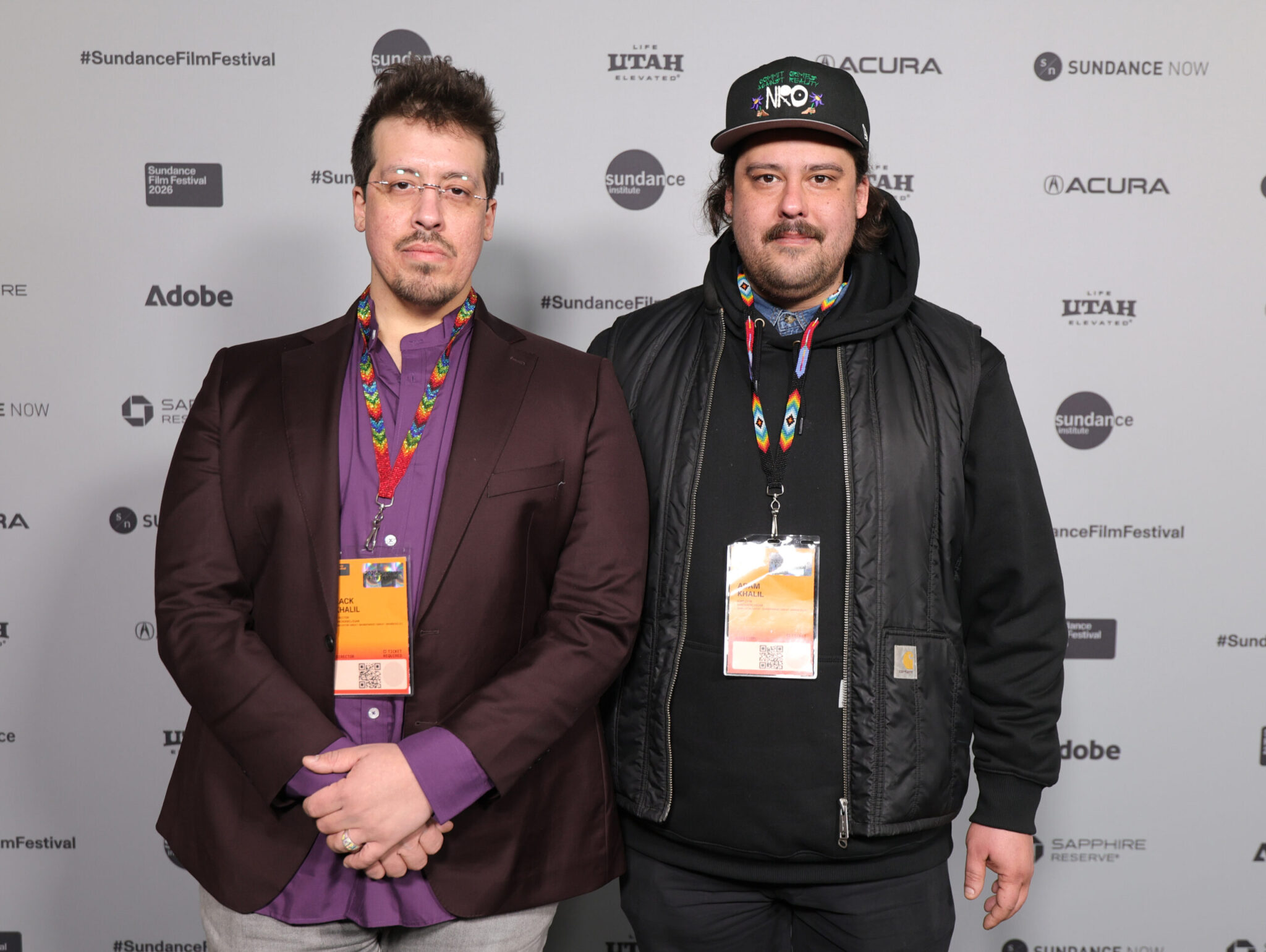
(L-R) Zack Khalil and Adam Khalil attend the “Aanikoobijigan [ancestor/great-grandparent/great-grandchild]” premiere during the 2026 Sundance Film Festival at The Yarrow Theatre on January 26, 2026 in Park City, Utah. (Photo by Neilson Barnard/Getty Images)
By Cecilia Santini
The documentary Aanikoobijigan [ancestor/great-grandparent/great-grandchild] follows a group of Native American repatriation specialists who work to return the looted remains of Indigenous Ancestors from museum collections, universities, and archives to their tribal communities for reburial.
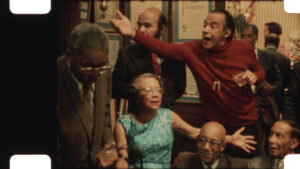
The film, playing in the NEXT section of the 2026 Sundance Film Festival, features interviews with repatriation specialists, historians, and museum workers, outlining the history of Indigenous burial ground desecrations over the last several centuries and paying tribute to the devoted work of the people bringing their Ancestors home. At the post-premiere Q&A at The Yarrow Theatre on January 26, directors and brothers Adam and Zack Khalil (Ojibway) explain their personal connection to the material. “Zack and I’s mother [who] passed away about 12 years ago was deeply involved in repatriation work,” Adam says.
A nonlinear concept of time shared by many Native communities lies at the heart of the film. In this understanding, familial and communal relationships transcend time, and families and peoples are bound to one another by a “tether of relevance,” as archivist Blaire Morseau (Potawatomi) says in the film. She explains this idea through the word that serves as the film’s title: “Aanikoobijigan” means “Ancestor” and “great-grandparent” as well as “great-grandchild” — indicating that a person is “simultaneously Ancestor and future generation,” she says.
This relationship with time — the spiral of past, present, and future, and the proximity of each — makes the work of repatriation urgent and personal. At the post-screening Q&A, Zack goes in depth about this concept and how it shaped the film.
“Native American filmmakers and artists are often put in this pedagogical position of having to educate others about our culture, and in this film that serves a really utilitarian function,” he says. “People need to know the Ancestors are in these collections, and people need to understand the reason why it’s so important that they are returned. And for us that Anishinaabe concept of time, which kind of comes from an Anishinaabe worldview, is really fundamental to understanding that on a deeper level. These repatriation issues are sometimes erroneously framed as a religion versus science kind of thing, which it really isn’t. I want to be clear about that. It’s fundamentally a human rights issue.”
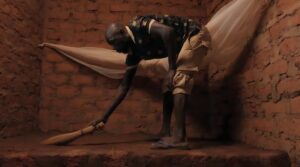
Kaleidoscopic visual effects, animation, and imaginative scenes illustrate this profound view of time, the Earth, and the deep connections that exist between the physical and spirit worlds, while key words and terms are displayed on screen in a huge font. “We often try to complicate the way that most people think of film as … like an arc that has a kind of linear quality to it,” Adam says when asked about these stylistic choices. “We’re also thinking about film in a vertical orientation, so that way we can code many different meanings for many different audiences along this vertical orientation as the film is moving by.”
“That animation, this really explicit depiction of linear time versus spiralic time, was a way of driving that point home, making sure it was felt,” Zack adds. “Sometimes when non-Native people think about Indigenous spirituality, there’s kind of a flattening effect, and the real reason why our Ancestors need to be returned is something that even an empirical scientist can understand: That everything that we took from the Earth they want to give back in their final act of reciprocity, and that sense of spiralic time is in relation to that concept as well.”
The directors’ deeply thoughtful approach to their craft extends beyond images, with powerful and sometimes eerie sounds creating an emotionally intense sonic environment. When an audience member mentions how profoundly anxious the use of loud bass noises made him while watching, Adam replies “Sick!” to general laughter, before eloquently explaining the choice.
“A lot of times in documentary, we’re listening to what people are saying and witnessing something and constructing empathy based on that, and I think empathy is good, but it’s also a slippery slope — because it’s this idea of ‘Put yourself in someone else’s shoes,’ as opposed to just respecting what someone in those other shoes is saying and treating it as legitimate. So I think we also have a little bit of a hesitancy and a fear around documentary, because of that ability to transpose one’s own relation to what they’re witnessing.”
Adam contrasts this with what he and Zack call “a physiological cinema, like cinema that actually makes you feel some type of way. Whether that’s with bright, flickering lights or certain frequencies that create real discomfort, there’s a way to kind of articulate what’s happening on screen that’s felt rather than intellectually understood, and wanting to kind of bring those two things along with each other.”
Zack continues, “I think the experience of being in some of these larger museum spaces or these cold sterile archives where the Ancestors have been imprisoned, for sometimes centuries, we wanted to try to convey what it felt like to be in that space as an Indigenous person and what these tribal repatriation specialists go through every day — and also maybe point to what it must be like for the Ancestors themselves who’ve been in those spaces, which are incredibly sci-fi. [It’s] like they’ve been abducted by aliens essentially from the future, and we wanted the audience to feel that sense as well.”
Aanikoobijigan is a stirring testament to the dedication and perseverance of Native communities. Adam says, “I think the movie’s also really about tribal sovereignty, and this idea that our communities are the experts on our communities, and that we have sovereign authority in this kind of third space of sovereignty as nations within nations, to advocate on behalf of what our community needs.”