



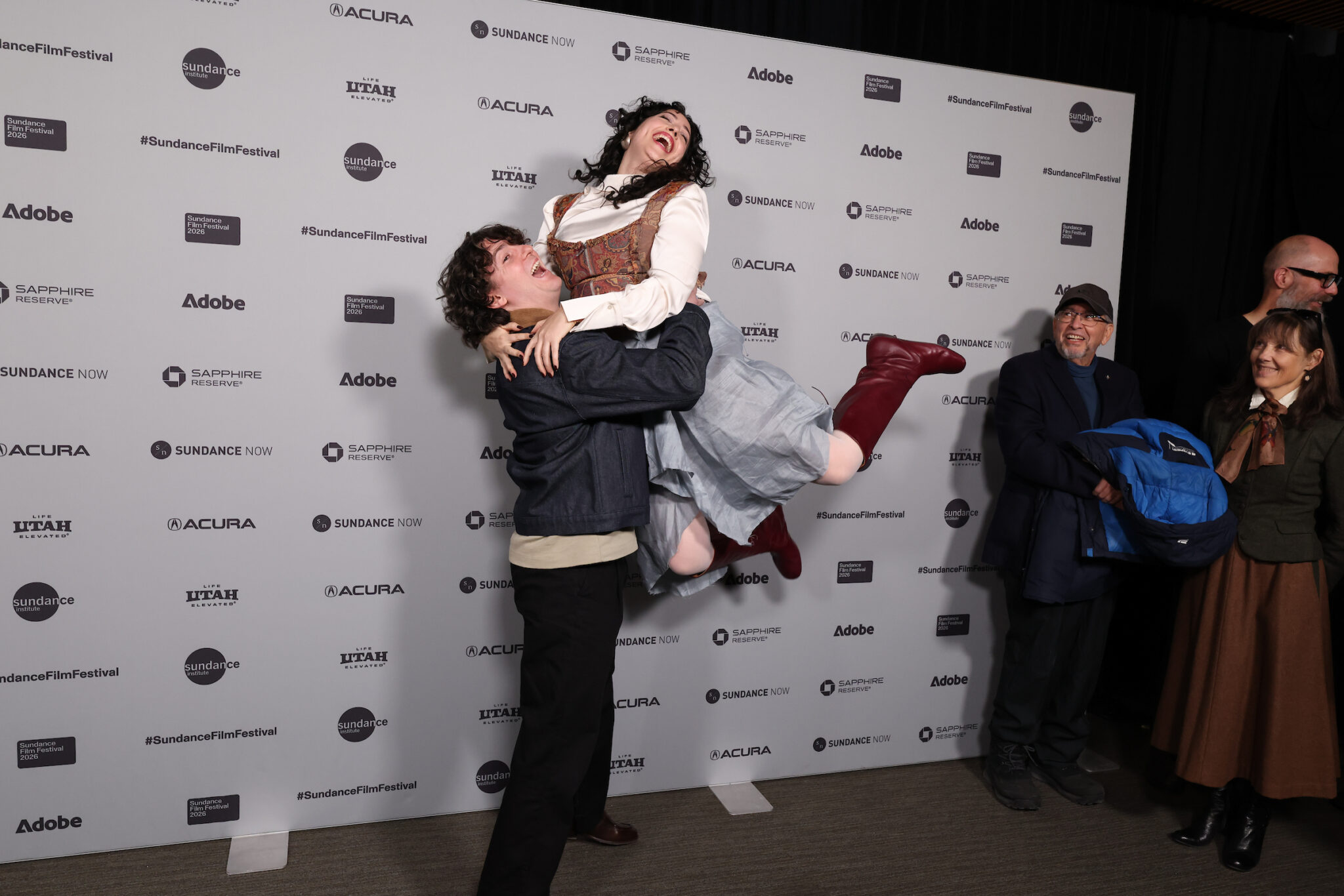
Gabriela Osio Vanden and Jack Weisman attend the premiere of “Nuisance Bear,” an official selection of the 2026 Sundance Film Festival. © 2026 Sundance Institute | photo by Jason Peters
By Jessica Herndon
Nuisance Bear raises a timely question: What happens when an ancient migration route collides with modern life? Premiering in the U.S. Documentary Competition at the 2026 Sundance Film Festival, the film follows a polar bear moving through Churchill, Manitoba, often called the “Polar Bear Capital of the World,” as it navigates a landscape crowded with tourists, wildlife officials, and systems designed to manage its existence. Branded a “nuisance” for simply surviving, the bear forces us to consider what coexistence truly means.
After the success of the Oscar-shortlisted short film of the same name, directors Jack Weisman and Gabriela Osio Vanden expanded the story. Guided by an Inuit narrator, an Indigenous person from the Arctic regions of Canada, the documentary observes what it means for polar bears to be constantly watched, tracked, and redirected by humans.
The filmmakers found that capturing footage of the bears was made easier when they opted to put their cameras on cars. “You feel safer, you feel like you’re being more respectful to bears, you’re able to move with them,” explained Vanden during the post-premiere Q&A at the Library Center Theatre, adding that the film crew was able to build on the technique as they continued to film. “We just developed that further. We had better stabilizers on the vehicles, we could control everything from within.” With their technique intact, Weisman adds that the process of filming wildlife was still a taxing one. “There’s a lot of just capturing and hoping something would happen,” he says. “Mostly nothing happened. We were living on a prayer.”
Possibly the most challenging part of making the documentary wasn’t the waiting game. It was editing over 700 hours of footage. “You have to spend, like, a year and a half, going through it,” says Weisman. Andres Landau, their editor, became their visual mastermind. “We put him through torture,” Osio jokes. “He deserves for our first child to be named after him.”
In Nuisance Bear, it’s thrilling to watch bears slip past barriers and outmaneuver traps meant to contain them. But scenes like these beg the question: Are we more powerful, or are they? Equally compelling is the film’s striking cinematography and sound design, which allow viewers to immerse themselves in the majestic Arctic while also feeling unsettled.
Cristóbal Tapia de Veer served as the film’s composer. “He was just so enthusiastic and understanding of what we were trying to do, so it was just a no-brainer that we would go with him,” says Vanden. The directors were very specific in their initial conversations with de Veer about the sound of their film, telling him, “we don’t want over-sentimentality, we don’t want you to just feel sad for the bear, no orchestra,” says Osio. “But he’s a genius and we kind of just let him cook.”
De Veer was instrumental in setting the tone and vibe for the filmmakers’ project. “He came on board before we even had a rough cut,” says Osio. “So there was this beautiful thing that happened where he would send us bits that we could edit to.”
More than a visually stunning nature documentary, Nuisance Bear asks audiences to reconsider environmental awareness, the impact of our choices, and how we coexist with wildlife.