



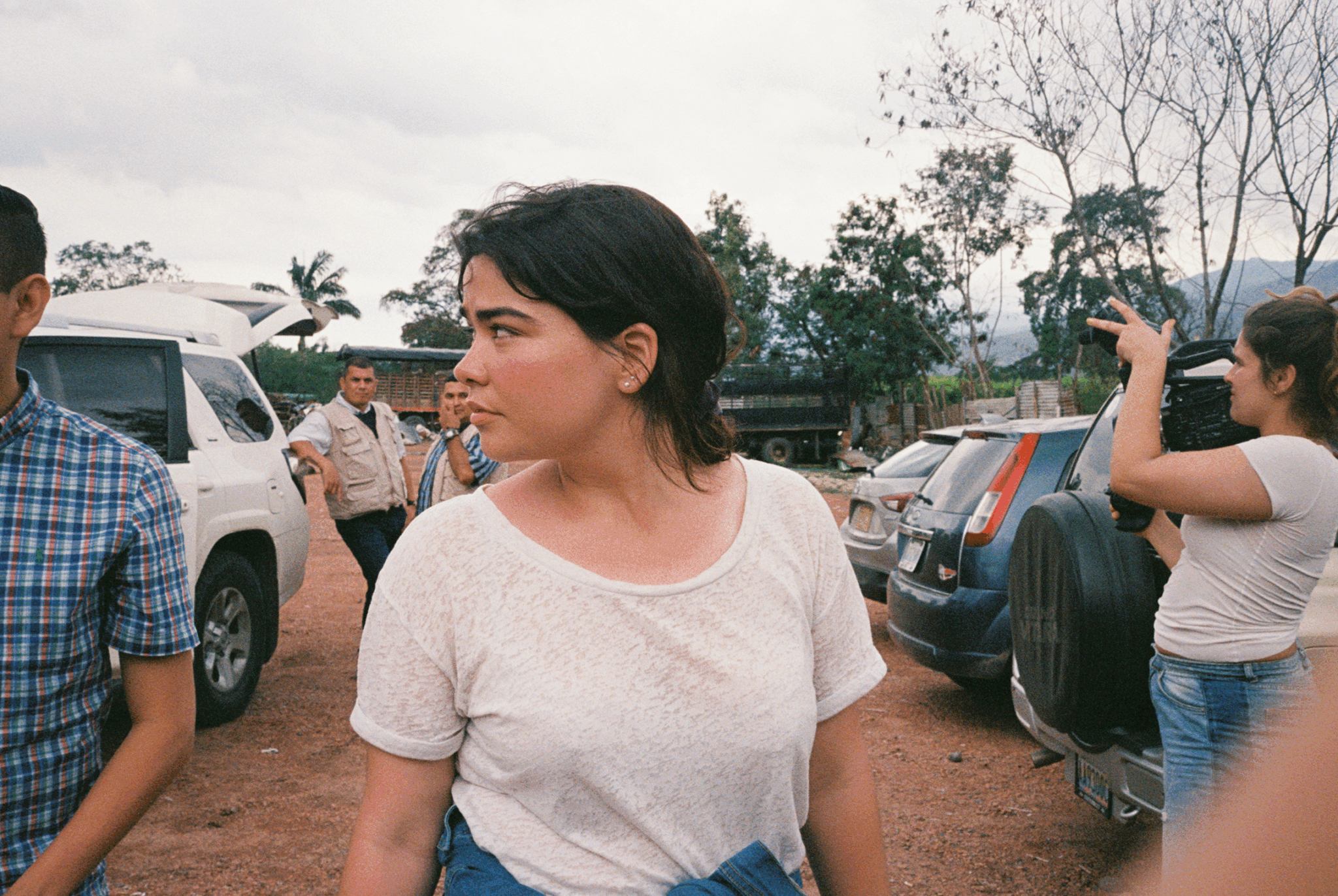
Pictured: Filmmaker Vero Kompalic (Photo by Gia Rigoli)
By Vero Kompalic
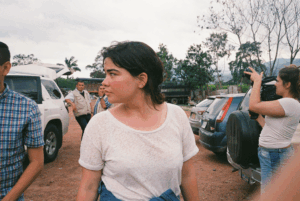
This is the last picture I ever took in Venezuela.

I had seen the girl in the row ahead, minutes before, hugging her grandmother and cousins, saying goodbye. For the whole plane ride, the girl held onto her mother’s hand, consoling her as she cried.
I have always considered myself a Venezuelan filmmaker, even if I have not yet been a filmmaker on Venezuelan soil, a distinction which has defined me in my work.
When I started working in film, I had to enter my community from outside the country, always keeping Venezuelan projects on the horizon, pushing them further into the future, for “when things changed.”
For the past two decades, Venezuelan filmmakers have constructed a national cinema outside of its borders. Questions of “What constitutes a Venezuelan film?” have arisen often, as filmmakers have been forced to flee or seek resources outside of national bounds. Under some definitions, a film can only be nationalized by its funding or a governmental recognition, which greatly limits filmmakers from countries in conflict. The work of organizations, filmmakers, and audiences has been central in keeping us anchored to one another.
In 2020 I attended the Sundance Film Festival with a film in the NEXT section. It was my first festival experience, and my workload was so heavy that I only had time to watch one film. I chose Once Upon a Time in Venezuela by Anabel Rodríguez Ríos.
Two months earlier, I had gone through my asylum interview. For eight hours, I retraced in great detail everything that had led me to leave Venezuela and seek protection outside of it. Sitting at the Sundance Film Festival watching a Venezuelan film shortly afterward felt deeply complicated and emotional, and I thought of the girl on the plane.
In spite of the past two decades of severe humanitarian crisis and exodus, this time has also given us the tools to build the next chapter of our collective history. When the double earthquake hit earlier this year, leaving behind a landscape of unprecedented disaster and grief, Venezuelans immediately started organizing a relief network to rescue themselves.
From WhatsApp groups, to chains of medicine and food that connected the entirety of the diasporic globe with La Guaira, to citizens aiding the censored press, to people lifting rocks and buildings, it felt like the people’s action was alive and spectacular to witness. A friend and incredible filmmaker Edwin Corona Ramos mentioned shortly after the disaster, upon joining relief efforts: “As a society, we have been preparing for this for a long time.” It was a sentiment shared and felt by everyone around me.
In order to survive this chapter of our history, Venezuelans have devised a social intelligence that has rescued us time and time again, against the backdrop of institutional and governmental collapse and neglect. We only have each other to construct anything that can last, sustain us, or aid us.
This same mechanism has applied to our national cinema, which has had to reinvent itself outside of traditional ideas of audience, infrastructure, and filmmaking.
JEVA Org, for instance, was started by a group of veteran womxn from the Venezuelan film industry, among them my producing partner and Sundance Institute Ignite alum, Emiliana Ammirata, and Claudia Lepage, producer of Once Upon a Time in Venezuela. JEVA Org has created networks between womxn filmmakers inside and outside Venezuela, helping us stay connected and find crew, collaborators, and supporters across borders.
To answer the magnified challenge of censorship and limited distribution avenues inside the country, filmmaker Richard Nieto Fernández and his team started Habitar el Cine, a film ecosystem that incorporates a distribution agency, a film magazine and an annual film festival in Caracas that screens political and social works. This past year they hosted a retrospective of Iranian filmmaker Sanaz Sohrabi in Venezuela.
These initiatives come from the same instinct that rose after the earthquake and after every period of food shortage, mass blackouts, or medical collapse: When the infrastructure fails, we find ways to build it ourselves.
My national identity is a personal political statement that entirely informs my producing practice. It is a refusal of the idea that leaving Venezuela meant leaving Venezuelan cinema behind. It allows me to connect my work, and my way of working, with this recent development and heritage of collective intelligence that I am so proud to witness, and hopefully to practice as well.
Next week, I will get on a plane and return to my hometown for the first time in seven years. I will be a filmmaker on Venezuelan soil. Times have not necessarily changed, but it doesn’t matter anymore. There’s a new country and a new cinema on the horizon, and we are building it together.