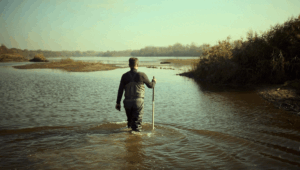




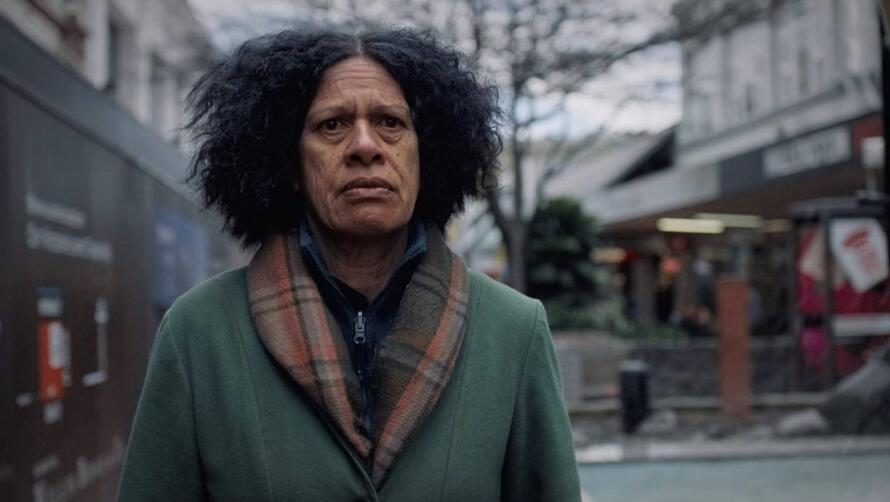
Tanea Heke as Mata in Ainsley Gardiner and Briar Grace-Smith’s film “Cousins.”
By Moi Santos
For Asian American and Pacific Islander Heritage Month, the Sundance Institute Indigenous Program would like to recognize the Indigenous Asian and Pacific Islander storytellers who have contributed to examining and extolling the richness of Indigenous Asian and Pacific Islander diasporas in their work. Essential to this is the critical examination of the AAPI label. While the term can be mobilized for coalition building, it can also conflate and erase the unique histories and experiences of Asian and Pacific Islander communities. To learn more, please visit this guide that was put together by Empowering Pacific Islander Communities.
In celebration of Asian American and Pacific Islander Heritage Month, we spoke with Māori filmmaking duo Ainsley Gardiner (Ngāti Awa, Te Whānau Apanui, Ngati Pikiao) and Briar Grace-Smith (Ngāpuhi, Ngāti Hau), who made history earlier this year, becoming the only Māori women to direct a feature fiction film since the 1988 release of Merata Mita’s Mauri. In this month’s Perspectives, they discuss their new film, Cousins, a drama based on Māori author Patricia Grace’s beloved 1992 novel of the same name, delving into their creative process and underlining the importance of representing Māori stories and experiences onscreen.
[Ed. note: This interview has been edited and condensed for clarity. Learn more about where you can find Cousins here.]

Briar Grace-Smith and Ainsley Gardiner. ©2019 Sundance Institute | Photo by Jovelle Tamayo
MOI SANTOS: What inspired you to become a filmmaker?
AINSLEY GARDINER: My earliest memory of being moved by a film was when I was 4, watching a black-and-white, live-action, foreign-language version of The Little Mermaid in which the mermaid sacrifices herself for the prince by throwing herself into the sea, turning into hundreds of floating flowers. I’ve never been able to find that film again, but I could feel even then the medium’s power not just to move me, but to connect with me. I felt a kinship with that mermaid; I felt empathy as much as sorrow.
I remember, even then, the power of the film not just to move me but to connect me.
—Ainsley Gardiner
I continued to find myself in the most unlikely of films. As a teenager living in a small town, I went to the movies every week with my friends. It was a place to hang out, to meet up with boys, to sneak a drink of beer or a puff of a cigarette. The town had one cinema, and it became a symbol for my growth from a child into an emerging adult. Later, my tastes grew, and in foreign and independent cinema, I found the same kinship to characters, no matter where they were from, no matter how different.
BRIAR GRACE-SMITH: It was a gradual thing. I’ve been a storyteller from a young age; at school, my nickname was “Briar the Liar.” I was either zip-mouthed or spinning some kind of fantastic yarn at “morning talk” times. My mum took me and my cousins to a play called Happy Days by Samuel Beckett when I was 6. In it, the cast of two were buried up to their necks in sand and coming to terms with the world ending. My cousins fell asleep while watching it; it was pretty boring because no one moved. But my mum told me someone had written the words that the actors were reciting, and that interested me a lot.
MS: What approach do you take with your filmmaking? How did you develop that approach, and how do you hold on to it throughout your process?
AG: I never believed in the auteur theory. I’ve always understood the process to be incredibly collaborative, even at the most fundamental level. Even working with someone like Taika Waititi, who is a genius without question, I could see how so many contributed to what would ultimately be defined as his vision. I’m interested in convergence, where storytelling, tikanga Māori, and community converge. I believe many of the aspects of my approach to filmmaking are inherent in me as an Indigenous woman. Although the journey of identity is ongoing for me, at a genetic level, I think being Māori provides a map for how I approach my work.
BG-S: I’m still exploring my way of working, but I’m intuitive as a writer and also as a director; I know that coming into a space or location, sometimes your plan will change. Things that worked on the page won’t always work in the location, but stay open because something better will come. I’ve also enjoyed the collaborative nature that can be part of filmmaking. During Cousins, we also did our best to work with a “flat hierarchy,” so no one was in command. We were all in control of our own jobs, but we all shared a common vision and worked together toward that. It meant that egos were left at home.
Ainsley and I had the luxury of working together as screenwriter and producer over the period that the script was being developed, so without realizing it, we were also laying down the kaupapa, or how the film would work. During the time of development, we became very aware that Cousins was a film about community. Community, behind and in front of the camera, was important. Over the course of the development process, Ainsley and I also continued to upskill ourselves as directors, and when we decided to co-direct, we both stuck to the scenes and characters that we felt most connected to.
MS: What are your favorite Māori- or Pacific Islander–directed films, and why?
AG: I didn’t know I was Māori for much of my childhood; I identified as half-caste and thought that meant something. I grew up middle-class in a very white neighbourhood, but I always experienced the deep longing to know myself, so every Māori film I saw resonated at a bone-deep level. Larry Parr’s short film The Makutu on Mrs Jones was the first where I saw brown faces and a story steeped in Māori culture. Ngåti by Barry Barclay and Mauri by Merata Mita, and Merata’s documentaries Bastion Point: Day 507 and Patu, and the film she helped Geoff Murphy make, Utu. I love all of the films I produced for Taika. His sense of humour elevated his films above all I had seen before. He captured the light and the dark in a way that captured what I see as the essence of Māori storytelling.

Taika Waititi’s 2010 film “Boy.”
BG-S: I love Boy by Taika Waititi because it’s funny, it’s sad, and there are so many layers to it. It’s saying something about the big wide world, but from the perspective of a young boy who lives in a small town. There’s a lot of social commentary going on. Here’s a filmmaker who knows the world he’s writing about. I also loved The Orator by Tusi Tamasese. I like the languid pace of his films and the visual storytelling. His stories carry with them a kind of darkness that I like. I’m watching a guy bake bread, but I don’t feel safe at all! I also loved Vai, the omnibus feature film by Pasifika filmmakers, and I have just watched it again. It moves like the tide: It’s awash with color, song, laughter, and tears. It’s such a celebration of women’s voices, and it’s so grounded in the Pacific.
MS: How is your cinematic language shaped (or not shaped) by your Māori identities? Do any other identities overlap?
AG: It is more likely that my cinematic language has been shaped by all of the thousands of films I have watched. But my approach to filmmaking, the process of it—that has been shaped by being Māori. My cinematic language, I think, revolves around visual metaphor. Barry Barclay, in his 1985 documentary, The Neglected Miracle, and later in his book, Our Own Image, acknowledged the significance of the thematic metaphor (in the case of the doco, sovereignty) and the importance of it to storytelling. I’m driven to find a cinematic language that visually and emotionally embodies the thematic metaphor.
The concepts of manaakitanga (care of people), whånaungatanga (kinship/connection), and tåonga tuku iho (treasures passed down from our ancestors, in this case our stories and our culture) underlie my approach to filmmaking.
—Ainsley Gardiner
In terms of process, the concepts of manaakitanga (care of people), whånaungatanga (kinship/connection), and tåonga tuku iho (treasures passed down from our ancestors, in this case our stories and our culture) underlie my approach to filmmaking. Acknowledging the source of stories, often going to shoot the story where it’s from, working within, and with, Māori communities, and attempting to create a flat hierarchy that is representative of how our marae/communities operate. These are the qualities I try to bring to a project that come from being Māori.
MS: What or who has helped you tap into claiming your identities?
AG: Larry Parr was my first mentor in the film industry, and he was one of the most successful Māori producers of his time. It wasn’t so much that he taught me the fundamentals of Māori filmmaking; it’s that he brought being Māori to everything he did. Merata Mita gave me my first opportunity to grow into my dream of directing at a Māori directors hui (gathering) in Tairua in the early 2000s.
Taika and I had been challenged often about whether our first film, Eagle vs Shark, was a Māori film, and I still had the feeling of not being Māori enough to be a Māåori filmmaker. Merata set me straight. She taught me simply this: Whakapapa (genealogy) makes me Māori, and my success will silence the critics. She was right on both counts, and I credit her with giving me the confidence to pursue my own identity journey (which is painfully slow and lifelong, I imagine) and to continue in this industry. I miss her wise counsel so much.
Cliff Curtis has made up the third corner of this powerful triumvirate I’ve been lucky enough to call mentors. He’s my cousin, and we’ve worked together, argued a lot, and been there to have each other’s backs as we’ve grown in this industry. Larry, Cliff, and Merata, at the inaugural Wairoa Film Festival in 2005, convinced me to keep producing, as after five years, I was already ready to call it quits. They taught me a lesson in service, and now that I’m a more mature filmmaker, I’m able to recognize the privilege it is to be able to serve my communities by paving the way, offering my own mentorship to others, and continuing to challenge the status quo and work to decolonize our screens and screen practices.
BG-S: As Māori, if we’re able, we introduce ourselves by reciting our pepeha; in it, we identify our waka (canoe), our tribe, our river, our mountain, and our marae. It’s our way of declaring who we are and connecting ourselves to each other. However, in my youth, our communities and stories weren’t reflected at all in what I was reading in books or seeing on the screen. We were missing.
I knew then that I had stories to tell too. I understood the importance of having ourselves, especially as young people, reflected in the stories we hear and see.
—Briar Grace-Smith
When I was about 13, I read a novel by Patricia Grace called Mutuwhenua. The protagonist was a young woman who was of dual lineage, and the story was about her journey toward claiming her identity. It was the first time I’d read a book where I identified so strongly with the character. I put it down and read it again. I knew then that I had stories to tell, too. I understood the importance of having ourselves, especially as young people, reflected in the stories we hear and see.
MS: In your work, how do you honor or reclaim Indigenous Sovereignty?
BG-S: I hope I contribute to giving a broader perspective of who we are as Māori. Lately I’ve been thinking about the way we develop stories, as well as about Indigenous screenplay structure. I often have this inherent desire to tell stories and write screenplays that revolve around a community of characters, and my scripts don’t always follow the three-act structure. It’s not uncommon among Indigenous writers; I’m reading a lot of scripts by emerging Māori/Pasifika writers at the moment, and I see it often. On the marae, in the speeches (whaikōrero) of Māori orators, a kind of spiral storytelling takes place, full of characters and events from past and present that finally connect and make sense of the now and the point that’s being made. As a novel, Cousins used that type of nonlinear structure, and this was emulated in the screenplay.
MS: You two were the 2019 recipients of the Merata Mita Fellowship, and until Cousins, Merata was the only Māori woman to write and direct a dramatic feature. Cousins has now reached $1 million at the box office and is one of the top 20 New Zealand films of all time. Can you talk about what that means for you?

Merata Mita (L) and Sydney Freeland (R). © 2009 Sundance Institute | Photo by Lyndsey Shakespeare
AG: Because of the massive influence Merata has had on my life and career, when she died, I felt a strong drive to complete the project she’d been working on with Himiona Grace, The Pa Boys. A couple of years later, when Briar and I discussed Cousins, it was a similar drive to honor Merata by completing this project she’d been so passionate about.

Himiona Grace’s 2014 film “The Pa Boys.”
I don’t feel good about the fact that Cousins is only the second feature film in 33 years to be helmed by Māori women as producer-writer-director. I’d rather there had been so many films by wāhine Māori. But stories have their own mauri (life force), and the film we were able to make, the type of storytelling Briar was able to achieve in her script, the fact we could co-direct our first feature together, the wealth of acting talent we had available to us—all of these things needed the time it took to get this film made.
To receive the accolades we have received and to do so well at the box office are wonderful things, but the most significant response has been from Māori—particularly wāhine Māori. It’s something I experienced when Taika and I made Two Cars, One Night, and it’s always been the greatest measure of success for me. Māori are so used to seeing themselves as told through a pākehā (non-Māori) lens. To know that our people feel seen when they see Cousins is the decolonization of the screen that Merata spoke of. I think she’d be proud of us and what we’ve been able to achieve. I know that the film is the accumulation of all of her work as much as it is ours, and so I’m proud of what we’ve all worked for decades to achieve.

“Waru” was released in 2017.
BG-S: The test of an Indigenous film is always to see if it resonates with your own people, and we’re so rapt we succeeded there, but we’re also super grateful that the themes it carries resonate with people beyond that audience. There was a nearly 30-year drought in between Mauri (written and directed by Merata Mita) and Waru (a film made up of eight parts, written and directed by nine Māori women). We’ve had Vai (a film by eight Pasifika and Māori women), and now we have Cousins. I hope it helps pave the way for more films written and directed by Māori and Pasifika women, because there can be no doubt now that the talent is there, and so are the audiences.
MS: Merata wrote this film and was supposed to direct it. You both also worked closely together with Patricia Grace. I’m curious how you honored their visions and also made the story your own.
AG: Briar started from scratch to write this version of Cousins, but her long relationship with Patricia and Merata meant that by osmosis and wairua (spirit), she was able to weave the conversations and struggles of the past into her own process. I felt an overwhelming sense of responsibility to those who had gone before in terms of this project, and I often employed the “What would Merata Mita do?” approach to decision-making. The more Briar and I worked together, the closer I came to understanding that the one thing Merata would do would be to give us creative freedom to make the film that came from us—the truest expression of our shared vision. It was freeing, and it also made it easier to weave in the expectations and suggestions of others.
BG-S: Merata was a close friend of my then–mother-in-law, Patricia Grace. While I was at her house hanging out in the background, making cups of tea, and looking after babies, I was privy to a lot of conversations the two of them had about the novel adaptation. However, never once did I think the script would end up in my hands! So while I didn’t read Merata’s script from that time—we wanted to start fresh—I was aware of some of the problems that she and Patricia faced, and they had to do with the epic nature of the novel and the number of characters. Knowing this, I was very brutal early on in the writing process, letting go of locations, scenes, and numerous characters.
MS: What inspired you to make Cousins, and what do you want the audience to take away from this?
AG: I was drawn to Mata’s story: her loss of and search for culture and identity, and her deep determination to find her way home. Cousins is a story of all that’s lost and the incredible power of Māori to hold on to our essence—our sense of connection—despite that loss. It’s the story of colonization and the many ways in which it has worked to destroy us: loss of land, language, culture; our men sent to war; cruel adoption laws and state intervention; displacement and homelessness. It’s a bloody tragic story, but what I love most about it is that it tells the story with love and kindness and humor. It treats our men and women with dignity; it leaves us with more hope and pride than despair. I always hoped the Māori audience would take away a massive sense of pride in who we are and a renewed commitment to ourselves. Ka whawhai tonu mātou. We will continue to fight for what is ours forever.
BG-S: Apart from the fact that Cousins is one of my favourite books—and the themes that it carries has great universal resonance—it was knowing that Merata had spent decades trying to get the film made. The idea that it never would make it onto the big screen didn’t feel right. The story on one level touches on big events like World War II and the role of the Māori Battalion; it also talks about the confiscation of Māori land. I’d like audiences to come away with greater awareness and context of our postcolonial history in Aotearoa. On another level, Cousins is an intimate story about the theft of a child and the repercussions of her disappearance on her family. I think that especially since COVID, family and connection have become even more precious. If there’s a message to take out of the film, it’s around looking after and looking out for each other.
MS: How was collaborating on this film different or similar from when y’all worked on Waru?
AG: Working on Waru really gave me a deep insight into what I think is an Indigenous storytelling practice. The wånanga (gathering) is at the heart of it: a group of women coming together to discuss a difficult reality, to share openly, to disagree robustly, and to come together for the sake of love and growth and healing. However, after this initial process, it settled back into the standard, fairly individualistic endeavour of getting a film made. The influence of that on Cousins was the commitment I’ve already mentioned—to collaborate at all costs, to wånanga about everything, to put aside our individualistic impulses to find the point at which our experiences and visions meet.

”Waru” was directed by nine Māori women.
BG-S: Waru helped us realize that collaboration can be empowering. In that process, we all had different strengths. We worked alongside each other during the development process and were there for each other during the filming. It was a great preparation for Cousins, which was a longer, more challenging version of that experience. Ainsley and I again have different skill sets and natures, but we complimented each other—during our time together, we learned how to talk through opposing ideas. Collaboration in film is often thought of as some kind of dilution of ideas, but we’d often find ourselves with something better than either of us had initially brought to the table.
MS: What’s your definition and take on the “Asian American and Pacific Islander” label?
AG: Well, it’s fairly arbitrary, but I’m all for coming together in as many different ways as we need to to find shared goals and experiences and ways to support each other. The relationships we have built over the years with other Iindigenous filmmaking communities has played a huge part in all of our successes. I just made a film with Cree Métis filmmaker Danis Goulet, who I’ve known since my first outings to Sundance. So I think the definition is far less important than the relationships that can flourish under the banner.
MS: What impact do you hope your projects will have?
AG: As a Māori filmmaker, like it or not—and I like it, to be honest—my work will always be part of the conversation about Māori identity. How am I contributing to the way we see ourselves? How am I contributing to the restoration of balance between Māori and the world, and among Māori ourselves. I hope my projects have a positive impact in this conversation. I hope I inspire others to pursue their own dreams, to believe in themselves. I hope that those in the dark feel seen when they watch our films and know they’re not alone. I also really want to follow in Taika’s footsteps and make action films and sci-fi that are ultimately underpinned with a Māori worldview, regardless of the content or genre.
MS: What are you working on next?
AG: Right now I have some books to adapt, and I’m hoping to move into the TV space with more epic storytelling. Before that, I want to do some work on the development process and explore how we can bring a uniquely and inherently Māori approach to how we tell stories. That might take some time. Watch this space.
BG-S: I’m working on a few projects, but one is a dramedy series which I’m writing in collaboration with Samoan writer Victor Rodger, with Desray Armstrong producing. It’s a coming-of-age story about a woman in her late 40s.
MS: What advice do you have for aspiring filmmakers?
AG: Find your tribe. Make shit. Finding the people who have shared values and similar goals, regardless of who they are or where they are from, is the most important thing. This tribe may not be your blood tribe, and I’m using the term tribe metaphorically—one hundred percent, find your blood tribe too! But the relationships you have will sustain you, and if you’re all moving in the same direction at roughly the same pace, you’ll grow stronger faster.
This goes for finding a producer to work with who is emerging. I’m not a big fan of trying to find an experienced producer when you’re an inexperienced filmmaker, because you learn so much together if you’re all starting out. And go make something. Money will always be a barrier if you let it. Don’t let it. Shoot on your phones, edit on your laptops, learn as you go. There’s so much to learn. That never changes. Above all else, be open to learning.
BG-S: Listen to the voice inside, and speak up. You’ll never regret it.