



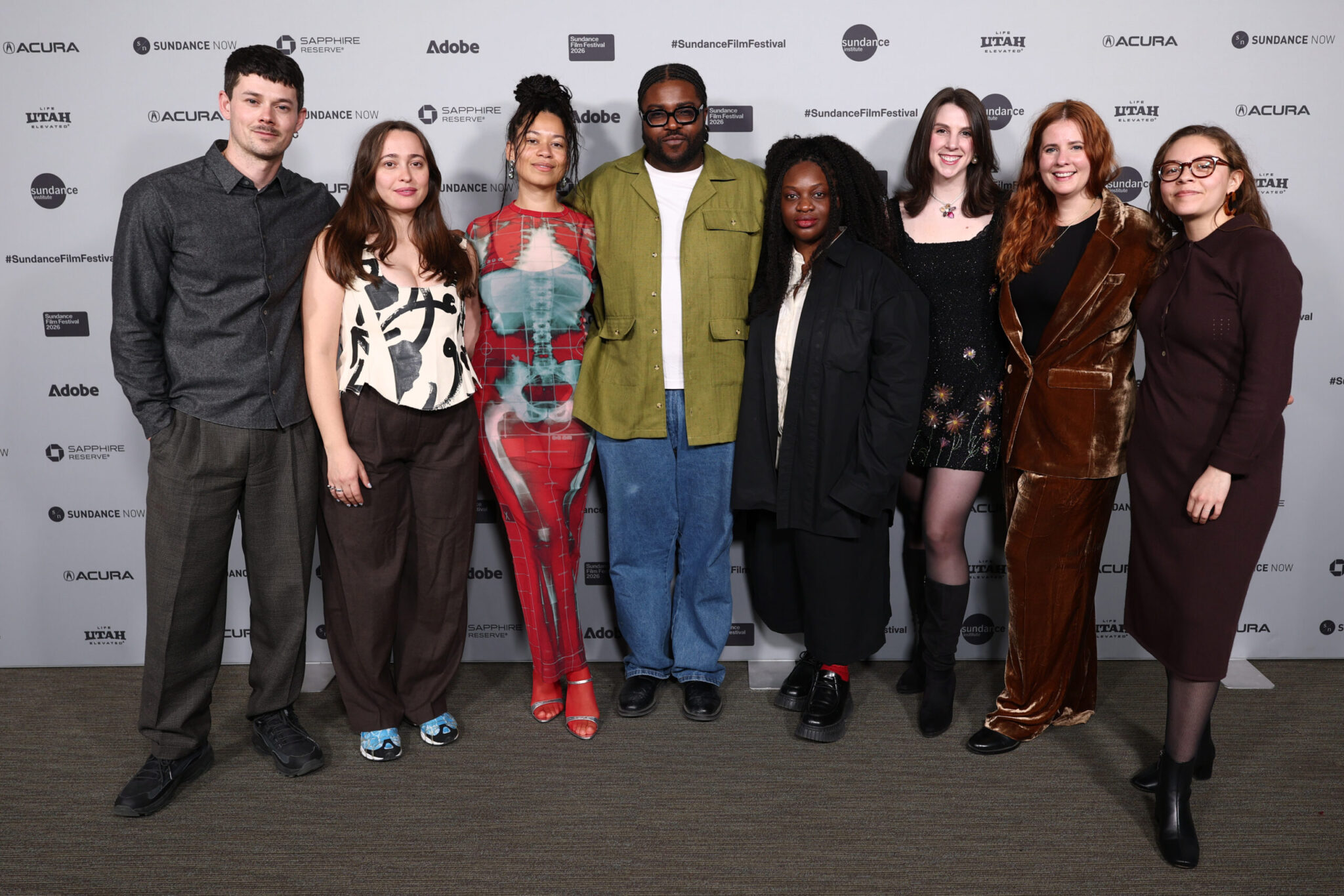
(L-R) Matthew Puccini, Amandine Thomas, Chloe Leigh King, Will Niava, Praise Odigie Paige, Anna Baumgarten, Ana A. Alpizar, and Diana Sánchez Maciel attend Short Program 5 during the 2026 Sundance Film Festival at the Library Center Theatre on January 26, 2026, in Park City, Utah. (Photo by Cindy Ord/Getty Images)
By Cecilia Santini
The films of Short Film Program 5 span countries and genres, with subjects both weighty and helium-filled. But all of them are deeply personal to their directors, as they shared in the Q&A after the program’s premiere at the Library Center Theatre on January 26. This collection of films looks at absence and grief, the complexity of familial and romantic relationships, immigrant experiences, and how balloons make everything better.
In Birdie, a family of Nigerian refugees lives in a quiet Virginia country house in 1970. The devoutly Catholic mother (Sheila Chukwulozie) and her two teenage daughters (Eniola Abioro and Precious Maduanusi) wait for word about the girls’ father, a soldier who stayed in Nigeria, not knowing if he’s alive. A background noise of hummed hymns and fuzzy radio broadcasts accompanies beautifully composed shots of the family going about their new life, framed by doors, windows, mirrors, and the Virginia countryside.
“I was thinking about my immigration experience coming to the U.S. in 2003,” says writer-director Praise Odigie Paige, who was born in Nigeria. “I was thinking back to my sister and I — it was kind of this really awkward and confusing experience living in this period of uncertainty and growing into new bodies while we were going into a new country. … I was really drawn to telling a story about a particular migration period that we don’t know much about, which is late ’60s, early ’70s. There was this huge wave of African immigration to the U.S. … I wanted to explore what it might have felt like for them, mourning this old life while trying to figure themselves out in this really strange place.”
Jazz Infernal, which took home the Short Film Jury Award for International Fiction on January 27, is also an immigrant story about the absence of a father. In this short, a musician (Ange-Eric N’guessan) gets lost in Montréal immediately after arriving from the Ivory Coast. As he navigates public transit and gets caught up with a chaotic-but-well-meaning Québécois (Alexis Belhumeur), he carries the memory of his late father, a famous jazz musician, with him in the form of his trumpet.
Director and co-writer Will Niava explains the partially autobiographical origin of the film: “I immigrated to Canada about 15 years ago and I wanted to tell a story about my first day in Canada. Though this story’s not exactly mine, it is the story of many people who immigrate anywhere. … [Quebec] is a place that kind of inspired me to get out of my shell. … But then my father passed and I felt the need to release my grief through this medium, through art. It’s a love letter to him.”
Meanwhile, a very different kind of father-child relationship is the subject of DON’T TELL MAMA, which looks at a difficult dinner between a 16-year-old Black girl (Jordyn Jenkins) and her white Montenegrin father (Uliks Fehmiu), who’s separated from her mother. The father’s insensitivity and the daughter’s discomfort unfold over a tense 10 minutes.
“I wanted to make a film about the dynamics between a father and daughter,” writer-director Chloe Leigh King explains. “I wanted to tease out the nuances therein and create and share a very intimate and personal world that is very autobiographical to a certain extent. Really I wanted to add something into the zeitgeist about father-daughter films that I’d never really seen depicted before, particularly in interracial stories — I feel like they often can be … very oversimplified … and I wanted to really just layer in a lot of the darkness that exists in that dynamic quite often, at least in my experience.”
The complexities of parent-child relationships are further explored in Norheimsund. In this short, a young Cuban woman (Paula Massó Varela) develops an online relationship with a European man, encouraged by her mother (Yaité Ruiz), only to find out how transactional the relationship really is. Her hopes and dreams are tied up in the relationship, as are her mother’s, and this adds to her pressures and disappointments.
Cuban writer-director Ana A. Alpizar provides context for the story during the Q&A: “Unfortunately, these kind of stories are very, very common in Cuba. Cuba has been a sexual destination for a lot of tourists, especially from Europe. … It’s a country [where] the median salary is around $10 per month, so you can imagine how much of a difference it would make, someone that comes with euros or dollars. For these girls it’s a possible escape from Cuba and could definitely be a better life for them and their families. All the women that I’ve met — my friends from college, from high school — they were the inspiration for this film.”
Class also rears its head in Callback in a very, very different context. Max (Justin H. Min) and his boyfriend, Will (Michael Hsu Rosen), are both aspiring actors. But when Will books a callback, jealousy and unspoken resentments in the relationship surface. Will is wealthy, while Max buses tables, and Max can’t disconnect Will’s acting success from his material privilege.
This is another story drawn from real life, as writer-director Matthew Puccini tells the audience at the Library. “I was in a relationship that had some similar dynamics — this was a much more heightened version,” he says. “I was really interested in exploring how ambition and class and jealousy can start to corrode a relationship. And particularly in queer relationships how our partners can sometimes be our mirrors and what happens in that scenario. And I also just wanted to make something really fun and crazy.”
That might also be an apt description of Balloon Animals, a sweet, funny depiction of how strangers and dark humor can unexpectedly be a salve for grief. A friendly pair of bored grocery store workers (Angela Giarratana and Izzi Rojas) lift a woman’s (Kelsi Roberts) spirits when she shows up after hours to buy some balloons from them.
The movie was inspired by writer-director Anna Baumgarten’s experiences promoting her first film, Disfluency, which she describes as a “traumedy.” During that tour, she says, “I was having serious conversations about personal trauma with strangers. People of all ages, genders, everything were telling me things that they’d maybe never told anybody. I had disclosed things that I had never told anybody in these beautiful little conversations with strangers. And sometimes it was awkward and sometimes we laughed really hard and made jokes we would not make with other people. So that’s how Balloon Animals was born.”
An encounter between strangers is also central to Albatross, a moving look at the loneliness and exhaustion of a woman (Georgina Saldaña Wonchee) caring for her husband (Patrick O’Brien), who has dementia. When she encounters a fellow Mexican (Ciro Suárez) in a parking lot, her longing for connection is brought to the surface.
“I have a very strong personal connection to caregiving. My mother is my father’s primary caregiver,” Amandine Thomas, who directed and co-wrote the film, says. “I was really interested in exploring, together with my co-writer Gerardo [Coello Escalante], this kind of transition in a romantic relationship from being a romantic relationship to something else, and the kind of shame of a caregiver yearning for connection in her life.”