




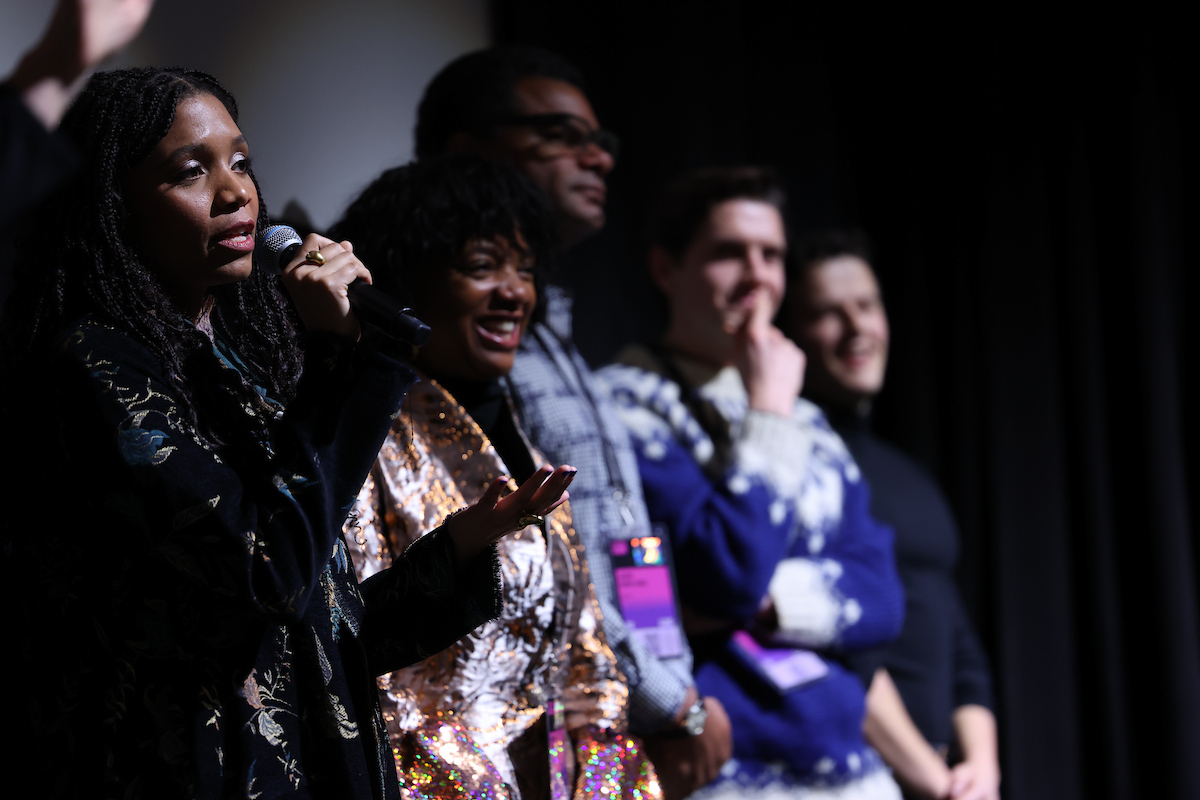
(L-R) Olive Nwosu, Ollie Mayo, Stella Nwimo, John Giwa Amu and Alex Polunin attend the Q&A for LADY by Olive Nwosu, an official selection of the 2026 Sundance Film Festival. (© 2026 Sundance Institute | photo by Lauren Hartmann)
By Ramona Flume
The sold-out crowd at the Library Center Theatre was transported to the sprawling seaside city of Lagos on January 22 for Olive Nwosu’s brilliant debut feature, LADY, which immerses audiences in the emerging African metropolis through the eyes of Lady, an independent woman who works as a taxi driver. In fact, the initial vibe felt more like a party than the World Cinema Dramatic Competition premiere of a film.
Festgoers socialized, hugging and calling out to one another while slipping off scarves and meandering in the aisles as volunteers gently urged everyone to get settled to avoid a late start. Sounds of Lagos street traffic played over the theater’s sound system, and the hustle and bustle of rush hour noise made for an appropriately lively backdrop as last-minute waitlist and film team members were ushered to their seats.
All noises ceased, however, when the calming presence of director Olive Nwosu appeared onstage to introduce her film. “We’re seated in a library — a place of record, memory, history, and wisdom,” the Lagos-born, London-based filmmaker says in almost-hushed tones. “This film is a bridge into a female, African way of seeing the world, and LADY is made with women who hold history, and record, and wisdom in their bodies. This film was made for them. Some of the women who made this film cannot be with us tonight. Art travels across borders more easily than the bodies that make it. But we are celebrating in Lagos tonight.”
Lagos is certainly a central character to Nwosu (who was born and raised there before moving away at age 16) and her new film. “I wanted to reconnect with the city and tell a story from the inside of it — from the point of view of a young woman who’s finding her way through the city,” she says, describing the second largest city in Africa as a complex place that brings up complex feelings. “There is so much potential and energy and youth and so many brilliant young people — and at the same time, the city is a difficult place, clearly.”
With LADY, Nwosu’s aim was to paint the charged, cosmopolitan city of her youth with a colorfully bold brush and at the same time, not turn away from its ugly underbelly. In the film, Lady’s world is beautiful but fraught with struggle; surrounded by dynamic characters, unsettling situations, and radical friendships with a small clique of sex workers (all played by superb Nigerian actors) who she begins working for as a private driver.
Throughout the film, we see Lady, played by a transcendent Jessica Gabriel’s Ujah, scrimp and save to obtain a one-way bus ticket to Freetown (a personal idyll, but also an actual beach town in Sierra Leone) amid a hardscrabble city that is suffering under an oppressive regime beholden to international interests. And the resulting plot centers around the ways in which Lady, her female compatriots, and Lagos as a whole transform as they insist on finding and fighting for their own freedoms.
Her taxi cohorts band together early in the film, joining protests against the rising prices and fuel subsidies that are sparking unrest across Lagos, but Lady is determined to find her own way to freedom. Set in a time when the average Lagosian had to choose between breakfast and lunch, Lady wants to find a way to have it all — her way.
She accepts a better paying (but more dangerous) job as a private driver, and we watch as her exploits propel her closer and closer to a greater personal and collective consciousness. Narrated in part by DJ Revolution, the clarion call speaking through Lady’s car stereo throughout the film, we hear the rising urge for the youth of Nigeria to decolonize their minds. (“Let us never forget that this country, our Motherland, was formed of subjugation. It has remained, and will remain a land of subjugation. It is up to us, this generation, to finally awake.”)
Immediately following the film’s credits, a pre-taped set of interviews with “The Women of LADY” who couldn’t be at the Park City premiere played to hearty cheers and applause from the crowd. Each of the film’s stars, starting with Jessica Gabriel’s Ujah, introduced themselves and stated who they’d like to personally dedicate the film to — from their mothers to the younger versions of themselves. It was a great surprise and tribute, alluding back to what Nwosu said in her intro: “Art travels easier than the bodies that make it.” The audience cheered in excitement at each of their favorite performers as they beamed onscreen from around the world.