




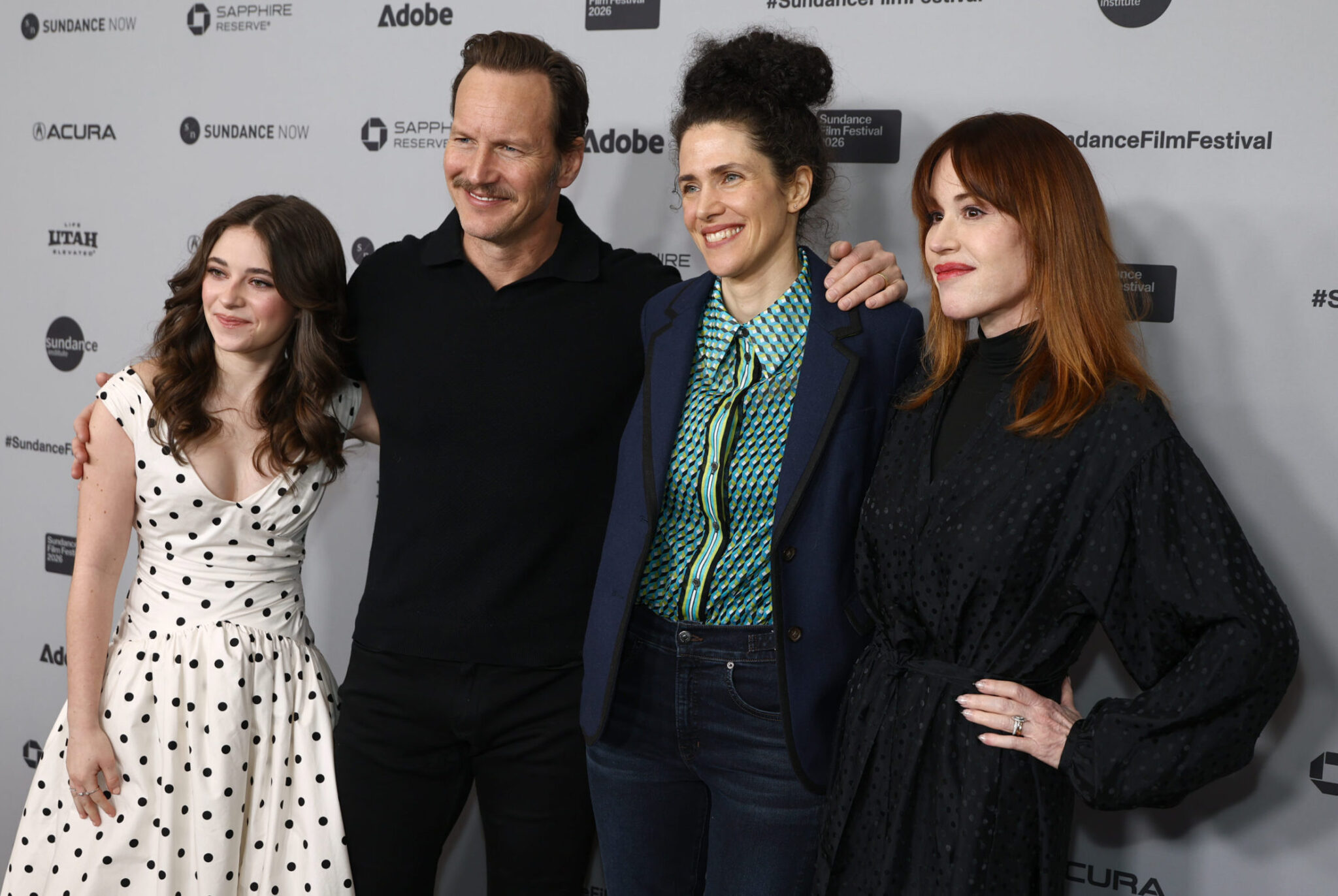
(L-R) Alyssa Marvin, Patrick Wilson, NB Mager and Molly Ringwald attend the “Run Amok” Premiere during the 2026 Sundance Film Festival at Eccles Center Theater on January 26, 2026 in Park City, Utah. (Photo by Arturo Holmes/Getty Images)
By Adam Silverstein
How do you make a movie about a high school shooting — and then turn it into a musical? That’s the question Run Amok dares to ask, and improbably, powerfully answers. Premiering in the 2026 Sundance Film Festival’s U.S. Dramatic Competition at the Eccles Theatre, NB Mager’s film is messy, funny, devastating, and oddly hopeful, all at once. It shouldn’t work. It really does.
The premise alone makes the room tense. A decade after a deadly school shooting, a group of high school students stage a musical about the day their town wishes it could forget when three students and a teacher lost their lives. The attacker was killed by Mr. Shelby (Patrick Wilson), a teacher who has since become a local legend. For Meg (Alyssa Marvin), the student at the center of the film, the trauma is personal: her mother was the teacher who died. The musical is Meg’s idea — not as provocation, but as catharsis.
Marvin plays Meg with a rawness. She’s sharp, awkward, funny, and visibly carrying emotions she can’t yet fully process. The film nails the texture of high school — drama kids especially — with uncanny accuracy. There are dark comedy beats that land hard, including an intentionally inappropriate needle drop of “Killing Me Softly” that draws laughter from the audience.
Meg isn’t trying to recreate what happened so much as understand it — and understand her mother, who now exists only in fragments and memory. Her resentment bubbles up in strange ways, sometimes misdirected, sometimes unfair, always human. Molly Ringwald, who plays Meg’s aunt, offers a soft counterpoint.
Wilson, both a producer on the film and a presence onscreen, grounds the story without centering himself. Shelby supports the musical instinctively, even as the school’s principal (Margaret Cho) pushes back, worried about optics and backlash. Elizabeth Marvel is chilling as the shooter’s mother, a woman shattered by grief and shame.
The musical numbers are scrappy, earnest, sometimes off-key — exactly as they should be. The film goes to tough places without flinching, examining America’s gun culture, the normalization of violence, and the strange rituals we build around grief. There’s even a pointed joke about a PTA evolving into a “Parents Teacher Arms Association,” which lands with a bitter laugh.
During the introduction, Mager explains what led her to the project. “There’s something so uninhibited and bold about young people at this stage of their lives,” she says. “I knew I had to tell a story that meets our current moment.”
By the time the credits roll, the room feels wrung out but strangely uplifted. In the Q&A, Mager talks about how the character of Meg arrived “fully formed” and how much research went into approaching the subject from a new angle. Marvin echoes that sentiment, describing long conversations with Mager about Meg’s interior life. “I see a lot of myself in her,” Marvin says. “It all flowed together.”
Wilson gets one of the biggest reactions of the night when he explains why he wanted to be involved. “I don’t want to hear adults talk anymore,” he says. “I want to listen to the people going through it. This is the generation growing up normalizing lockdowns. We have to listen to the kids.”
Run Amok doesn’t pretend a musical can fix America’s epidemic of gun violence. What it suggests instead is that allowing students tell their stories — even awkwardly, even painfully — might be a place to start.