




Why does this story need to be told now?
People have said to me throughout this process, “It’s so relevant, especially now.” Unfortunately, it has been relevant for a long time. But I hope this film can be part of a different kind of discourse around violence and grief.
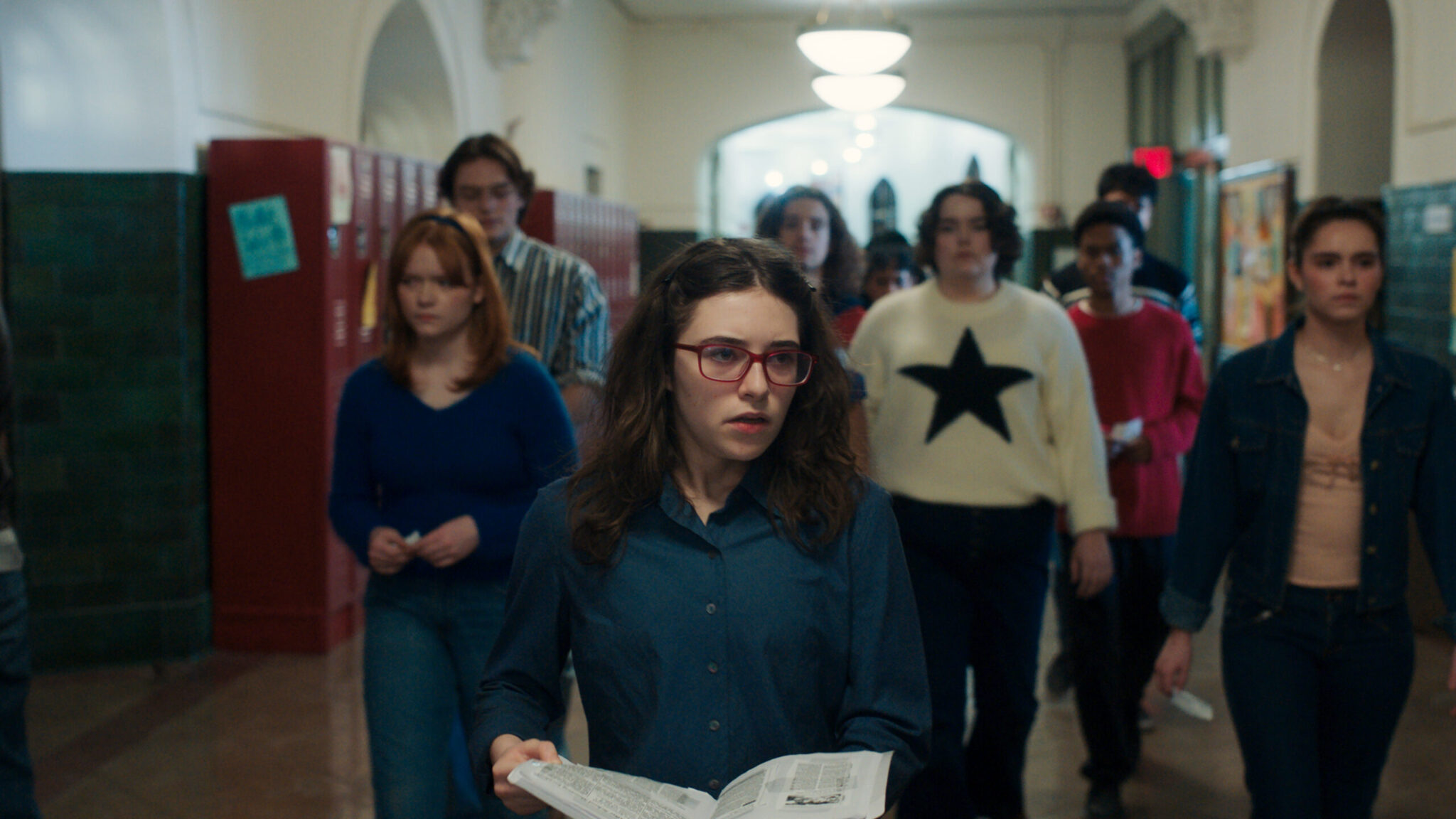
Because while the film explores those things, it doesn’t wallow in them. It allows these ebullient, effervescent kids to lead the conversation, and they’re unstoppable. They insist on honesty, bravery, and hope.
Describe who you want this film to reach.
You’re not really supposed to say you want your film to reach everyone, as it sounds overly broad and possibly self-important. But I did want this story to have a real openness, especially because it deals with a challenging issue that has become more divisive than I think it needs to be. And, back to the original inspiration: young people were always at the forefront of my mind in making this. So if there’s one particular group I hope this reaches, it’s them.
Tell us an anecdote about casting or working with your actors.
I was fortunate to have rehearsal time with my actors — something I value deeply, coming from a theater and acting background myself.
Patrick Wilson, despite his very busy schedule, came to rehearse with Alyssa Marvin in preproduction. That relationship is so central to the film, and being in a room with the two of them, reading the script, talking through moments, getting it on its feet, was incredible. They’re both powerhouses. The rapport and trust we built there showed so much on set. It brought a real immediacy and tenderness and sometimes explosiveness to their scenes.
We also had a full day of rehearsal with all the kids in the cast, in the same theater space where we filmed. It was such a blast. We did improvs of them in character, interacting, forming this band of beautifully misfit energy. I felt like I was watching them come to life, the whole world of the film coming alive in front of me. I was laughing hysterically and also crying, which sort of sums up the film.
What was your favorite part of making Run Amok? Memories from the process?
Every day on set felt like a gift, even when we were on a below-freezing suburban street in February. There was this incredible energy, a willingness to figure things out, stretch creative muscles, and leave it all on the court. When you show up each day knowing you’re surrounded by that level of talent and enthusiasm, you can’t ask for more.
On our very first day, my first time directing at this scale, we stood in a giant theater for the safety meeting. Afterward, it was my turn to stand before this huge crew. And what I did was invite everyone to do the “making a movie” dance. It’s a dance anyone can do, even the naturally uncoordinated like myself: you hop around and flail your arms while chanting “making a movie.” And everyone joined in. It set the tone: it’s ok to look ridiculous, to be vulnerable. We’re doing something big and serious, but we’re also here to have fun and do something we love.
What was a big challenge you faced while making Run Amok?
Production is inherently exciting and inherently challenging. It is fast-paced, physically relentless, full of moving parts. It takes a whole group pushing the boulder up the mountain together.
But once production wraps and everyone goes home, you suddenly find yourself in a quiet room with one other person: your editor. That’s a different kind of hard, but also one of the most rewarding stages. You’re rediscovering your story. It’s like meeting someone you knew so well, but now they’ve changed. You have to get to know them again and help them become their best self.
It really does feel like being the movie’s therapist or life coach. You’re asking the film: Who are you? No, who are you really? Why are you like this? What do you want? And then you have to listen. Similar to writing, but now you’re not alone in the room.
Tell us why and how you got into filmmaking.
I got into filmmaking when I was around 11 or 12. A friend of mine’s dad was an aspiring actor, so she knew what I didn’t yet know: that people actually make movies. They don’t just appear fully formed. That was groundbreaking. She and I, and a few other friends, started making little movies together.
Then I started making films for school projects, a mock 20/20 episode for science, a puppet adaptation of Things Fall Apart for English, a live-action As I Lay Dying. At some point, I committed myself fully to acting, which I studied and pursued professionally first. Partly because I didn’t know of many women directors (representation matters!) and partly because acting was an enormous challenge for someone as in-her-head as I was. I love a challenge.
Studying acting, learning to live truthfully in imaginary circumstances, cultivating empathy with your whole self — that absolutely informs who I am now as a director and writer. It lets me give my actors everything I once wished for from a director. And it helps me feel collaborative decisions viscerally, from production design, to camera movement, editing, and score.
Why is filmmaking important to you? Why is it important to the world?
A poetry teacher once gave us a simple prompt: Write about what you don’t understand.
For me, that’s what all art is — a way of grappling with what you don’t understand, or what you want to understand. And unlike in other fields, art has no obligation to provide answers. You can pose a question and explore it from every angle, maybe discover a hypothesis, but still leave the audience with the question even after the movie ends. You’re not there to teach them a lesson. You’re there to wonder and to stay curious and kind.
Film, specifically, has both immediacy and accessibility. It invites audiences in with such openness: come into this world, spend some time with these people, and let’s watch them be human, just like us.
What is something that all filmmakers should keep in mind in order to become better cinematic storytellers?
Be open to your collaborators. Be prepared, trust your instincts, and then stay open. Filmmaking is fundamentally collaborative. It’s “yes, and.” When you see your cast and crew as a kind of roving theater troupe, so many more possibilities emerge. Incidentally, “theater troupe” was something the kids in the cast would periodically scream in unison throughout filming.
What was the last thing you saw that you wish you made?
When I was younger and first discovering the kinds of films that inspired me, I’d watch something I loved and think, I wish I had made that. There was a formalism to it. I wanted to be able to do what they did. Films like All About My Mother, City of Lost Children, Eternal Sunshine of the Spotless Mind, Adaptation, Y Tu Mamá También, Pan’s Labyrinth, and so many others.
And then I watched Parasite. By then, I was further along in my own path, and for the first time, I didn’t think, “I wish I had made that.” I thought: I am so incredibly grateful that this exists. I literally weep with gratitude for films like that — for the years of work, self-inquiry, and rigor they require from their creators, all in service of giving the audience this singular experience.
My wish now is to make a film that does that for someone else.
Who was the first person you told when you learned you got into the Sundance Film Festival?
My mom. She happened to be visiting and standing right next to me when the call came. I felt like a little kid, thrilled, and also like a grownup who could finally say, “Look, I know it seems like I don’t have a stable life or career, but these people think I actually know what I’m doing!”