



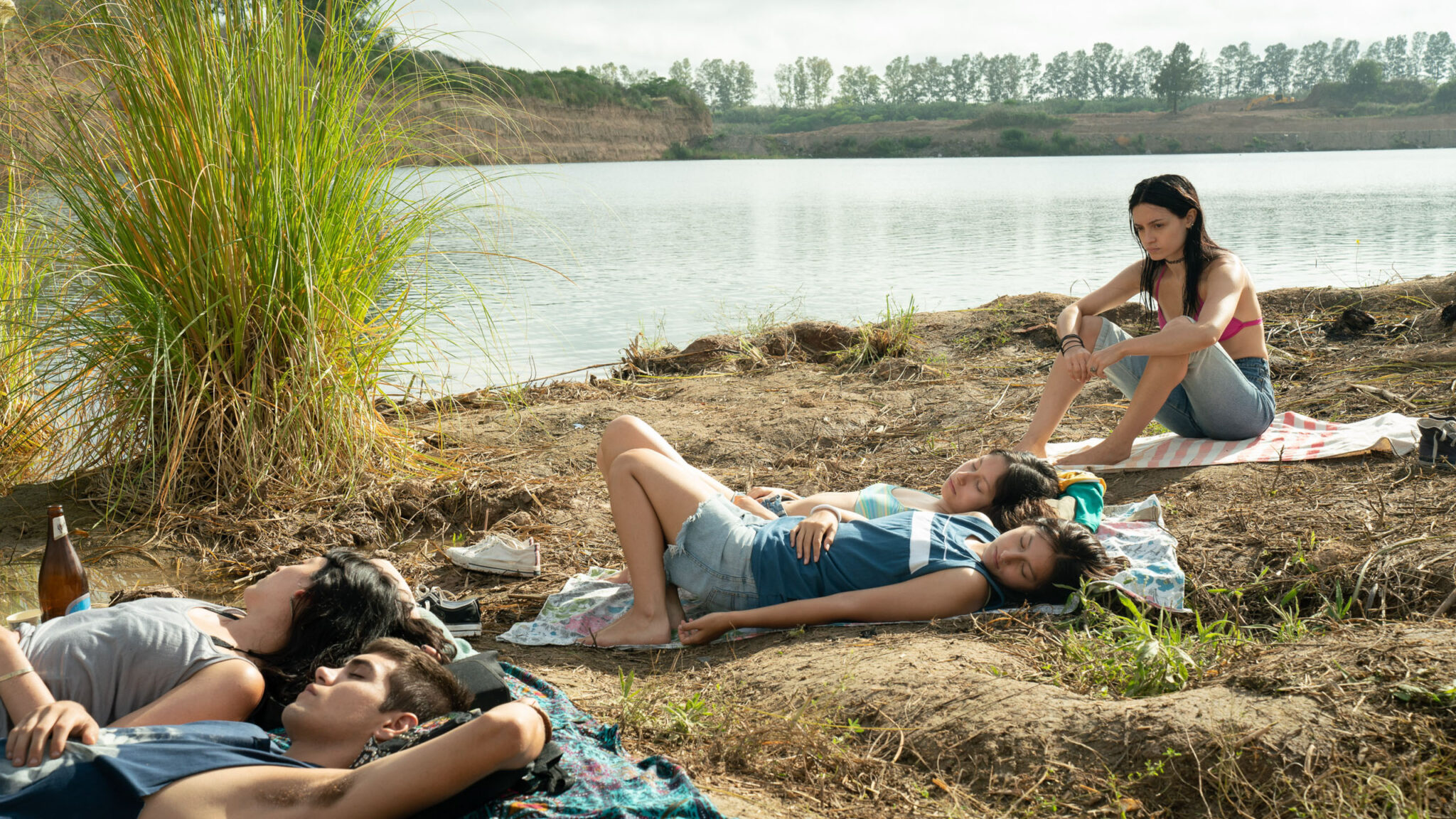

What was the biggest inspiration behind The Virgin of the Quarry Lake?
On the one hand, it was reading the stories of Mariana Enríquez and feeling aligned with her way of seeing the world and her characters, especially her female, teenage characters, who are intense, possessive, bold, and strange. I also connected with the way she expresses female desire. And on the other hand, something specific that really drew me to these stories is that they inhabit this boundary area — occupying a liminal zone where the ordinary and the paranormal merge and become tangled together and confused. I think that’s kind of like the way I interpret the reality we live in.
I am also inspired by classic, genre movies and the stories of Stephen King. Probably most specifically, by Carrie. Finally, I was dying to make a film about teenagers during the 2001 crisis in Argentina and to tell the story of how my generation, which is the same generation as the girls in the film, experienced that time.
Films are lasting artistic legacies. What do you want yours to say?
Honestly, that’s a hard question for me to answer because making a film is a long, complex process and for me, it’s more to do with instinct. It’s something more visceral. It often happens that you know what you want to say and how you want it to look, but then you start asking yourself why you wanted to tell the story in that way. That’s why it’s hard for me to think about it in terms of what the legacy of the film will be.
It also triggers different things in different people and within that dialogue, who knows what might come up? The film might be about a moment in this girl’s life, in a particular place in the world, but the drama she’s going through is common to everyone, just like we all have those dark sides to our nature. So shedding light on that can be kind of cathartic. I think that’s the great thing about the language of genre films. I’d like it to express what it’s like to be a girl from the suburbs who gets her heart broken in the middle of a social crisis and how tough that can be, but also how sexy it can be.
I also think that even though this is a film set in a specific time, there may be something about that reflection of the past that rings true in the present. It’s a film that also talks about how we naturalize violence because we live in a very unequal, individualist system. That violence is part of our daily lives and if we are constantly bombarded with horrific things, then logically we end up becoming too numb to it. Within this process, we turn the other into the enemy and make them responsible for all our problems —almost as a kind of defence mechanism — and that is very dangerous. I think some of that resonates in the present.
What was your favorite part of making The Virgin of the Quarry Lake?
What I enjoyed most about making this film was working with the actors, this gang of young kids. I was surprised at how methodical and hardworking they were. They really gave it their all. I also really enjoyed working with the group of friends I always work with and during the shoot. Working with Diego Tenorio, the Director of Photography, was really stimulating. We just really understood each other. It was a challenging shoot, though.
We were on a knife-edge the whole time because of financing and the current financial crisis in Argentina and its inflationary process. The film was at risk of not getting finished several times! But I always thought that if [Francis Ford] Coppola could do it with Apocalypse Now, I had to be able to do it with this! Ha!
The best day was the scene in the dive bar, the Nicky Novak, which is a place that really existed in Buenos Aires in my 20s. We wanted to recreate that same atmosphere. When the day came to shoot that scene, we were all really tired, but we decided to do a continuous shot to give it continuity and make the performance more organic and it turned out great! We danced all day and the crew and the actors really enjoyed that party!
Why does this story need to be told now?
Because it represents a young, Latina girl who’s living in a violent time, in a violent and charmless reality, and who is obliged to fake some kind of sanity. Because it talks about the mystical and transcendental value of women’s friendship.
Tell us why and how you got into filmmaking.
Originally, I was more interested in literature. I’ve always been an avid reader and from a very young age, I knew that what I enjoyed most was escaping from reality by inventing stories, which I’d write down in my notebooks. When I was little, every Sunday, my dad would take my brother and I to the cinema. It was a way of keeping us entertained. It wasn’t too expensive and because we used to go to the matinee screening, my dad could take a nap, which he always did and he even used to snore! Thanks to that, I grew up watching films every week. Over time, I got my friends to join in experimenting with the camera my dad had bought me. Since I was 20, my camera has been an extension of me.
Why is filmmaking important to you? Why is it important to the world?
It’s important to me because, in a way, it’s the driving force behind my days, behind my existence. I don’t know what it’s like not to be thinking about a film, or making a film… By now, it’s become part of the air that I breathe. I don’t know what will happen in the future, whether it will always be this way, but it’s the way it has always been up until now.
Cinema is important because it builds memory and because it explains our stories. And also because it allows us to escape from our daily lives for a few hours and enter into a deep, meditative state, which perhaps connects to that which we call the soul. It also allows us to reflect upon our own selves and our own nature, because it offers us different perspectives and ways to view the world, which could be similar to our own, or contrary.
And let’s not forget that film can be an arrow that is shot into the future. I know about the history of my country and of my ancestors because I’ve seen films about it and when we look to the past, it serves for us to reflect and to construct a present. Film represents our collective memory and it ties worlds and people together. That’s why it’s important for it to be diverse and heterogeneous.
What is something that all filmmakers should keep in mind in order to become better cinematic storytellers?
I suppose getting over the fear that all stories have already been told, which is something you hear a lot. And the prejudice about what you should say and how you should say it. I think we should think about this profession as something playful, because when we play is when we feel our best. I also think we have to question somewhat the idea of the author as the most important person and start thinking of filmmaking as a collective creation. The more you welcome the team into the creative process, the more enriched the film will become. So, I think the best thing filmmakers can do is to be open to the idea of working with their own ideas and with the ideas of others, understanding that it is within this synergy that the authorial entity resides and lives.
Which of your personal characteristics contributes most to your success as a storyteller?
If I look back, I wouldn’t choose to quit college again. But I do think that my somewhat eclectic and chaotic work experience (working in video stores, reading books, I worked as a camerawoman for several years on a tabloid documentary TV show when I was 20, then I worked on the party scene until I was 25) was both disadvantageous and advantageous.
On the negative side, it meant I was really lacking a lot of information about how to make a film and had to learn by trial and error. But on the positive side, not having a model of how I was supposed to do things meant that I didn’t have any prejudice and wasn’t doing things just because I thought I should. I think I’m a natural risk-taker, because what other people consider risky just doesn’t seem that way to me. My work as a young woman on that type of documentary TV and in nighttime parties saw me navigating dive bars, counter-cultures, mysterious worlds… and I think that has informed my view of the world and made it more oblique, more from the margins.
I also think my enthusiasm can be contagious, which is a very good trait to have.
Tell us about your history with Sundance Institute. When was the first time you engaged with us? Why did you want your film to premiere with us?
Of course I’ve always been aware of the Sundance Film Festival, but I hold it in such high esteem that honestly, I was really surprised that my film was selected. I really wasn’t expecting it! But it’s so exciting and I think slowly, it’s sinking in! Sundance is synonymous with cinema that’s risky, visceral, countercultural, that doesn’t respond to the needs of the market.
This is exactly the kind of cinema that I love and that I used to watch in the early 2000s when I was 20 years old. It’s the type of cinema that represents me and I believe that those independent movies that I used to watch in movie clubs in Buenos Aires (Reservoir Dogs, Blood Simple, Pi, [films by Richard] Linklater) had a huge influence on the aesthetic of the film we’re presenting in the way we portray the suburbs of my city and the generation of kids in 2000. Our film references and has a lot to do with those North American independent movies, most of which were from the start of the millennium. They were also the kinds of movies that we saw in the movie clubs and festivals in Buenos Aires and they’d all been premiered in festivals like Sundance. So I like to think that maybe this is the natural home of La Virgen de la Tosquera.