



Photo: Jonathan Hickerson
Sundance Institute
Sndance.org is dispatching its writers to daily screenings and events to capture the 10 days of festivities during the 2016 Sundance Film Festival in Park City, Utah. Check back each morning for roundups and insights into our experiences throughout the Festival.
Little Men
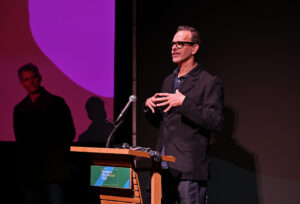
As John Cooper mentioned before the world premiere screening of Little Men at the Eccles Theater on Monday night, this marks the sixth time that director Ira Sachs has presented a film at the Festival, the last being Love Is Strange in 2014. And as Sachs mentioned in response, his relationship with Sundance goes back to 1988, when he visited as a 14-year-old, before it was called Sundance, and before even Cooper was in the fold.

The new film is the third in what might be considered a trilogy of films set in the intimate spaces of New York apartments, this time chronicling the difficulties between a new-to-Brooklyn family and the shop keeper tenant they’ve inherited from patriarch Brian’s (Greg Kinnear) recently deceased father. While the adults work through the realities and personal costs of gentrification, their early teenaged sons Jake (Theo Taplitz) and Tony (Michael Barbieri) become fast friends, and try to bridge the gap. Their relationship becomes the heart of the film.
“For me the film is very personal. Partially because of the memory of being young, but also from the questions that I found I have to ask myself all the time, particularly as a parent,” Sachs said. “How to be good people, how to be good parents, and how to love and take care of the people we love. There’s no winner, there’s no loser, there’s no victim or bad guy. It’s just questions of how we live together. And it was really wonderful to be able to examine those questions with this group of people.”
Sachs talked about the process of finding that group of people – which included actresses Jennifer Ehle and Paulina Garcia – particularly how they found the right people to play junior high school aged boys. The casting of Taplitz, who sent a tape from L.A., came first. “The first moment we saw the tape we were like, that’s it. Because it actually felt like we were watching a documentary about a boy at the very moment that we wanted to capture,” Sachs said. Meanwhile, open casting calls were also being held in New York. “We sent an email to the Lee Strasburg school, which does a lot of work with young boys and girls, teaching acting. Michael came in, and it was a bit of a problem because he came in to read for Theo’s part,” Sachs said. “I said switch scripts, read the other side. And he read the material and I was just really so taken with him. And they were wonderful together. They’re the easiest two actors I’ve ever worked with.”
“What’s that supposed to mean?” Kinnear said, jokingly staring down Sachs. “We certainly had a lot riding on these two guys.”
“Movies that I love about kids, like Kes, or The World of Henry Orient, or Mes Petites Amoureuses by Jean Eustache – which is a big film for me – it’s always the kids you remember. And really it’s not about exactly their acting, it’s about who they are. Some element of them will stick with you for a long time. I try to find kids that will stick in your mind and memory and somehow remind you of being young.” Sachs’s interest in his two actors extended to tweaking the script that he wrote with Mauricio Zacharias to reflect the real lives of Taplitz and Barbieri.
“I generally work closely with the script that we write, but I also try to think about the actors I’ve cast and see how I can shift it to make it closer to them. Michael was obviously a natural actor, and he wants to go to LaGuardia High School for the performing arts,” Sachs said, which then became the ambition for the character of Tony. “There were certain things that we took from life that transformed the script very subtly but I think importantly.”
“Michael, I’m feeling very good about you getting into LaGuardia,” Kinnear said about his young co-star, who drew the loudest applause during the post-screening introductions. “I’ve got a good feeling about it.”
Halal Love (and Sex)
By Jeremy Kinser
Lebanese writer/director Assad Fouladkar’s progressive romantic comedy Halal Love (and Sex) depicts a trio of lovesick Muslim women in Beirut as they search for personal happiness and fulfillment. The film premiered at the Prospector Theater on Monday.

Fouladkar begins his story, very appropriately, during a sex education class at an all-girls school as a young student becomes traumatized when she misunderstands that worms called “Alaka” make babies after they crawl into the female. She convinces her younger sister that they must wear plastic bags to bed to avoid getting pregnant. It’s an uproarious gag that continues to play out over a few scenes throughout the film.
In the main story threads, the girls’ exhausted mother, Awatef, begins a search for a second wife to help meet her husband’s sexual demands. Quarrelsome newlyweds Batoul and Mokhtar repeatedly threaten to divorce over the husband’s intense jealousy. Sultry divorcee Loubna is optimistic about a second chance with her first love, Abu Ahmad, through a temporary marriage.
During a post-screening Q&A, several audience members expressed surprise at the modern relationships depicted in the comedy and asked for more clarity on the unconventional and surprising take on marriage and divorce among Muslim couples. Actress Darine Hamze, who starred as Loubna, helped elucidate saying that some Islamic rules favor females. “Temporary marriage was made for women because they have sexual needs,” she informed, adding that Muslim women can also ask for divorce if it’s been written into the marriage contract.
“I’m so proud to be in this movie because it shows the other side, the human side, that women are equal,” Hamze shared. “They all have desires, wishes, emotions, love affairs, broken hearts. This is what I like to see because art unites us all and it shows you real images of women.”
Sensing the audience’s surprise at the frank depictions of his female protagonists, Fouladkar revealed that he’d taken some inspiration for his clever, knowing script from his own childhood. He noted that when women meet with each other, they discuss sex in an open manner. “Men are not allowed in the circle, but children are,” he said. “[As a child] I was allowed in and held on to these memories.”
Michael Jackson’s Journey from Motown to Off the Wall
By Jeremy Kinser
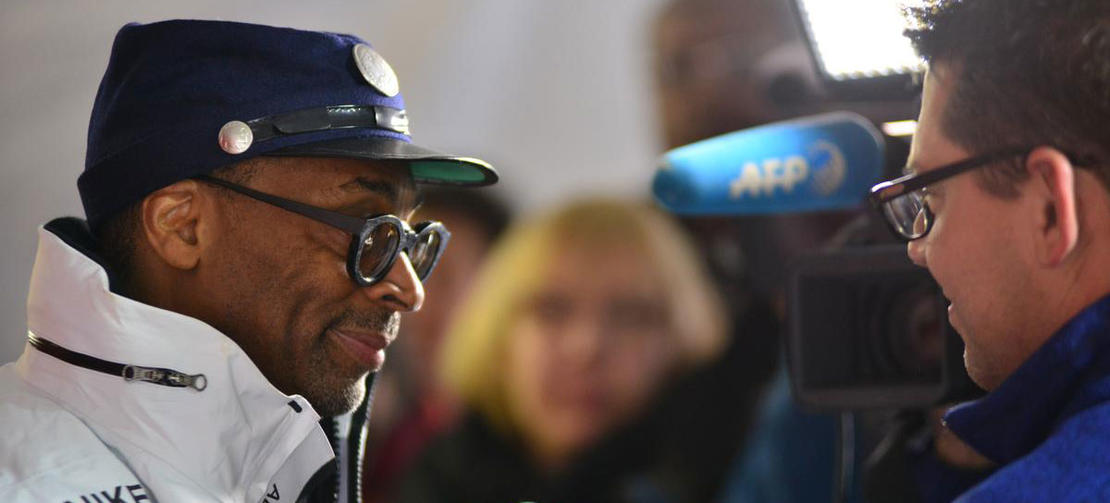
Michael Jackson’s Journey from Motown to Off fhe Wall chronicles the singer’s transformation from boy band frontman with the Jackson 5 to global superstar. The non-fiction film, directed by Spike Lee, screened at the Marc Theatre on Sunday and the Library Center Theatre on Monday prior to its broadcast premiere on Showtime February 5.
At this point one might think there’s little left to uncover about the self-proclaimed “King of Pop.” Yet, with his second film about Jackson (following 2012’s Bad 25), Lee accomplishes something many might deem impossible. For an hour-and-a-half he forces audiences to forget three decades of bizarre antics and lurid headlines and witness Jackson as a peerless performer, inarguably one of the most dynamic singer-dancers to ever take the stage.
Made under the guidance of John Branca, who is executor of Jackson’s estate and has a producer’s credit on this film, don’t expect a warts-and-all portrait. Partly an exploration (track by track) of Jackson’s hugely influential 1979 album Off the Wall, Lee’s chief concern is showing an artist trying to find himself.
Apart from a few curious interview subjects (Kobe Bryant, John Leguizamo, Lee himself) who don’t offer much to elucidate the mystery behind the singer’s personality, it’s compelling to see a bevy of Old Hollywood hoofers such as Fred Astaire, Sammy Davis Jr., and Gene Kelly who tout Jackson as their heir apparent. A multitude of superstars ranging from Stevie Wonder to Pharrell sing his praises as a virtuoso entertainer and illuminate his musical legacy.
One facet of Jackson’s complex personality that becomes apparent during the course of the film is his sheer, relentless drive – a quality often overlooked due to his soft-spoken off-screen persona. Lee uncovers a letter written by Jackson while on tour with his brothers in the late ‘70s in which he details his goals in life. He declares that he wants to leave the boy singer behind and borrow from history’s best entertainers to become a greater entertainer than any of them. With the abundance of archival concert footage Lee showcases here, it’s tough to argue that he achieved his goal.
Complete Unknown

Returning to the Festival for the first time since his debut film Maria Full of Grace took home the Audience Award in 2004, Joshua Marston joked with Festival Director John Cooper about bad blood developing during the intervening years. Implying disappointment over the reception for his previous film, The Forgiveness of Blood, which was launched internationally, Marston said, “I learned the hard way how important Sundance is.” What he came back with is a unique thriller about a woman who’s a master of reinvention, played by Rachel Weisz, who suddenly shows up at a birthday party for the boyfriend, played by Michael Shannon, she vanished from 15 years prior.
“We wanted to make a movie about a woman who was not what she presented herself to be,” Marston said, referring to his co-writer Julian Sheppard, who along with the film’s cast and producers, were on hand for a post-screening Q&A at the Eccles Theater. “We started with an image. If you were at a party and you saw someone across the room who you were certain you recognized but when you met them they went by a different name and a different biography and weren’t acknowledging you – what that strangeness would be. And then what if she changed her identity? And then as we explored that, what if she’d done that more than once? What if she’d done that serially?”
What actress could pull off such a character? Who could convince as a chameleon but also let the audience in on an emotional life? For Marston, all signs pointed to Rachel Weisz. “We needed an actress who could convey both a depth and a mystery, and also an intelligence, that you would believe that she was a polymath, that she was smart enough to do this again and again.” It’s also a delicious role for an actor, since it proposes a character that effectively operates the way actors do. When a member of the audience asked if changing selves is what motivates him, Michael Shannon sounded weary of the process – if also a bit sly about sounding weary of the process.
“I think I’ve kind of got it out of my system. I’m ready to return to Michael Shannon,” he said. “There are a lot of parts I’ve done that I love. I love what I did with Tracy Letts, Killer Joe and Bug. I love what I did with Jeff Nichols, with Ramin Bahrani, and Werner Herzog. I’ve had a nice go of it. But yeah, I think I’m missing myself,” he said, with a tone that suggested air quotes. “Mm-hm.”
But the premise wasn’t just suggestive of the acting process, as Marston related it to the writing process, and to the bold structure he and Sheppard devised for the script. “We weren’t interested in creating a three act structure where 20 minutes into the movie you set up a question, and the whole movie is about seeing if so and so is going to get away with the crime. Rather, we start off in one direction, and at a certain point the movie just takes a left turn, goes in another direction. And then takes another left turn. At a certain level structurally, consciously or not, what we were doing in effect was doing what Alice does. We were just constantly reinventing the movie. The movie keeps changing tone, and it becomes this shape-shifting movie about someone who does just that.”
But he didn’t stop there, extending the theme of reinvention to directing. “To an extent this is autobiographical,” he said. “I got into being a filmmaker because every movie is a sort of anthropology where I get to go into another world and explore something entirely. And what if that was literal? What if literally you didn’t just make a film every few years, you became a whole other person?”