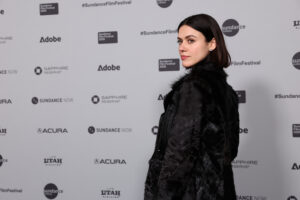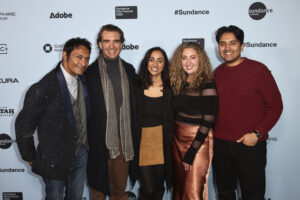




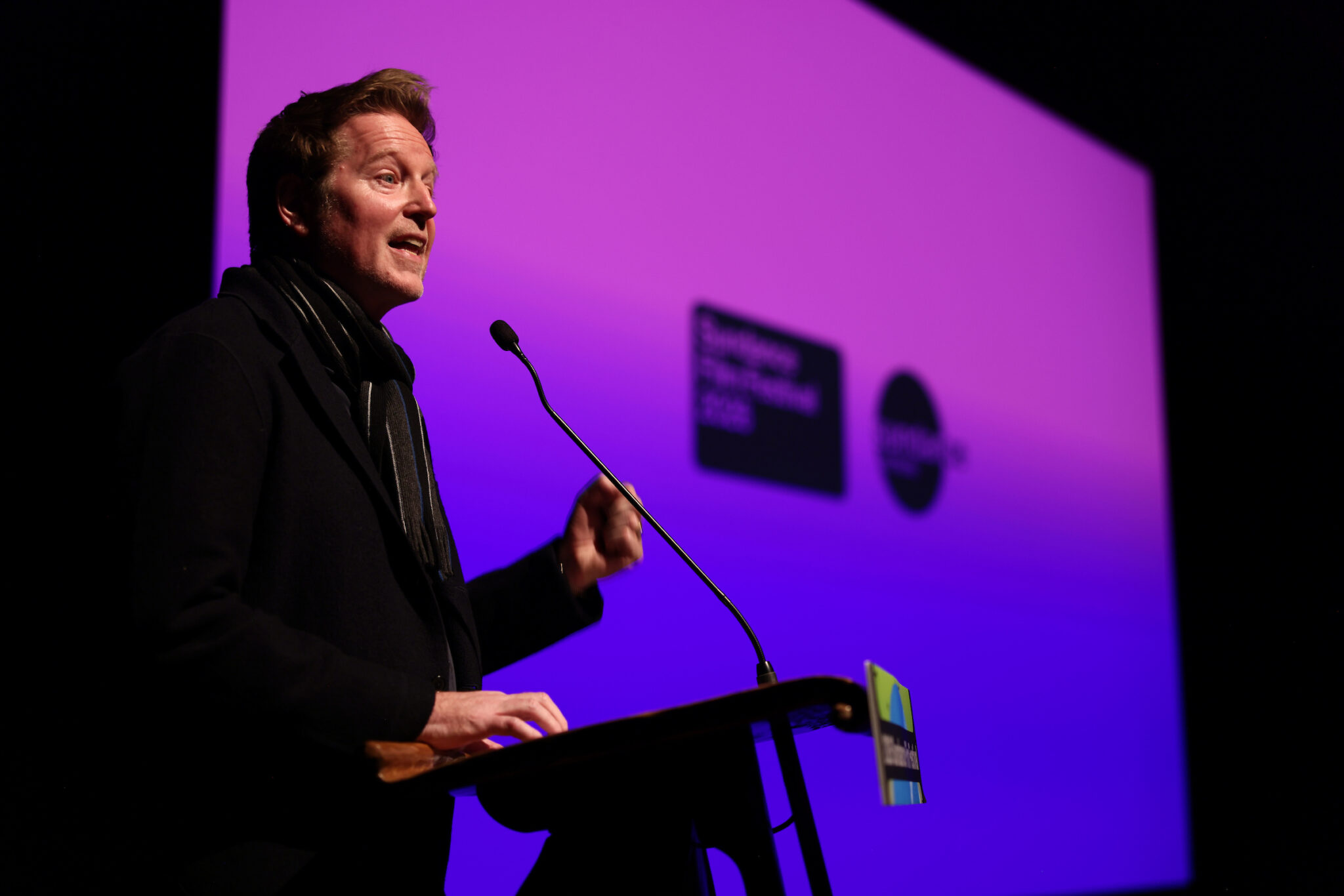
Andrew Stanton attends the premiere of In The Blink of An Eye by Andrew Stanton, an official selection of the 2026 Sundance Film Festival. © 2026 Sundance Institute | photo by Jemal Countess
By Ramona Flume
Starting a film with the big bang tends to be an ambitious starter pistol for a sci-fi epic — and that’s exactly how the long-awaited premiere of In The Blink of An Eye, the recipient of the 2026 Alfred P. Sloan Feature Film Prize screening in this year’s Premieres section, sets the stage for its centuries-spanning story.
Oscar-winning director Andrew Stanton (WALL-E, For All Mankind) spent several years evolving this project from screenwriter Colby Day (Spaceman, 2024), which crisscrosses between three distinct moments in time: prehistoric, modern day, and the space-age future.
The interwoven triptych tale is part 2001: A Space Odyssey and part The Tree of Life with an obvious echoing of WALL-E mixed in. Its braided narrative is both grandiose and granular in its quest to tell an enduring story of love, human connection, and the propulsive circle of life with a stellar, star-studded cast (Kate McKinnon, Daveed Diggs, Rashida Jones).
The focus of cinematographer Ole Bratt Birkelan’s dazzling visuals fluctuates between a family of Neanderthals (Jorge Vargas, Tanaya Beatty) trying to survive sickness, hardship, and loss; a present-day anthropologist (Jones) looking back in time to determine “what we’re all doing here” while juggling a new romance (Diggs); and an artificially enhanced astronaut (McKinnon) who is tasked with saving humanity in the nether regions of the universe. The ambitious arc of the interconnected storylines, each attempting to convey the universal struggle of what it means to be a human at any given moment in time, is grounded by the real humanity portrayed by the talented ensemble cast.
Stanton thanks McKinnon in particular during the post-premiere Q&A for “leaving the comfort zone of comedy to represent the seriousness of our future” in her role as the “longevity-enhanced pilot” who holds the precarious position of saving humankind.
“You know, I like making people laugh a lot. That’s like my whole thing,” McKinnon says. “But at the core of that is loving connection. And that’s why I’ve always gravitated to the films of Andrew Stanton. They’re about the power of togetherness and goodness and hope.”
A resplendent score from composer Thomas Newman (a long-time collaborator of Stanton’s whom the director calls his “missing cast member”), helped distill In The Blink of An Eye’s elevated saga into a deeply relatable human drama.
Even the unsubtitled Neanderthal scenes were informed by the linguistic talents of Britton Watkins (“His day job is writing Klingon,” producer Jared Ian Goldman says) who worked to differentiate two separate dialects for the Neanderthal and proto-Homo sapien communities we see come together in the film. “The audiences don’t understand them,” Goldman says. “But they know they can’t understand each other either.”
Stanton doesn’t pretend to understand or answer all of life’s questions. But his layered attention to detail lends itself to this overarching tale of what it looks like to seek meaning in life and love. While In The Blink of An Eye isn’t a simple story, Stanton’s vision represents a fundamentally hopeful outlook that audiences might be relieved to see on the big screen in a time of bleaker, AI-driven narratives concerning the future. Humans have been around for centuries, and if we want to live through the tough days ahead, sticking together and hoping for the best might be our most prudent option for survival.