




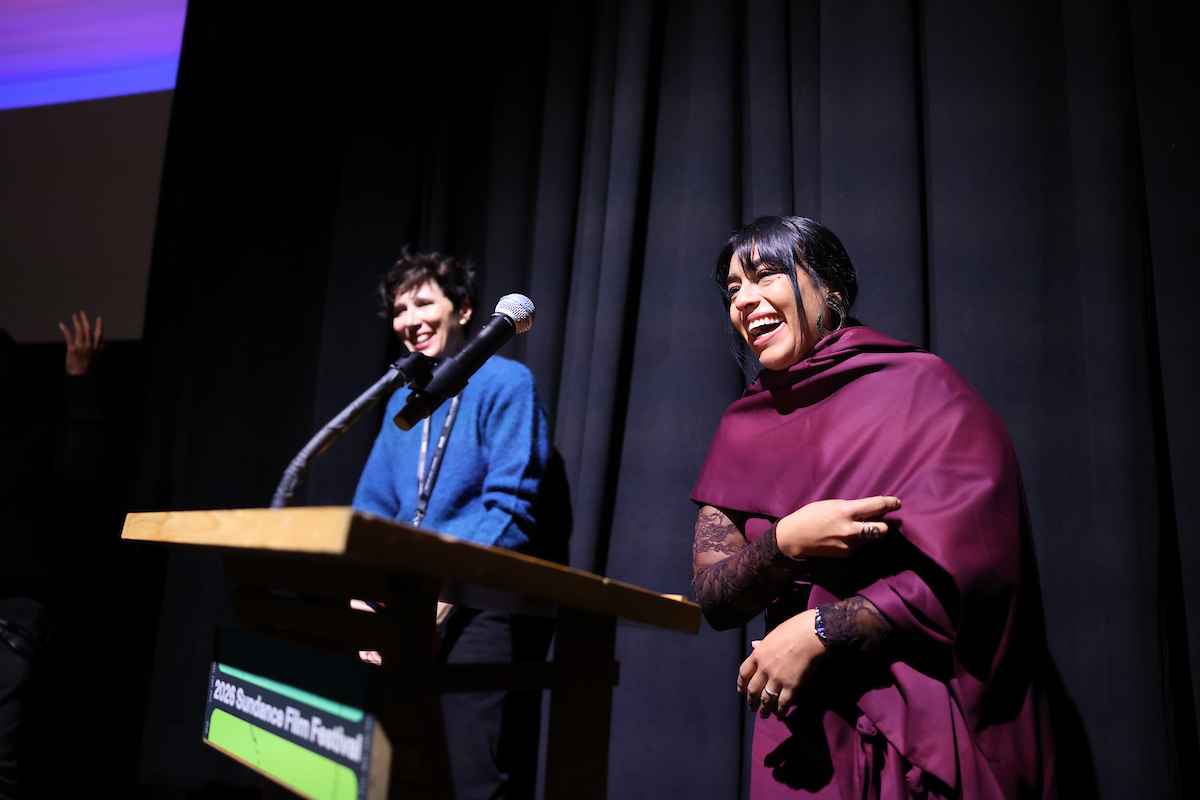
(L-R) Suzanne Andrews Correa and Adriana Paz attend the Q&A for The Huntress (La Cazadora) by Suzanne Andrews Correa, an official selection of the 2026 Sundance Film Festival. (© 2026 Sundance Institute | photo by Stephen Speckman)
By Ramona Flume
“I do not know if I’ll be able to talk,” Adriana Paz (Emilia Pérez) says as she receives a rousing standing ovation from the Library Center Theatre audience, visibly emotional as she steps up to the mic with words not quite fully formed. “I’m shaking… and I was crying.” Festgoers, still in awe of the performance they had just witnessed in The Huntress (La Cazadora), continue to applaud for Paz as she attempts to gather herself.
Writer-director Suzanne Andrews Correa (Green, 2019 Sundance Film Festival) jumps in to explain. “That was the first time she’s seen the movie.” The audience collectively gasps and breaks out into another round of applause before Andrews Correa continues on in praise of Paz, who was joined onstage by more than a dozen of her cast and crew members after the film’s premiere on January 22 as part of this year’s World Cinema Dramatic Competition section. “You really brought this to life, and you break my heart every time I see it,” she says to Paz. “This film wouldn’t be what it is without you.”
Based on the real-life story of “Diana, the Huntress of Bus Drivers,” Andrews Correa’s debut feature film (workshopped in the Sundance Labs) is a gripping tale of retribution and vigilante justice. It recounts the harrowing experiences of a lone female assassin accused of killing two Juárez, Mexico men in 2013 who violently assaulted her and other women on their bus routes.
Paz dazzles as Luz, the tormented mother and sexual assault survivor driven to desperate measures in a battle to find justice for herself — and all the other missing and murdered women in her border town. “My body didn’t know it was fiction,” Paz says in response to an audience member’s question about the physical and mental toll of inhabiting such a traumatized character. “I have to confess my health has been affected a little bit. But I’m so grateful because I think it’s a privilege to portray a character like this… I was checking my Instagram during one of our last scenes on the bus, and I felt [Suzanne] got mad because maybe she was thinking I was getting distracted — and I thought, yes, because I needed it.”
The immersive setting and subject matter Andrews Correa depicts is certainly difficult. Ciudad Juárez in the mid-2010s was a dangerous time and place, especially for women, whose raped and mutilated bodies were routinely dumped in the deserts outside of the city center. Many of them were last seen boarding a public bus, and their disappearances were never properly investigated by local authorities.
In Andrews Correa’s true-to-life thriller (filmed on location in Juárez), Luz lives on the edge of a double-edged sword, oscillating between the hunter and the hunted as she runs from a dogged homicide investigator, Rosales (played by the talented Guillermo Alonso), and her own disorienting flashbacks, all while keeping tabs on her teenage daughter Alejandra (Jennifer Trejo). We watch as she’s forced into a crisis of conscience, confronting her dueling motivations to find (and hide from) justice in a society that is unwilling to protect or defend women.
Luz navigates the oppressive powers-at-large, from the factory where she works to the bus routes where she feels in danger of becoming another “desaparecida” on a daily basis — until she takes matters in her own hands.
Still, despite the darkness depicted in Huntress, Andrews Correa says that portraying hope was her film’s major objective. “What was really brought home in this film is that change starts from the bottom up,” says the writer-director. “And the way that these women came together to change their community with empathy, with compassion, with strength, with fearlessness, was incredible for me.”
“Where there is shadow, there is always light,” Andrews Correa continues. “It’s at the core of what this film is about. One of the things I was most inspired by in Juárez was how much hope there is. It’s a border city that draws people from all over for a better life. That just leads to amazing things. Despite this — because of this — those bonds between people are both shadow and light. You can’t have one without the other. It’s the most important part of the movie for me.”