



By Jessica Herndon
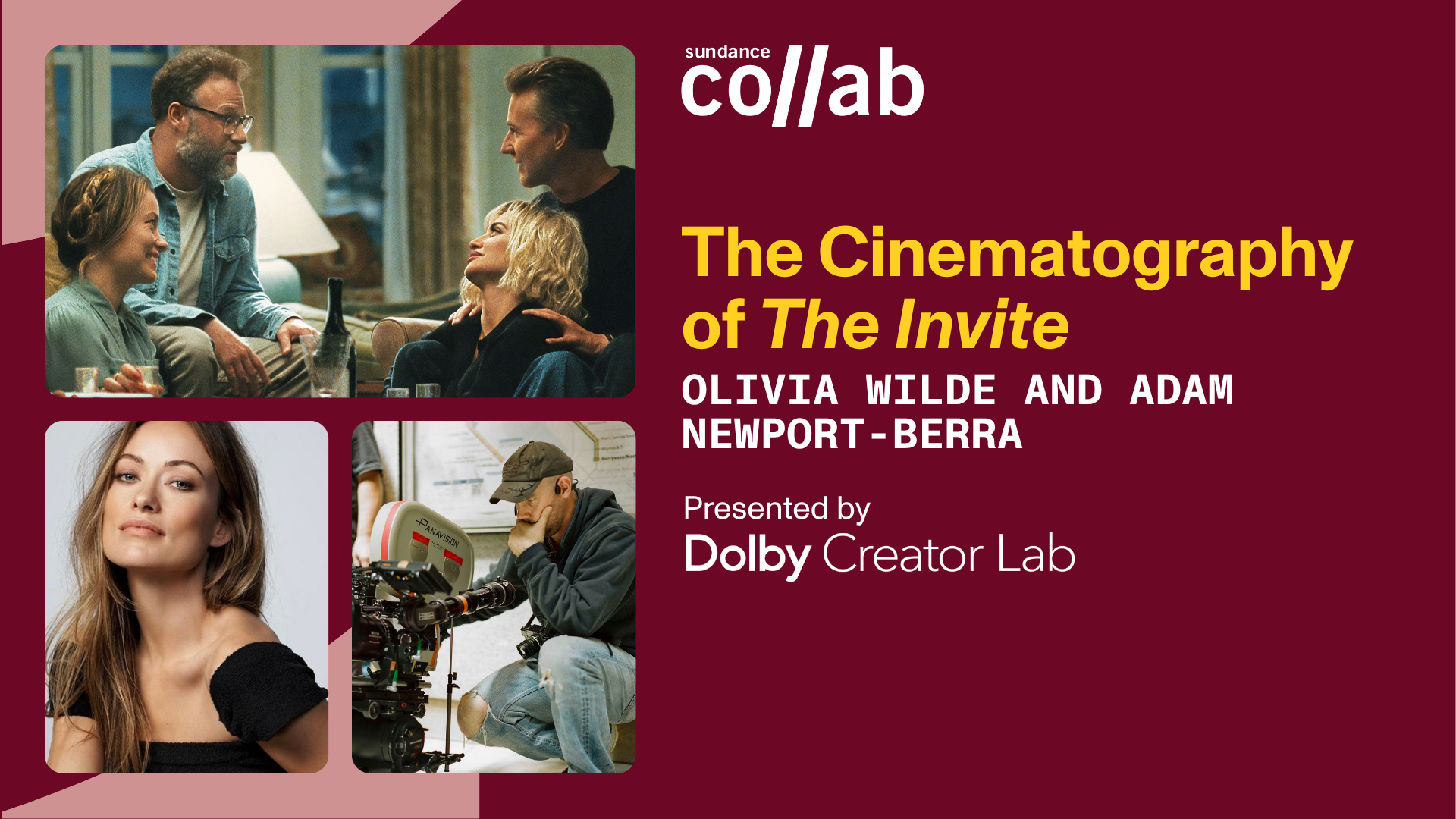
Before cameras rolled on The Invite, director Olivia Wilde and cinematographer Adam Newport-Berra immersed themselves in the work of filmmakers they admired. They revisited Mike Nichols’ Who’s Afraid of Virginia Woolf?, Agnès Varda’s Le Bonheur, Woody Allen’s Hannah and Her Sisters, and films by Éric Rohmer and Michelangelo Antonioni — not to imitate them, but to understand what made them linger. Was it the composition? The lighting? The texture? The way an actor’s expression lit up a frame?
“All these things felt disparate, but once you found a through line, you’re like, ‘Oh, that’s our movie,’” says Newport-Berra. “You want to ingest them often and early in the prep. And then at a certain point, you want to forget about them.”
The result is a film that feels wholly original. A chamber dramedy shot on 35mm film, The Invite premiered at the 2026 Sundance Film Festival and marks Wilde’s third feature as a director. Set over the course of one evening, the film stars Wilde alongside Seth Rogen, Penélope Cruz, and Edward Norton. Wilde and Rogen play a couple in a difficult marriage who invite their neighbors, portrayed by Cruz and Norton, for a dinner party that veers off course. Though confined to a single location, the production achieves a delicious visual richness. For Newport-Berra, it was a quality that aligned with a simple goal: “I love photography, and I wanted to do something very photographic.” Filmed sequentially on a soundstage, the production allowed performances, relationships, and visual language to evolve naturally from scene to scene.
During a recent Sundance Collab conversation, Newport-Berra — whose credits include the 2019 Sundance Film Festival premiere and Directing Award: U.S. Dramatic and U.S. Dramatic Special Jury Award for Creative Collaboration winner The Last Black Man in San Francisco as well as The Bear, Euphoria, and The Studio, which earned Newport-Berra an Emmy for Outstanding Cinematography for a Series (Half-Hour) — and Wilde pulled back the curtain on how they crafted the film’s distinctive visual identity. The pair screened clips from The Invite while discussing everything from shooting on 35mm film, camera placement, framing, blocking, improvisation, production design, and creative collaboration.
Keep reading for highlights from the chat, then watch the full conversation to hear Wilde and Newport-Berra explore the filmmaking decisions behind The Invite, including their approach to camera movement, wardrobe, color, and more.
On why it was important to shoot The Invite on film.
“It’s so generous to skin tones and faces,” says Newport-Berra. “And when you’re focusing on the same four people over the course of the film who all have subtly different skin tones and textures and hair colors, you really rely on the nuance to help develop these characters. … It was exciting for me to build a set. We had the best people in the world designing and building it and decorating it and lighting it, but I’m always a little bit wary of sets. So for me, film was a way to smooth out the edges and, at the same time, rough it up a little bit. So that it just felt a little more natural, a little bit more real, a little less perfect.”
Adds Wilde, “It also just changes the environment. I think that there was a real benefit to the high stakes of having this film that was this finite resource that was so valuable to us. And with a film that has this much improvisation. It was interesting because I think a lot of people forgo film in comedies these days because they assume, oh, then we won’t be able to improvise. We won’t be able to kind of discover it. But that’s not true. It actually, I think, makes people
work a little bit faster and harder. And in finding the magic moments in the scenes, the stakes rise and then everybody just elevates all together. I also say that it makes acting slightly less embarrassing … from an actor’s perspective, there is this sense of suspended reality. It changes everything. When you can hear the film roll out, it changes something. You come out of disillusion. And so it makes the acting better. Everything looks better … I think it forces people to be probably a little bit more prepared. And there is just this added energy that flows through the scenes.”
On the framing and blocking in the film, particularly when Cruz’s character, Piña, and Norton’s character, Hawk, are introduced alongside Wilde’s Angela and Rogen’s Joe.
“What we knew is that we had to take you on a journey, even though you were never going to leave that space,” says Wilde. “And one of the things that was inspiring about Virginia Woolf when thinking of Mike Nichols and Haskell Wexler and how they work together to really make it a very emotionally visceral viewing experience that you felt like you were getting drunker with the characters as they were getting drunker. Like, you really got very close to them as they got close to each other. So, we wanted you to feel that you had been somewhere and that you had grown closer to these people.
“So, we don’t introduce Piña and Hawk in close-up for quite a while because we really are with Joe and Angela at this point. They are the others. And, you know, the idea of staying that wide and over Joe’s shoulder was really to accentuate the distance between them, because he is adamant that he will not close the gap. Joe will not close the gap. He refuses to do the normal thing, which is approach them and make this slightly less painful for Angela. And so, we wanted to kind of maintain that distance and make you feel as awkward as possible.
“There were many choices in terms of blocking and framing that were designed to make the audience feel uncomfortable. There’s a scene right after this where the four of us are sort of standing in this, like Spider-Man standoff, like four different sides. And the way we’re using close-ups there and cutting between them is really designed so that you feel a little bit out of sorts as an audience member, and you’re kind of just discombobulated a little bit, which is how it feels when you’re in the awkward stage of a dinner party or a gathering where no one really knows how to make conversation. And so it was a lot of like, what framing, what blocking will elicit that emotional response from the audience.”
Says Newport-Berra, “I was always trying to take the emotional temperature of the moment in the movie and watching the rehearsals, kind of walking around the space and just watching it from different places. And I think we kind of set up rules for ourselves that helped inform the compositions. We really tried to avoid showing Joe and Angela in the same shot as much as possible. Whereas Hawk and Piña were often in the same shot and felt very comfortable in the space; they almost felt more comfortable in Joe and Angela’s home than Joe. And because we were on location, we had to figure out what our tools were to make it feel dynamic. And that was physical space: architecture and geometry. And then just like composition and lensing … a wide lens gives a lot of depth and it makes the characters feel very far apart from each other.”
How they used the camera to convey the characters’ qualities and emotional states.
“We really wanted Piña and Hawk to have an effortlessness to them,” says Newport-Berra. “And we wanted them to feel sexy. We wanted them to feel cool. And we wanted to contrast that with Joe and Angela. … It starts with that really pleasing kind of slightly low-angle shot on Edward with a very normal lens. I think it’s like a 29 or a 35, which is a very human, very intimate lens. It kind of feels like you’re just sitting there looking up at him while he’s speaking, which, I think, makes him almost heroically cool. Whereas with Penélope, she’s pretty much the only time we use a Steadicam in the movie. … We wanted her to have this sort of seductive, sexy, sort of more brooding vibe to her. And so by putting the camera on a Steadicam and following her a little more closely, all of a sudden you just felt like there was this energy moving through the space that was sort of exploring it and like testing its boundaries. … And then with Joe and Angela, we had these awkward frames that were very flat, very straight on with a big line going through it … so they’re always a little bit off center, with a lot of headroom on a slightly wider lens. So you just felt this sense that they weren’t grounded and they were a little untethered, and they were trying to figure out their place, even in their own home.
“And we did cut to close-ups of Angela, Olivia’s character. But when we did, they’re on longer lenses and it’s very compressed, so it feels kind of claustrophobic. It doesn’t feel comfortable. It feels like we’re kind of watching her squirm. It feels like we’re examining her. Whereas when we cut to a close-up of Penélope, it’s on a slightly wider lens and it feels very voluptuous and sexy. We were playing with all those contrasts. These are all simple choices, but I think that they instantly set the tone for what we’re trying to say about the characters.”
Adds Wilde, “It was wonderful to feel like you could do so much with such a simple, almost subconscious effect that really is effective. And to be bold enough to make the choice to do that, to live in these singles — I think that often when you have a group scene like that, there’s this feeling of like, well, shouldn’t we be cutting to the wide.”
How the set, designed by Jade Healy, added to the structural and emotional depth of the film.
“Different layers of walls are slightly different shades. That created so much depth in the apartment,” says Wilde. “Jade is such a genius. She designed this so that we would have the architecture, of course, be a character in the film. The kind of mantra from the beginning with her was frames within frames. We obviously knew we wanted to use the structure as a kind of representation of boundaries and barriers and all these things. But we didn’t want it to feel overly self-conscious. … We wanted it to feel like we were going somewhere with it that didn’t become redundant, which took a lot of work in terms of the design. And by the end, we reveal angles that you haven’t seen before. So you hopefully have a different perspective on the characters.”