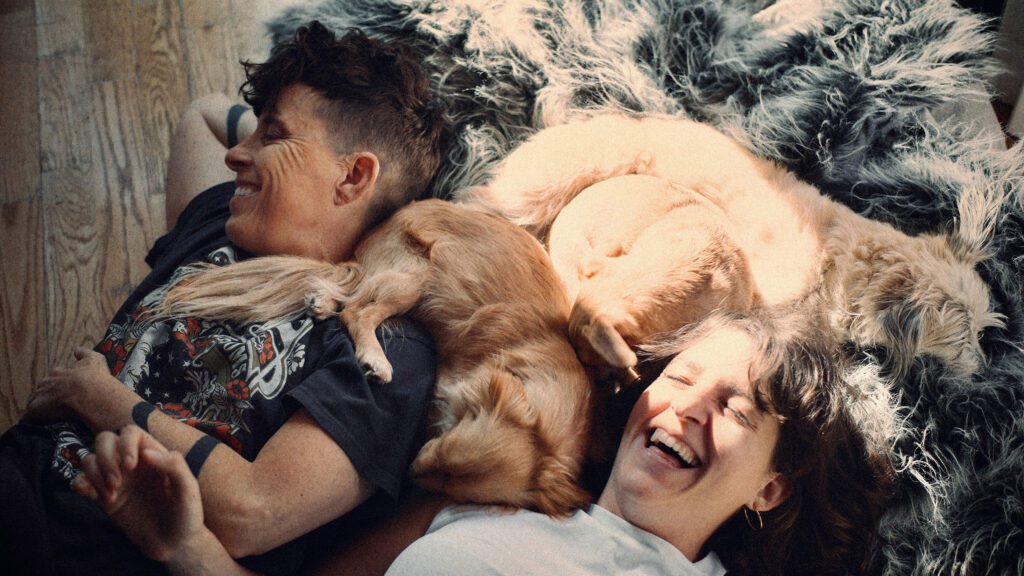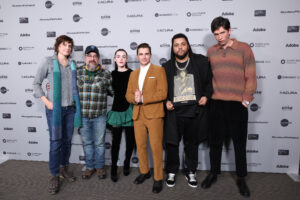




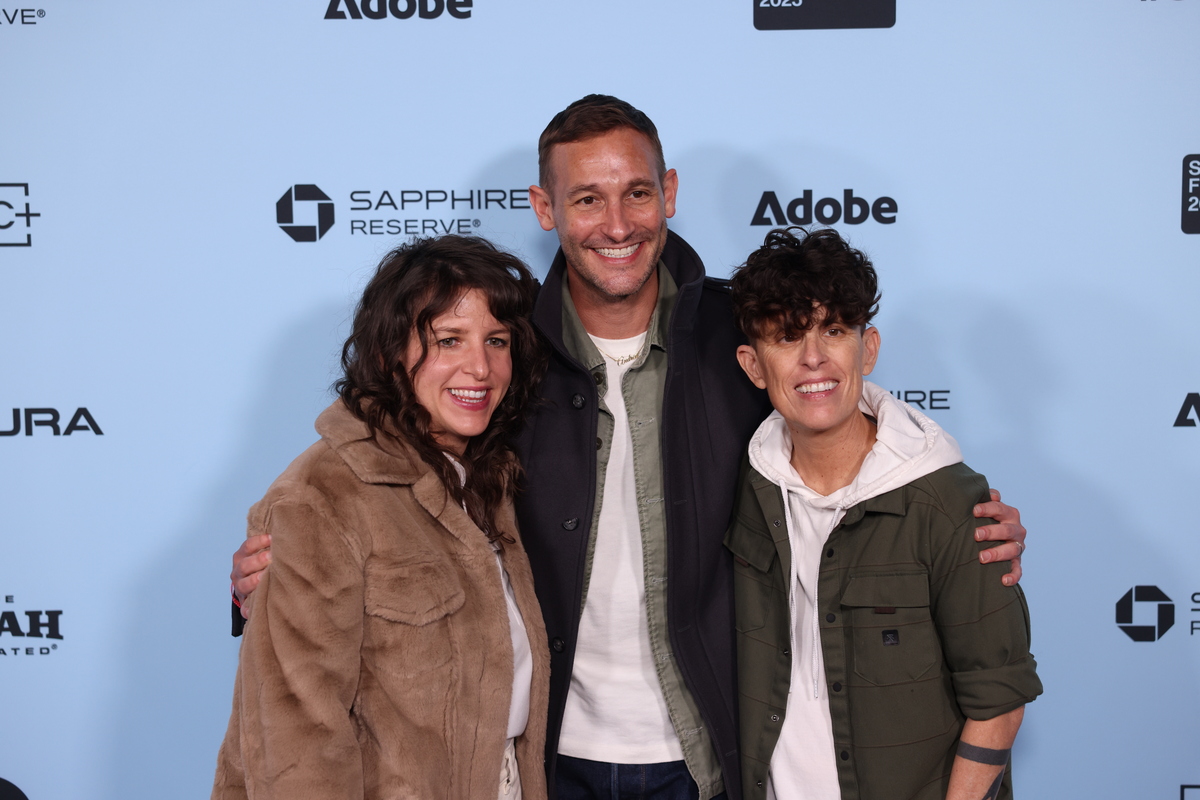
Megan Falley, Andrea Gibson, and Ryan White attend the premiere of Come See Me in the Good Light during the 2025 Sundance Film Festival. Photographer: Stephen Speckman
By Jessica Herndon
When Andrea Gibson took the stage at Denver’s Paramount Theatre for what would become their final live performance, the poet had one request for filmmaker Ryan White. “If there’s any way we can make sure all my people will get to see this one day,” Gibson told him, “make it happen.” White never forgot those words. Although about 2,600 people witnessed the two-night engagement in person, he held onto the hope that one day the performance could reach a wider audience.
That moment arrives on July 5, when White’s Andrea Gibson: Love Letter from the Afterlife premieres at the Red Rocks Amphitheatre in Morrison, Colorado. More than a film screening, the event is a multimedia celebration of Gibson’s life and work, bringing together poetry, music, and cinema in one of the places they loved most. Gibson’s widow, fellow poet Megan Falley, will be in attendance, while the Colorado Symphony and singer-songwriter Sara Bareilles — who penned the original song “Salt Then Sour Then Sweet” for Come See Me in the Good Light — will perform as part of the evening. (Get your tickets here!)
The premiere also marks the next chapter in the incredible journey of Come See Me in the Good Light. White’s intimate documentary follows Gibson and Falley as they navigate Gibson’s ovarian cancer diagnosis with humor, tenderness, and grace. The film premiered at the 2025 Sundance Film Festival, where it won the Festival Favorite Award before going on to earn widespread critical acclaim, including an Academy Award nomination for Best Documentary Feature.
Ahead of the Red Rocks premiere, we spoke with White about the unforgettable Sundance Film Festival debut and Gibson’s legacy.
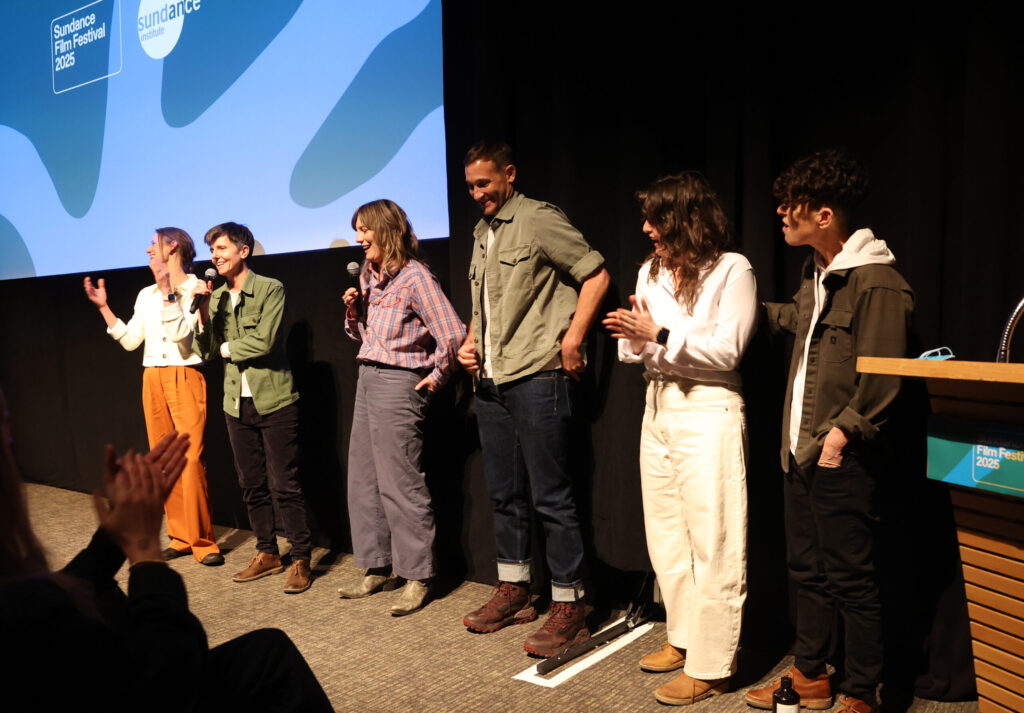
I was at the premiere of Come See Me in the Good Light during the 2025 Fest. It was such a beautiful time. What were some of your Fest highlights that year?
This is not hyperbolic. I think that is the most special night of my entire career. It’s amazing that you were there, by the way. So few people were. I remember we all sat in the back, our little group, including Andrea and Megan — very nervous, but also by design because Andrea was so sick that we were like trying to keep them away from the 450 people in the Library [Theater]. And I remember, whenever the first funny moments are, which I think are about five minutes into the film, the laughter in that audience being so much bigger than I had ever imagined for a cancer poetry film. Then it just kept building. And I think the emotional sad parts were also confounded in that same type of way that we all just relaxed very quickly.

I would have thought, when I began this film, that it was going to be an end of life documentary and it would end with Andrea’s death. Obviously, that shifted in the editing of the film, and then we decided to finish the film with Andrea still alive and they were barely healthy enough to make it to Sundance.
The moment the credits started rolling, I could feel that kind of like, question mark. I could even see people on their phones, Googling Andrea. Then I introduced Andrea and the room was literally vibrating as Andrea walked up, I think because people didn’t know that they were still alive. It was like Andrea rising from the ashes, in the way. And I know Andrea felt such an energy from the audience that they were just totally overwhelmed. That whole Q&A is kind of cloudy for me because I remember feeling like, this is the best moment of my life, getting to watch Andrea, who never expected to see this film, much less at a Sundance premiere in front of an audience talking about it.
What was behind your choice not to tell Andrea or Megan that you’d submitted the film to the Festival?
We didn’t know if we were going to get in and Andrea was close to dying so much, even while we were making the film, but especially when we were finishing it that it was this weird position to be in the filmmaker where it’s like, I don’t want to tell my subject something that might be the last thing they know about this movie. So we didn’t tell them until we got in. And they didn’t even know that the film could be finished that quickly. It was a wonderful phone call with them. Andrea was really emotional but they were confused as well, saying, “You’re telling me you’re done with this film and that if I survive for, like, seven more weeks” — or whatever that window was — “that I can be there?”
Then even in that seven weeks, we were all really nervous. Andrea got really sick and there was a definite moment where it was like, Andrea and Megan are not coming. And that week before, Andrea started feeling better and was able to make it.
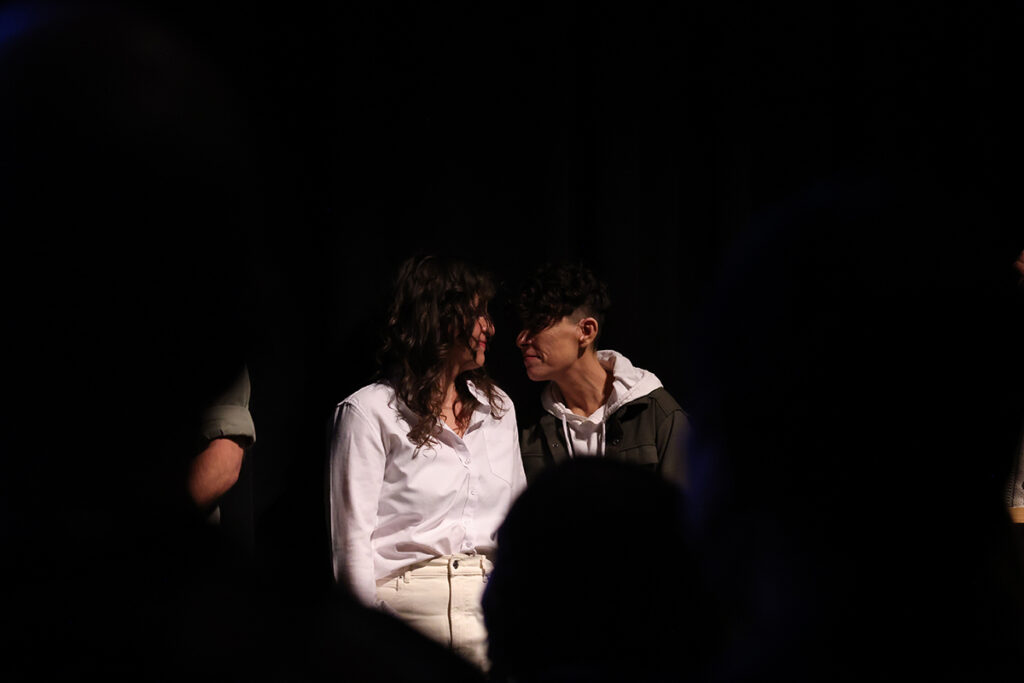
How beautiful is it that the premiere of Love Letter from the Afterlife will be in Colorado, where Andrea is from, where their final big show was performed, and where they lived during the last incredible years of their life?
This sounds super cheesy, but I can’t imagine a venue that feels more heavenly than Red Rocks. Like, you feel like you’re in the clouds, in a place that is otherworldly. And it was such an important place to Andrea and Megan. So the idea that they posthumously are playing their venue, I’m so excited because that show was so powerful. No one even thought Andrea was gonna get to do one of those. It was like, is Andrea gonna get too sick or die before the show? So being there was special for all of us, but it felt pretty devastating in the edit room.
We tried versions of Come See Me in the Good Light where that show was edited throughout. And, you know, because it was such a big moment, we felt like for the sake of the documentary and the ending of the documentary, it could only come at the end. And by that point, you’re in the final 10, 15 minutes of a film. And so I could only use small parts of it. That was like a devastating part — like, oh, I wish the audience of my documentary could see more of that show or see Andrea’s unedited delivery off of memory.
It was this one person show of everything about life and mortality. And there was a real beginning, middle, and an end. And [producer] Tig [Notaro] was very helpful creatively with that because Tig has done many comedy specials. And so the idea was well, let’s shoot it like a concert or like a comedy special so that possibly one day we could release it.
And so once we finish the documentary, my editor, Bernice, started cutting this immediately. And we were able to finish it. We had no idea what would happen with it. And sort of in this perfect storm of events with Red Rocks and Sundance and Megan — and Sarah’s going to be performing — it all came together for this incredible night to premiere it. I see it almost as heavenly. Andrea will be 30 feet tall in front of all of us delivering this performance to a live score… I’m sure it will be very special. Then hopefully we figure out a way to get it to the masses.
The documentary is called Love Letter from the Afterlife because it’s a poem that Andrea wrote for Megan while Andrea was still alive, obviously, but is written from the perspective of Andrea in the afterlife, in the beyond, whatever you want to call it, the other side.
Going back to the making of Come See Me in the Good Light, you’ve made so many incredible docs. What felt different about this and what did you learn about your documentary making process?
Tig’s pitch of Come See Me in the Good Light sounded like the last thing in the world I wanted to make. I was like, “Ok, wait, your nonbinary poet friend has late stage cancer? This sounds like the saddest documentary in the world and the least commercial documentary. Like, how would we even get that funded or distributed? Who’s going to want to see that?” So it was a real exercise for me in not judging a book by its cover. Because I had never heard of Andrea, it was a real exercise in not just having those knee jerk reactions to something because it is the most special experience of my entire filmmaking career even though my initial reaction was no, thank you.
It had all the odds stacked against it, that film. It was a film that we thought we might start making for a few weeks, and then Andrea would die and there was nothing to make out of it. I never thought this might get into Sundance or especially that a distributor like Apple might want a queer cancer poetry film. Much less that it would make it to the Oscar stage. But once [Come See Me in the Good Light producer] Jess [Hargrave] and I visited Andrea and Megan, we fell so in love with them. And we were like, we have to figure out how to get this to the finish line.
It was not easy to finance. It was very much a labor of love for everyone. Generosity from all these people that knew that they would probably lose their money. It was a reminder to me that early in your filmmaking career, you’re making things because you love it. You’ve never made a film. You have no responsibility to a distributor. You have no funders because no one’s giving you money. You’re making films purely for the love and heart of it. This felt like a real return to that. Not saying, I love all my films, but they come with strings that are a fact of life, of being an adult filmmaker. It’s beautiful that I have a sustainable career now or that I get offered things from legitimate distributors, but this one felt like being in film school again. It felt like a reward — just following your heart and a story that’s really about goodness and humanity.
How did you navigate the heavy moments in Come See Me in the Good Light, like the reading of the devastating results of the cancer scans, especially considering how quickly you made the film.
It was tricky because I was not somebody who was comfortable with heaviness. I’m a very good listener, observer, I’m very sensitive, and I’m good at making people feel comfortable, and I like that part of the process. I like winning someone’s trust and making them feel safe and I like to think that I’ve always honored that trust. But I’m not somebody who really returns that vulnerability in exchange. And I think that I would argue that’s what has made me good at my job at times. I’m not spending a lot of time talking about myself or sharing about myself. But Come See Me in the Good Light was really challenging for me in that way. I’m not someone who’s really comfortable with feelings in general and my own mortality for sure. And then I was just thrown into it.
Andrea and Megan, I’m so grateful to them because I’ve changed how I operate, even in my own marriage, and my own relationships — they had to bring out a vulnerability in me that was necessary to make that film. It was like a crash course in how to feel your feelings and be ok expressing them. And I feel so grateful to them.
What type of project are you looking to do next?
I think making Come See Me in the Good Light has very much shifted [myself and Jess’s] radar on the rest of our careers. Come See Me in the Good Light has made me and Jess really try to focus on working less. My job is such a privilege and we have been on this hamster wheel that I think is the most beautiful, fun, privileged hamster wheel for the last 20 years of our life that I needed something like Come See Me in the Good Light.
And Andrea would say it to me explicitly, like, “Ryan, why are you working so much? Are you learning the lessons that I’m learning right now? Because you’re here a lot. And I want to make sure that you are finding the time in your life that’s for the people that you love or the things that you love or the creatures that you love.” Jess and I are turning 45 this summer, and we have worked really hard. We have made a lot of films, especially in the last 10 years. We want to pump the brakes a little bit and make a little more time in our lives for things that aren’t work, even though we love our work.
We’ve always tried to make a balance of light and dark. Now it’s about being really thoughtful about the ones that we choose. I think we might lean a little bit more into the light in the future. Come See Me in the Good Light might have been lightning in a bottle. Stories like that, that are like a shot of adrenaline to the soul, I think Jess and I will seek those out now. We’d be very lucky if we could find a few more of those.