



By Jessica Herndon
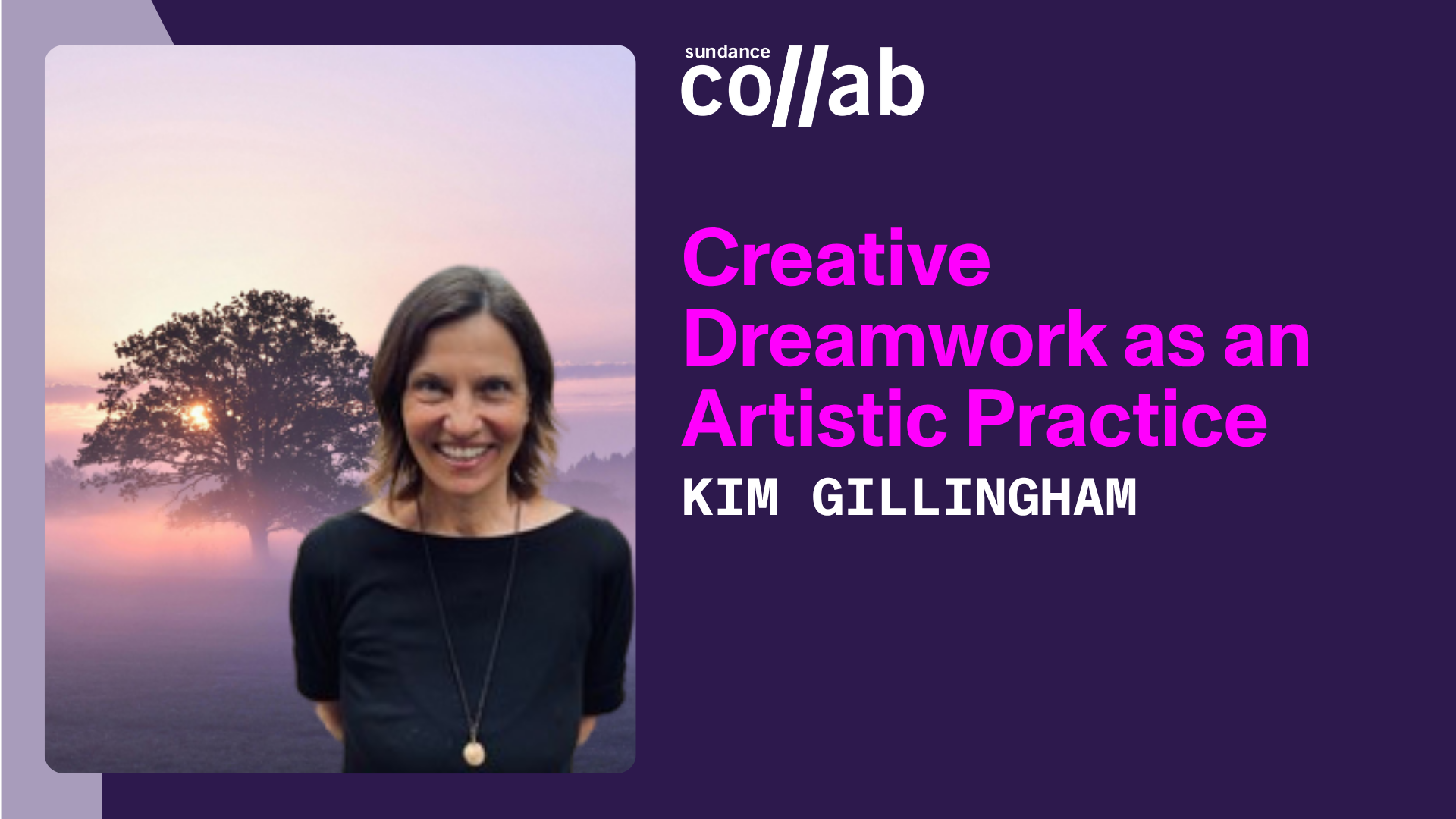
Things move so quickly these days that finding stillness can feel almost radical. However, according to dreamwork specialist Kim Gillingham, that pause is where some of the best creative breakthroughs live. During Sundance Collab’s immersive session Creative Dreamwork as an Artistic Practice, Gillingham invited artists to turn inward, embracing a more intuitive, embodied way of creating.
At the heart of her approach is Creative Dreamwork, a practice that treats dreams as collaborators in the artistic process. Rooted in Jungian psychology and shaped by her studies with analyst Marion Woodman and acting coach Sandra Seacat, Gillingham’s method encourages artists to engage with the subconscious to unlock imagery, emotion, and insight.
Guiding participants through moments of reflection, Gillingham posed a simple but powerful question: What’s the best way for you to come into contact with your inner self? The answer, she suggested, lies in learning to “drop into the body” and move into sensation, where deeper creative instincts reside. It’s a practice she has brought into dynamic creative spaces, including her work as a dream consultant on Chloé Zhao’s Hamnet, where she collaborated with the cast and crew to activate a shared creative energy.
To ease into the practice, Gillingham guided the Sundance Collab participants through a series of cues: a gentle sway or any movement that feels soothing to the nervous system, placing a hand over the heart and belly, or lying down in a comfortable position. From there, attendees were asked to choose a dream figure, which could be a script they’re developing. Over the next hour, Gillingham led breathing exercises, slow movements and prompts like listening to something other than our thinking minds, to access the creative unconscious.
Following the session, Gillingham spoke with Sundance Collab for a conversation that expanded on her approach to creativity. Below, find five key quotes from Gillingham — from why feeling lost in the process can be a good thing to ways to better remember dreams and how the practice translates on set. To get a taste of the creative dreamwork practice, watch Gillingham’s Sundance Collab Advisor Studio session.
How Movement and Gestures Help Us Connect With Our Subconscious
Our practice is a very physical practice and in the understanding that the unconscious in the psyche is the body and is accessed within the body. So the whole of the practice is to descend from the known “thinking mind” into the richer field of the unconscious, and that is to come out of sitting and thinking and come into feeling and expressing. So if I can find a gesture, even if I don’t understand it, it will feelingly open a pathway for whatever the energy is that wants to come through.
A big part of this work is getting lost and getting confused. And you’re really lucky when you get lost, because then you have the moment of going, this is terrible. I don’t know what’s going on. Oh, I’m interested in something over here. And that’s actually the work with the unconscious when you allow yourself to get lost and then something constitutes to help lead you in a new direction.
How to Access Dreams We Don’t Remember
It’s a practice — dare I say, discipline — to linger on the threshold when we first wake up and let the images stay with us and repeat them and be curious about them. We know that the phone is like a dream evaporator.
The minute we touch it in the morning, the dreams are gone. So, if you can wind yourself away from any device there and just stay on the threshold. And even if all you remember is a feeling, honor and stay with that. The more you honor it, the more the dreams will begin to make themselves known.
Like little seeds in the garden, ask the inner self to help you remember the dream before you go to bed. Say, “I’m building this practice and I want to work with it. Help me remember the dream,” and then give yourself a fighting chance in the morning by seeing that opening threshold time and lingering on the threshold. Some people say, don’t move. See if you can stay in the same physical sensation, so the dream images will be with you. It’s a nice practice to wake up and think, did I wake up on an inhale or an exhale? And oftentimes when I’m in that inhale or exhale, the dream images will come back to me.
The other thing I say to do is make the dream up. Start by saying, I wish I would have dreamt, and just write a dream. Make it up. Begin to work with that.
What Creative Dreamwork Looks Like on Set
We work by gathering together and all of us asking for a dream — incubating around the particular project and asking, reveal to us what you want us to know so that we can bring the truth through. Everyone will have a different dream, and we’ll all work on those dreams, either individually or as a collective. And then you’ll start to feel the recurring themes come through and the energies that want to be expressed. Depending on the level of inclusion of the process, the symbols from the dreams might find their way into the movies. The energies that you touched on, the lines that came through might find their way in. But most of all, it supports the actors in abandoning any need to perform and allowing themselves to be authentically engaged in an inner process while present on camera.
And for the director, I believe it lends a very clear line of steam and underlying purpose of what pieces are coming from the unconscious… On Hamnet, we worked with the camera department. The AD was in there. We worked slowly and often. Sometimes the DP is in, but mostly it’s the director, the cinematographer, and the actors.
How to Navigate Trauma Within Dreamwork
With infinite care, infinite respect, slowly. Never, ever pushing on the psyche. Never ever pushing on the body. If ever I’m asking for a memory and something comes up that I don’t want to deal with, I can just say, “No, thank you. Please, may I have a memory that would be better for me to work with on this particular day?” To be engaged in the therapeutic relationship is fantastic for us. [It] gives us more robust elbow room to work with our inner figures — and with a lot of respect.
Understanding the Significance of Recurring Dreams
Experientially, when we have a recurring dream, that is the thought that something must have happened in the last few days — that there is enough healthy ego strength for the material to come through and be integrated now. So it’s as if the inner self is like, I think they’ve got it now let’s try that dream again, see if they get it. So you can go back and think, what if? What’s happened in the last few days that might have given the inner self the fortitude to offer the dream again? Then once the dream comes, all we need to do is connect creatively. We’re not trying to solve them. We’re not trying to analyze them. We’re not trying to fix them or change them. We’re just seeking a little bit of contact with the material from the unconscious.
To find more on-demand recordings, head to the Sundance Collab video library. And for the latest on events and online courses in TV writing, screenwriting, directing, producing, and documentary filmmaking, sign up for a FREE Sundance Collab account and subscribe to our newsletter.