



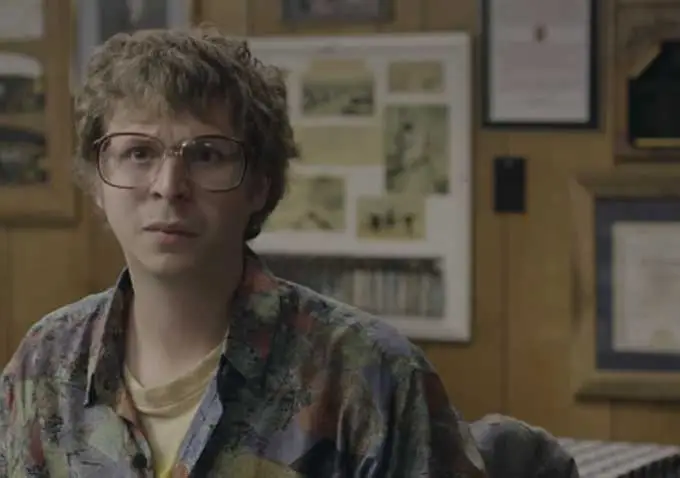
Michael Cera in appears in Janicza Bravo’s short “Gregory Go Boom,” which premiered during the 2014 Sundance Film Festival.
By Jessica Herndon
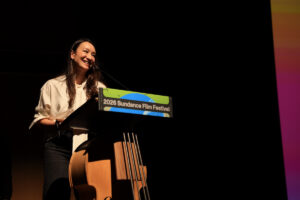
The Park City Legacy Short Film Program felt like a sweet homecoming, as six shorts that premiered at the Sundance Film Festival between 1995 and 2014 traced the early work of filmmakers who have gone on to shape contemporary cinema and television.
UNA HORA POR FAVORA by Joey Soloway, 575 Castro St. by Jenni Olson, Greetings from Africa by Cheryl Dunye, Rejected by Don Hertzfeldt, Gregory Go Boom by Janicza Bravo, and Whiplash by Damien Chazelle, who couldn’t make it to the screening, aren’t just artifacts. They’re origin stories, reminders of how bold ideas often arrive in short, fearless form.
Short films have long been where the Sundance Film Festival first signals what, and who, comes next. Ahead of Wes Anderson’s Hollywood dominance, he got his start at the Fest back in 1993 with the short film Bottle Rocket. Before Thank You for Smoking and Juno, Jason Reitman introduced himself to Fest audiences with Operation in 1998. Years before Hunt for the Wilderpeople and Jojo Rabbit made Taika Waititi a household name, he screened his short Two Cars, One Night at the 2004 Fest.
The Legacy Short Film Program honored that lineage, spotlighting how the Festival has consistently been a first stop for dynamic voices that go on to make noise far beyond Park City. It’s the same tradition that welcomed Sterlin Harjo, Lake Bell, and Dee Rees. And its one that continues to introduce the next wave of storytellers ready to leave their mark.
Soloway served as the program’s host, kicking off with the filmmaker’s classic 2012 short UNA HORA POR FAVORA, about an unlikely relationship between a woman (Michaela Watkins), desperate for a love connection, and the day laborer (Wilmer Valderrama) she hires. Laughter filled the room as the audience watched the hilarious short that not only highlighted Soloway’s ability to write sharp comedy, but introduced us to their directing skills. Before the film screened, Soloway shared that despite having produced and written shows like Six Feet Under and United States of Tara, no one would let them direct. So, they took it upon themself to direct their short, and went on to create and direct episodes of the series I Love Dick and Transparent, for which they were also the showrunner.
After the screening of Olson’s 575 Castro St., the 2009 film set to an original audio recording by Harvey Milk made in November 1977 that was to be played “in the event of my death by assassination,” Soloway said, “Who would have thought, when you made this film, that we would need to hear those words today. That we would need to hear from one queer person to another, humanize yourself in the eyes of the enemy.” Said Olson, a consulting producer on this year’s Barbara Forever, of Milk’s power as a debater and as someone who stood up for gay rights, “I hope that we can all channel that, be inspired by that, be courageous, speak up, and cut through the shit.” Olson added, recalling how the idea for the short took shape, “I was commissioned to make the film for the release of the Focus Features film Milk in 2008. I’m known for making 16 millimeter urban landscape essay voiceover films, so I was kind of surprised when they asked me to do it. I had been part of doing the digitizing of that tape, and I had it on my phone. They redid Castro Street through fantastic production design and I went into the camera store [on set], which is where he recorded the tape. I listened to it, and of course I was bawling.”
Known for stories that focus on what it is to be Black and queer, Dunye’s Greetings from Africa, a candid take on lesbian dating in the early ’90s, originally screened at the Festival in 1995. “I just loved it,” Soloway said after the film screened. “Lust and rejection. Lust and rejection.” Laughter burst across the theater when Dunye replied, “Hmm hmm, my life.” Dunye added that she was inspired to make the film and create her own cinematic language, which blends narrative fiction with documentary elements, after seeing Spike Lee discuss his film She’s Gotta Have It. “The room is filled with Black women. Everybody’s having issues with his portrayal of Black women,” remembers Dunye. “And he was like, ‘If you want to make a movie and change this stuff, make your own movie. Next question.’ And I was like, ‘I’ll make my own.’” Soloway pointed out that they feel it’s even harder now than it was when Greetings from Africa first released for queer folks of color to get their work out there. “But you still gotta do it, right?” Dunye replied. “I think our cinema is politics, so that’s really important to me and gets me out there and people who look like me out there.”
As Hertzfeldt, who has made a career out of making short films, stood in front of the crowd after the screening of his short Rejected, which originally premiered at the 2001 Sundance Film Festival, he joked, “I can understand if nobody has any questions.” In the short, twisted animated characters are commissioned to do family-friendly ads for the Family Learning Channel, but they struggle to thrive. A stick figure kid takes its first steps only to fall down a ridiculously long flight of stairs, and a character is beaten with a bat for not wearing a silly hat to a silly-hats-only party. There is also a lot of blood. “There was a vicious cycle that still exists with animators where they are usually being taught that their work has no value, and they’re ushered to do advertisements, and it’s always bothered me,” said Hertzfeldt. “That was sort of the starting point for all of that. So, this is kind of my bratty short.”
The last film to screen was Bravo’s Gregory Go Boom, which stars Michael Cera and premiered at the 2014 Festival, where it won the Short Film Jury Award: U.S. Fiction. Soloway desperately wanted to know how Bravo pitched Cera the idea for the short, which centers on a paraplegic man whose life unravels when he goes off on his own. “I’m trying to imagine, like, the one line — a person with a disability has sex for the first time and then implodes,” says Soloway. “I think how I pitched it to him was a paraplegic man wants to leave home,” answers Bravo, who says Cera was only interested in producing one of Bravo’s films until Gregory Go Boom came across his desk. Adds the filmmaker of what inspired the short, “I was feeling pretty rejected in my day-to-day, and I was working through my own struggle to stay in life.” Now Bravo, who served as a juror for this year’s U.S. Dramatic Competition, adds, “I’m in a different headspace. I wouldn’t make that today.”
As the program came to a close, Soloway offered this inspo to the audience: “Go see all the movies, support the artist, make friends, and most of all, if you go back to your hotel room and you have a script you’re working on, finish it and just go, go, go!”