



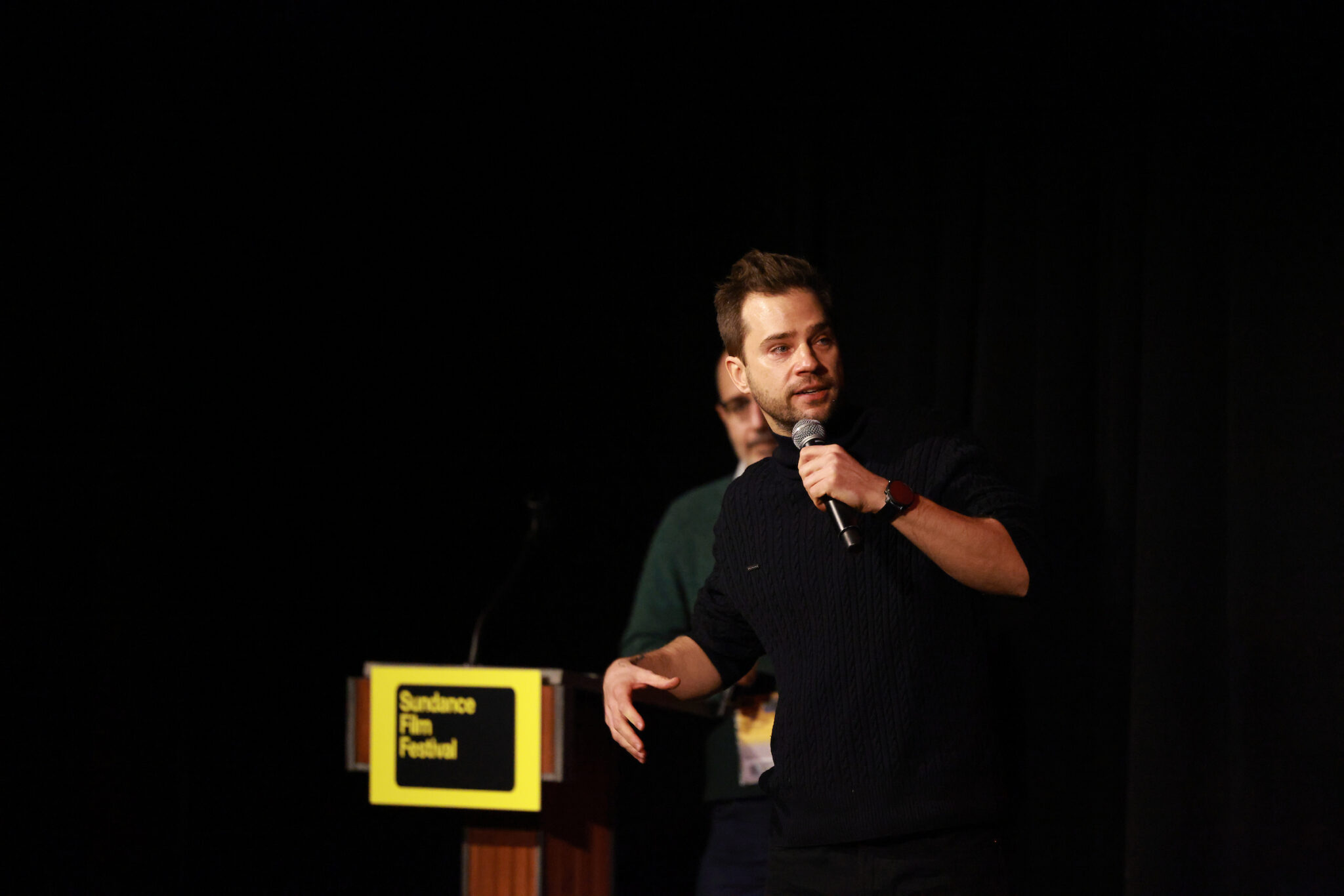
Michał Marczak attends the Q&A for “Closure”, an official selection of the 2026 Sundance Film Festival. © 2026 Sundance Institute | photo by Lauren Wester
By Cecilia Santini
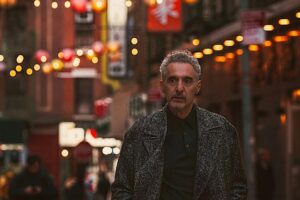
Krzysztof Dymiński disappeared in 2023 when he was 16 years old. He was last seen on a bridge above the Vistula River in Poland. Closure begins one year later, following Krzysztof’s father, Daniel, as he searches the river for his son. He takes his boat out in rain and snow, day and night, scanning the surface, dredging the bottom, digging through the banks, clearing mud, logs, and reeds. At home, Daniel and his wife, Agnieszka, grapple with their loss and with what they might never know — why Krzysztof did what he did, whether he’s gone forever.
This extraordinary film from director Michał Marczak, part of the 2026 Sundance Film Festival’s World Cinema Documentary Competition, invites us to enter into the family’s uncertainty and grief, to accompany them as they are haunted by both absence and possibility.
After the film’s premiere on January 23 at The Yarrow Theatre, Marczak came onstage and soon invited his entire crew up as well. He explained the unlikely genesis of the film: “I was actually with my wife and our six-year-old on a raft sailing down the Vistula River for two weeks. … We were scouting locations [for another film], and one night we were on the raft and it was dark and our flashlights ran out and we were trying to dock to this island. It got quite dangerous, and out of nowhere this man appeared with his flashlight and guided us to safety, and that was Daniel.”
That night, Marczak talked with Daniel and heard his story. Afterward, “I just couldn’t stop thinking about this movie, having kids and everything,” he says. “With my wife, we were thinking a lot about the mistakes we’d already done and the ones we’d probably do and how to avert them.” So he got in touch with Daniel again and put the other film aside. “I felt this story has to be told,” he says.
A surreal stoicism defines Daniel’s quest and the movie’s style. The camera travels with Daniel in his boat, submerges beneath the river, and hovers overhead in drone shots, but never ventures for too long from its main canvas, which is Daniel’s face. The score is an anxious humming. The cumulative effect is eerie. You’re afraid of what you might see around the next bend of the river or in the reeds, but what we don’t see troubles us the most.
The river occupies both a physical space as the setting of the film and a psychological space as the place that consumes Daniel’s thoughts. “He will cross the line, beyond which there’s nothing but this river,” Daniel’s father says about him at one point.
The movie’s sense of drama, immediacy, and emotion sometimes make it feel more like a fiction film than a traditional documentary. Responding to a question about how the material was captured and the visual and compositional skill on display, Marczak says, “I try to shoot all my documentaries in a very cinematic way. … But with this film, I wouldn’t have the guts to stage anything. It’s just out of the question with this subject matter.” He explains how he captured footage of the searches by using light camera equipment that he handled himself. He describes how important it was to remember what he’d already shot so he knew what new footage would fit with the existing material, thinking like an editor. “I think the trick to it was I worked a lot as an editor for 15 years and learned from this wonderful woman. … She taught me a lot about remembering what you have in the footage.”
“This was the most technically demanding and emotionally demanding [film]. … Everything is on the fly,” he continues. Producer Monika Braid chimes in: “He’s quite modest. He has this incredible sense of authenticity. He’s a very true documentary filmmaker and also is an incredible camera operator and director of photography.”
While Closure is a personal story, it also points to social problems — what it’s like to be young, lonely, and depressed on the internet; how young men cope when they don’t know how to express their feelings; how a family can support itself emotionally when it’s not taught how to live, as Daniel says. As the family begins helping others in similar circumstances, we’re invited to turn outward toward our own communities and the silent struggles happening in the depths of the people around us.
The Dymińskis couldn’t attend the screening because Daniel hurt his back while helping another family, but Marczak called Daniel and Agnieszka on his phone from the stage, to a great outpouring of love from the audience. “The loss of a loved one can happen in any family, so we truly believe that this film will contribute to a broader discussion of disappearances,” Agnieszka says.