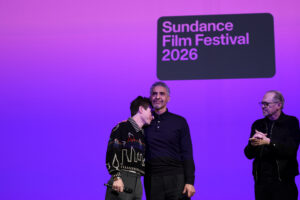





(L–R) Stacy Clausen and Joe Bird attend the “Leviticus” Premiere during the 2026 Sundance Film Festival at The Ray Theatre on January 23, 2026, in Park City, Utah. (Photo by Arturo Holmes/Getty Images)
By Adam Silverstein
As Leviticus begins at the Ray Theatre, it’s already clear this isn’t a gentle midnight screening. There are no seats left, the air thick with that specific late-night Festival energy — part excitement, part endurance test. This is the Midnight category doing exactly what it promises: daring you to stay awake and maybe regret it later.
Directed by Adrian Chiarella in his feature debut, Leviticus opens sweetly, almost deceptively so. Set in Australia, it follows Naim (Joe Bird) and Ryan (Stacy Clausen), two teenage boys circling each other with the quiet intensity of first crushes. Their chemistry is immediate and tender — glances held too long, bodies leaning closer than necessary. These are boys who just want to like each other. That simplicity becomes the film’s most devastating weapon.
Chiarella introduces the screening with dry humor, noting that the Midnight section is “a special section for me and Australian filmmakers,” before adding, “Why you keep inviting us Aussies to tell these harrowing stories in the middle of the night, I don’t know.” He also casually drops that he finished the film last night, which earns a laugh and a few nervous claps. The audience has no idea what’s coming.
What starts as a soft, almost romantic story quickly mutates into something far more disturbing. Leviticus pulls from real-world accounts of conversion therapy, transforming them into a supernatural horror that’s both literal and metaphorical. Desire becomes something to fear. Love becomes something that punishes you. As shame and religious control close in, the boys are forced to confront a violent entity that takes the shape of what they want most — each other.
The horror here isn’t just demons and blood, though there’s plenty of that. It’s the idea that queerness itself is framed as dangerous, sinful, something to be exorcised. One line lands like a gut punch: “This is what they wanted — us to be scared of each other.” In the Ray Theatre, you can feel the shift. The audience goes quiet. Laughter drains out of the room. What replaces it is dread.
Bird and Clausen are remarkable together. Their performances are open and vulnerable, informing the film’s more surreal turns in something painfully real. During the Q&A, Chiarella says he knew he had the film once he saw the two actors together. “I wanted to explore what they were scared of, and what love meant to them,” he explains. “It was inspired by stories about conversion therapy, but really it’s about being afraid of your own desires.”
That trust shows on screen. Bird shares that they approached the roles with total openness. “We wanted to be as vulnerable and authentic as possible,” he says. Clausen echoes that sentiment, adding that trust was essential, especially for the intimate moments. “On the second day of meeting, he asked me what my darkest secret was,” Clausen laughs. To build chemistry, they played Fortnite, went on coffee dates, spent time just being around each other. Bird quickly undercuts the sincerity with a joke: “Now this is over, I don’t have to be your friend anymore!” The room breaks into laughter.
The film’s final moments lean fully into that collision of beauty and horror, ending on a note that feels both bleak and strangely freeing, underscored by the sound of Frank Ocean. It’s a choice that shouldn’t work — and somehow does. The audience sits in stunned silence before applause breaks out, loud and sustained.
Leviticus isn’t an easy watch, and it doesn’t want to be. It’s a film about how systems of control twist love into something dangerous, about how fear gets weaponized, about the violence inflicted when desire is treated as a sin. But at its core, it’s also heartbreakingly simple: two boys who just wanted to crush on each other, and a world that couldn’t allow it.