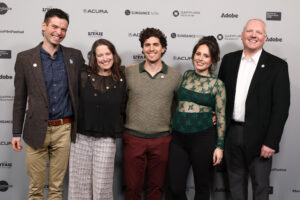




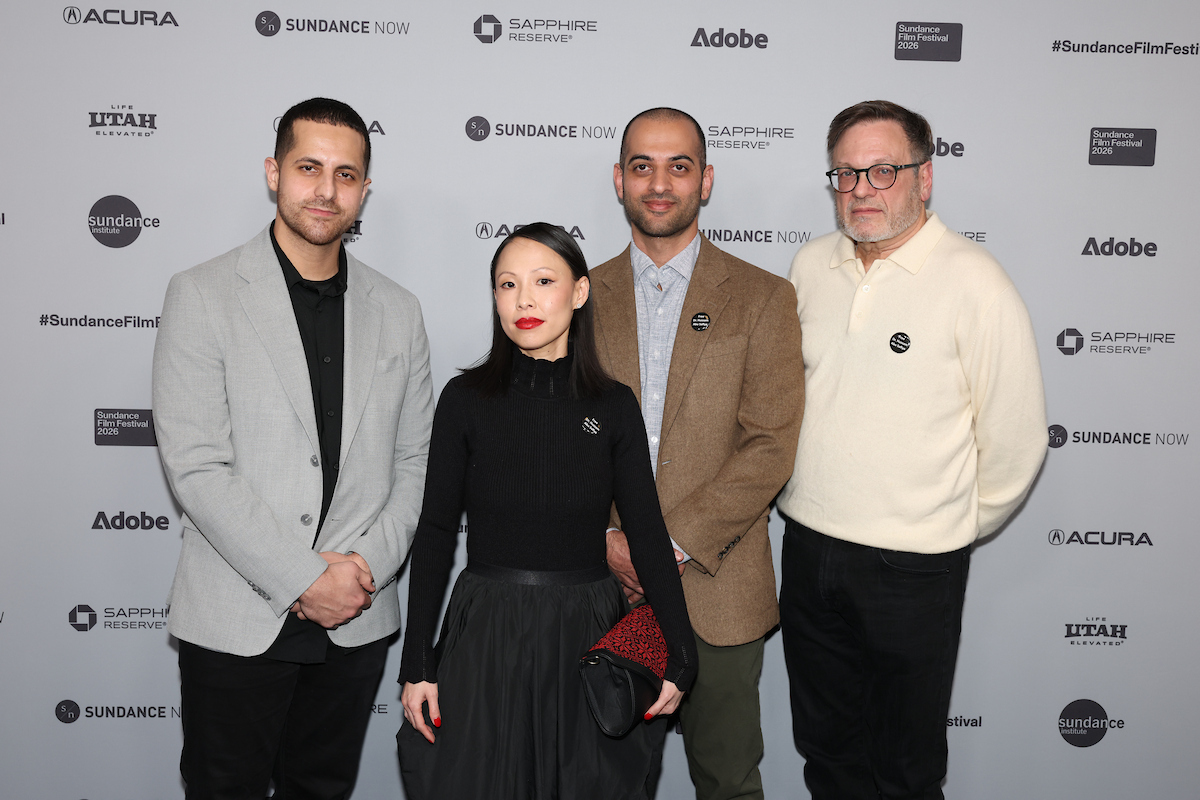
(L–R) Dr. Thaer Ahmad, Poh Si Teng, Dr. Feroze Sidhwa, and Dr. Mark A. Perlmutter attend the premiere of “American Doctor” by Poh Si Teng, an official selection of the 2026 Sundance Film Festival. (Photo by Gabriel Mayberry/Sundance Institute)
By Lucy Spicer
“We’re living through some hard, disheartening times, and we often feel like, ‘What can we do?’” begins Sundance Film Festival programmer Sudeep Sharma before the premiere of American Doctor on January 23 at The Ray Theatre in Park City. “I think something we’ve always talked about is, ‘Look to the helpers.’” And that’s exactly what director Poh Si Teng is doing with her feature debut — amid staggering destruction and loss, she’s showing us three helpers who put their own lives in danger so that they can offer aid in all the ways they know how, even when the odds of success are slim.
Screening as part of the 2026 Sundance Film Festival’s U.S. Documentary Competition, American Doctor follows three American medical professionals — Palestinian Dr. Thaer Ahmad, Zoroastrian Dr. Feroze Sidhwa, and Jewish Dr. Mark Perlmutter — as they travel (and in some cases attempt to return to) Gaza to provide emergency medical care for countless victims of unfathomable violence.
“We were there trying to save one life at a time. Stepping over babies that were going to die so we can get the one that we could save,” says Dr. Perlmutter, an orthopedic surgeon, during the film’s post-premiere Q&A. “Then when we came back, we noticed, really, literally leaving Gaza on my first trip, that there were no journalists. We knew they were getting killed, we saw them getting killed. We saw them getting targeted, we saw children specifically being assassinated. And there were no journalists. And so we felt that we had to tell the story.”
The urge to shed light on the horrifying conditions in Gaza created by continuous bombings and blockades over the past few years was also felt by the film’s director, who used to be a documentary commissioner for Al Jazeera English. “A year into the genocide, I had no more words. And you know, it was really difficult seeing people I respect, colleagues who were being targeted and executed. And I was a studio executive at the time, and I didn’t wanna do that job anymore,” explains Teng during the Q&A. So she quit her job and emptied her bank account with a view to making a film.
“And then I saw an interview of Dr. Mark Perlmutter on television, and he said all the most un-doctor things, as you see,” says Teng to a laughing audience as Dr. Perlmutter throws up a middle finger. When the two met at a fundraiser for the Palestinian Children’s Relief Fund, Teng asked if he wanted to make a film about his experiences. Soon after, Dr. Perlmutter introduced Teng to Dr. Ahmad and Dr. Sidhwa.
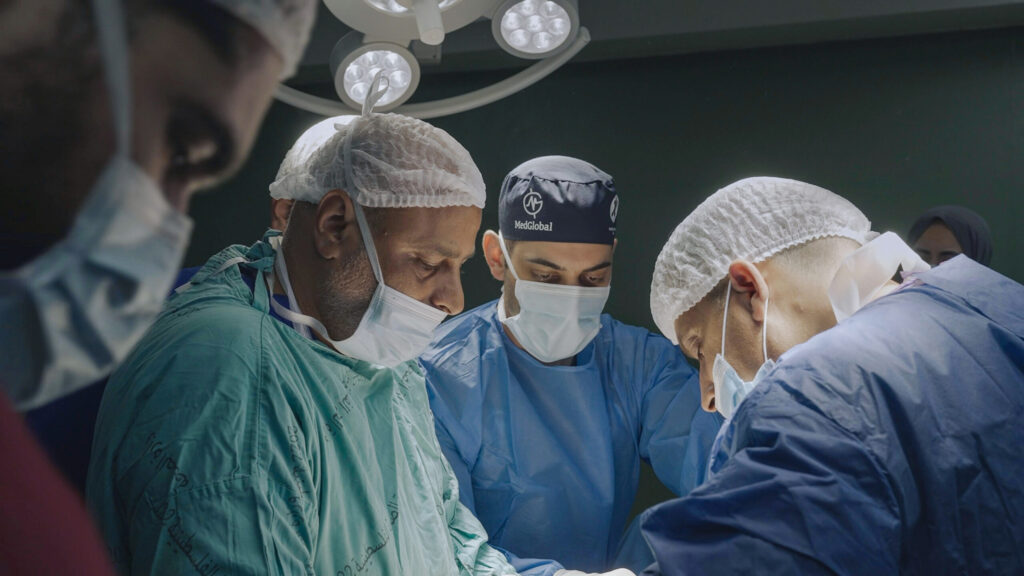
The three American doctors profiled in the film have different approaches to the way they speak out — at events, to the media, to elected officials — about what they’ve seen. “You can be like Dr. Thaer: politic, strategic, gets things done,” says Teng. “You could be like Dr. Mark Perlmutter: never minces words. Or you can be like Dr. Feroze Sidhwa, who does all the homework and provides the context to convince the most difficult of audiences.” And there’s a lot of convincing to be done, much of it ending in feelings of futility when the doctors are met with indifference or repeated disinformation, like assurances that a hospital was only damaged because of the Hamas-created tunnels that operated beneath it — tunnels that Dr. Sidhwa knows to be fictional.
These scenes provide a jarring contrast to the film’s graphic footage on the ground in Gaza, where an apocalyptic setting surrounds the Nasser Hospital. Inside, doctors must decide whom they can attempt to save while they are presented with an overwhelming number of patients with woefully insufficient medical supplies on hand. These moments are difficult to watch, and made all the more difficult when the hospital is later targeted by multiple Israeli airstrikes that kill children, health workers, and journalists.
It’s enough to make one feel discouraged, absorbing repeated acts of violence and seeing no repercussions for the perpetrators. Even Dr. Ahmad — who nevertheless continues to act on his duty of care — admits to feeling dejected. “I’ll be honest, when Poh started working on this [film], I was always mentioning something to her. I said, ‘I really hope it’s worth all of your time and effort and the entire team that put this together.’ I just felt like people would not be interested in hearing this,” he tells the audience during the Q&A.
“And that was just being a Palestinian, being born and raised during the First Intifada, the Second Intifada, so on and so forth, all of the different aggressions on Gaza — I just was resigned to the fact that this was not gonna be something that people felt was important or wanted to hear,” he continues. “And seeing this film and even seeing people in this audience, to me, inspires me to keep moving forward, because there are so many moments when you just feel so deflated, and you feel like nothing is giving, and you’re just trying so hard. And then you see something like this,” he says, gesturing to the audience.
Dr. Perlmutter also recognizes the power of a film like American Doctor to shine a light on truth and encourage small actions that lead to bigger ones. “This film can save hundreds of thousands of children,” he says, “By just stimulating, maybe swaying one vote” — getting one more individual elected who would object to funding additional weapons for Israel.
Because there is still work to be done. Truckloads of food and medical supplies are being turned away from the border — even when it was officially open, says Dr. Perlmutter — and the people of Gaza continue to starve and die from preventable infections.
“[The U.S. Civil Military Coordination Center] is supposed to be coordinating the entry of free building supplies, humanitarian aid, and things like that, and taking that out of the hands of the Israelis,” says Dr. Sidhwa. “Clearly it hasn’t done that. But right now what we’re seeing is the Israelis are allowing some limited amount of medical supplies to come in, but only going to NGOs and field hospitals, basically denying the ministry of health in Gaza — the only thing that the Palestinians actually run — the right to rebuild, actually treating anybody in any way they can. So you know, again, even though there’s what the whole world insists on calling a ceasefire going on, there’s still this implementation of systematic denial of Palestinians’ not only right to receive health care, but just right to control their destiny in general.”