




Maria Bamford attends the “Paralyzed by Hope: The Maria Bamford Story” premiere during the 2026 Sundance Film Festival at The Ray Theatre on January 22, 2026, in Park City, Utah. (Photo by Cindy Ord/Getty Images for Sundance Film Festival)
By Lucy Spicer
More than a decade before Bo Burnham sang songs about being stuck inside, Maria Bamford was singlehandedly filming a series in her parents’ Minnesota home following a nervous breakdown. She played all the characters — including her own family members and therapist — and didn’t shy away from the taboo topic of mental health. And that includes some of the strangest intrusive thoughts you’ve ever heard. But here’s the thing — it’s hilarious. If you’ve never considered that you could laugh about psych wards or the death of a parent, you haven’t heard comedy from Maria Bamford.
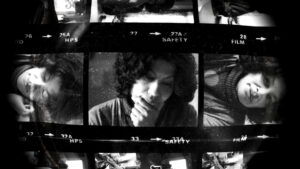
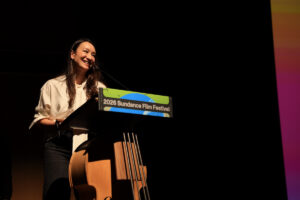
Judd Apatow and Neil Berkeley’s new documentary, Paralyzed by Hope: The Maria Bamford Story, is screening as part of the Festival’s Premieres section and uses a wealth of archival footage and contemporary interviews to craft a portrait of Bamford that gives her the recognition she deserves. “Our programming team was both charmed and provoked to fits of laughter as we watched this new film,” says Festival Director Eugene Hernandez before the documentary’s January 22 premiere at The Ray Theatre in Park City. “After our screening ended, we knew we wanted Maria Bamford at the 2026 Sundance Film Festival.” And if the raucous applause and cheering that follows from the audience is any indication, everyone else wants her here, too.
The beginning of Apatow and Berkeley’s film makes it clear that the project was the co-directors’ idea, not Bamford’s. “We just called her one day and said, you know, ‘Can we shoot with you?’” Apatow tells the audience as he introduces the film. “And she said, ‘Yes, but you have to give me $500.’ And then I said, ‘Why?’ And she said, ‘Because nothing ever happens in Hollywood, and my time is valuable. That’s a way of showing self-care.’” Bamford’s signature mix of vulnerability and humor is the keystone of the film. And when someone’s that funny and always has been (at one point the film shows a tongue-in-cheek obituary that Bamford wrote for herself as part of a school assignment), you can be sure that whatever material you collect from them will make for a highly amusing watch.
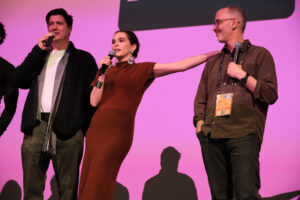
“We started with no idea of what it would be; we just started shooting,” says Apatow at the film’s post-premiere Q&A. “Maria kept living her life and things kept happening,” adds Berkeley. “But the real challenge was that Maria has told her story on stage, on YouTube, and all these different ways.”
In addition to interviews with Bamford, her loved ones, and fellow comedians who admire her, the documentary had to include footage from her various stand-up sets, allowing the audience to get to know her style if they weren’t fans already. “I love that there’s so much stand-up in this,” Berkeley says. “There [are] long jokes that we leave in there. The end of the movie is a three-minute set.”
“That was a challenge Judd gave us,” adds Berkeley. “This is a movie about a stand-up comic. Let’s make her be as funny as she is.”
The documentary succeeds, striking a balance between showcasing Bamford’s uproarious material and gathering words of love and support from her peers, including Stephen Colbert, who says that Bamford is his favorite comedian ever.
Everyone Apatow and Berkeley interview in the film agrees that Bamford is one of a kind. Between her talent for adopting different voices and her willingness to consistently address topics like her obsessive-compulsive disorder, nervous breakdowns, and grief, Bamford’s style is very much her own. “There’s no music in the movie, there’s no score,” notes Apatow during the Q&A. “Because every time we put music to you, it just got really weird,” he tells Bamford.
“Like any type of music to Maria doesn’t work. I’ve never seen it before. I did a Norm Macdonald documentary that’s coming out — the music works perfectly. Anything — happy music, sad music, carnival music — everything feels like it’s ruining every moment. Then at one point we said, ‘What if the whole movie just feels like Maria? And we just commit to being with you?’”
“You are music,” Apatow tells an embarrassed but appreciative Bamford. The love for her is palpable in the room, even as she uses her time to uplift others. “Other voices need to be heard, that’s what I would say,” she says when asked if there would be enough material for a sequel documentary.
But Apatow doesn’t let the Q&A end without reaffirming his admiration. “I think at the core of it is something that’s very hopeful for people,” he says. “I think one of the reasons why we all love what you do is it makes us feel like we can get better and we can evolve, and point toward the light.” Bamford adds, “And it’s OK to not get better, to keep fucking up!”
Maybe her most valuable — and predictably hilarious — piece of advice for anyone struggling? Seek help, even if it’s bad. “Walk through a Starbucks drive-thru, see if they can put eyes on your situation. I’m serious,” says Bamford amid audience laughter. “Don’t lower the bar to accessing any kind of help. Start mumbling about your problems in a public space. Somebody will tap in and say, ‘You know what?…’”