



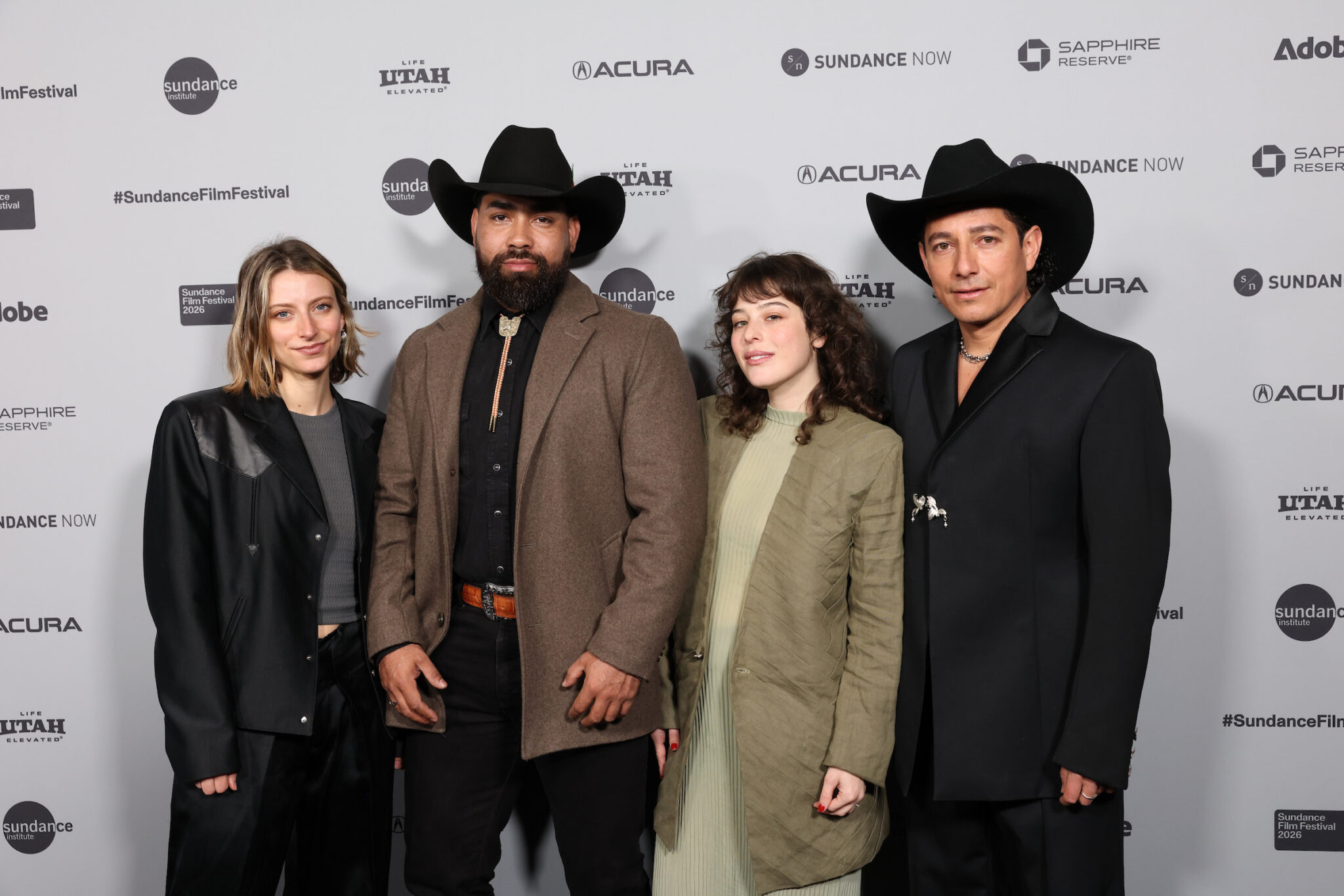
Sarah Strunin, Noé Margarito Zaragoza, Rebecca Zweig, and Efraín Mojica attend the premiere of “Jaripeo” at the The Yarrow Theatre on January 25, 2026, in Park City, UT. (Photo by Stephnie Dunn/Sundance Institute)
By Jessica Herndon
In the heartland of Michoacán, where tradition dictates that masculinity be performed through eight-second bull rides and tequila-soaked bravado, directors Efraín Mojica and Rebecca Zweig turn their camera toward what hides in plain sight. Jaripeo, their debut feature premiering in the NEXT section at the 2026 Sundance Film Festival, ventures into the hypermasculine world of Mexican rodeos to explore queer life.
Michoacán-born artist Mojica guides us through the jaripeos they began attending with friends. What began as escapism — as they donned rarely-worn cowboy boots and got wasted at the events — revealed itself as something unexpected as they began to notice stolen glances between men who might then steal off together beyond the hillside. Partnering with Mexico City–based filmmaker and Sundance Institute fellow Zweig, the co-directors transform these observations into a dreamscape where different filmmaking concepts capture fleeting touches and lingering gazes, reframing machismo through a queer lens.
“We approached different topics in different mindsets on the film,” Mojica tells us during a chat after their film’s premiere. “We really wanted to portray that. We had vérité, digital, and Super 8, which was this, like, queer eye. And then there’s the subconscious scenes that are different metaphors, that are experimental neons, strobe lights.” Adds Zweig, “We were building how each of these elements were functioning until the end of the edit. What we didn’t want to do was say, ‘No, we said that this element was going to represent this, right? Represent x, function as y.’ And so in a lot of ways, what the film wanted drove us to how we utilized each of those elements.”
Mojica and Zweig met in Seattle back in the mid-2000s. “We were little punks there,” says Mojica. “I invited Rebecca to spend Christmas with my family in Penjamillo.” While there, they went to a jaripeo. Zweig remembers thinking, “There’s something here that I like, that I am so drawn to — particularly the hypermasculine performance. And we just kept going back and I kept just writing things down.” She didn’t know what kind of project to weave together, she adds. “I just felt like there was something really potent.”
In 2021, the film’s producer Sarah Strunin, suggested she turn the idea into a documentary. “I went to Efraín because Efraín is also a very strong visual artist, and I was like, ‘I’m really interested in the masculinity of this rodeo. What do you think?” says Zweig. Mojica loved the idea. “I was like, ‘Yeah, let’s do it about the rodeo, but let’s make gay!’” they say.
In addition to Mojica, the film includes intimate conversations with other queer rancheros, men sharing memories, beliefs, their experiences, and their desire for self-expression. Jaripeo also pulses with the anxiety of living a split life. For many, there is guilt attached to discovering you desire men in an environment where tradition demands silence, where coming out risks losing friends, disappointing family, and shaming your ancestors. Mojica and Zweig don’t shy away from this tension; instead, they use their cinematic language to mirror the feeling. Strobe lights flash in the frame, embodying the panic of concealment and the euphoria of freedom.
Mojica felt this sense of freedom at the premiere as their family watched the film. They had never spoken with them about being gay. “It’s been crazy thinking about this,” Mojica says. “From the moment we started the film — for four years, just filming at my parents’ house and them thinking it’s a film about the rodeo at first. And then they realize, ‘Oh, it’s a film about the culture of the rodeo.’ ‘Oh, it’s the young kids at the rodeo.’ Then like, ‘Oh, the subcultures that are there.’ I sat with them last night to give them a little heads up, and I choked up. I could not say a single word. My eyes started tearing up, and I was like, ‘See you tomorrow.’ I really could not bring myself to…it was really emotional for me.”
Now, Mojica says they feel overjoyed that their family could be at the premiere. “They’re always very accepting,” they add. “They always knew, but there was just this tension that was always there for some reason. Today was the first time it was, like, vocalized. They knew in the way that they know who I am, but we’ve never talked about it. I’m happy we made this film because I want to make it seem way easier than it feels. It feels so constraining to be yourself, and talk about your emotions, but once you take that first step, it’s freeing.”
Zweig wants to make it clear, though, that coming out to Mojica’s family wasn’t the plan for the film. “Also when we started filming this, I did not know that Efraín was not out to their parents,” she adds. “And at the beginning, we were just co-directing it together. We didn’t originally conceive of Efraín as a protagonist. But that was what the film wanted, and we met it where it wanted to be.” Adds Mojica, “It was very important for us to just let the film be whatever it needed to be.”
Some of the most beautiful moments in Jaripeo are the slow-motion vignettes that transform the everyday into something dreamlike: a man dressed in drag becoming an unexpected crowd favorite, a rider achieving grace atop a bucking mechanical bull, another feeling beautiful while dancing under a disco ball. These moments ask whether the search for comfort in one’s own skin ever truly ends, or whether that longing remains eternal.
Jaripeo is a testament to those who navigate spaces never designed for their existence, but find liberation anyway.