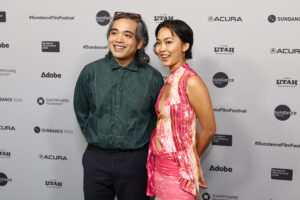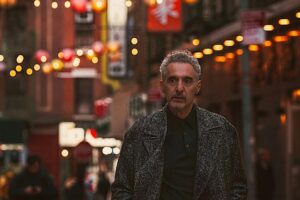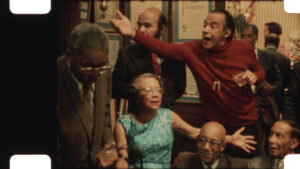




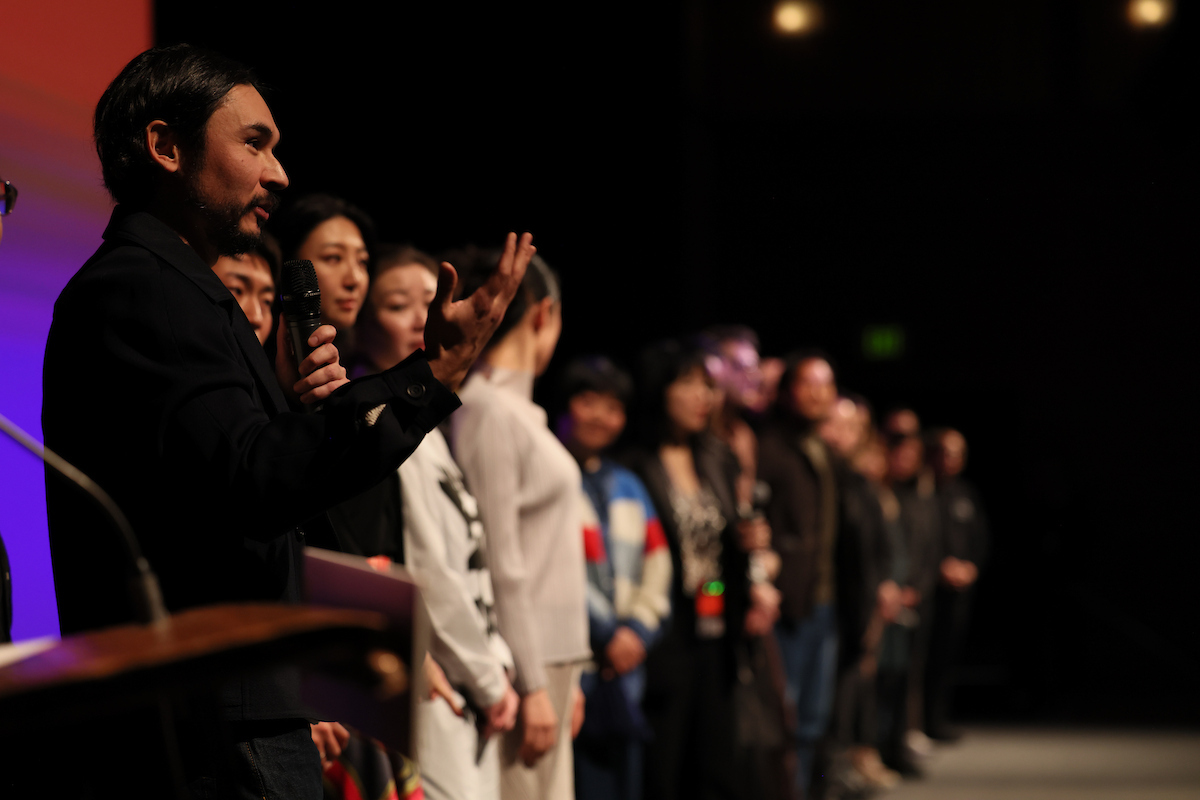
Director Josef Kubota Wladyka attends the premiere of “Ha-Chan, Shake Your Booty!” with the film’s cast and crew at Eccles Theatre on January 22, 2026, in Park City, UT. (Photo by Jemal Countess/Sundance Institute)
By Jessica Herndon
Premiering in the U.S. Dramatic Competition at the 2026 Sundance Film Festival, Ha-Chan, Shake Your Booty! arrives with a strong rhythm and emotional depth. Set against the backdrop of Tokyo’s ballroom dance scene, the film centers on Haru, a woman whose life once revolved around movement, music, and competition until a devastating loss stilled her world.
Prompted by her friends, Haru reluctantly returns to the dance studio temporarily. But her love for dancing — and an unexpected crush on her new dance instructor — begins to reignite a fire inside her. Desire creeps in, as do fear, vulnerability, and the question of whether it’s possible to want something new while still honoring what’s been lost. The film treats this mix of emotions with grace, letting longing and sorrow coexist.
Directed by Josef Kubota Wladyka, Ha-Chan, Shake Your Booty! is a colorful, occasionally surreal story about what happens when the body remembers what joy feels like, even as it’s still processing grief. Though the weight of her loss threatens to keep her in a dark place, Haru persists through movement, fantasy, and moments of humor.
At the center of it all is a beautiful performance by Rinko Kikuchi, who plays Haru. Though Kikuchi wasn’t able to be at the Festival, she recorded a video message, which played following the film’s premiere. “Filming was full of new experiences: ballroom dancing, speaking English and Spanish, and learning something new every single day,” she says in the video. “This film is filled with dance, love, mess, and life, and I really hope it reaches many of you.”
Wladyka was inspired to write Ha-Chan, Shake Your Booty!, along with co-writer Nicholas Huynh, by his mother, who, at 81 years old, is still an amateur ballroom dancer. When Wladyka gave his mom a shout-out from the stage after the movie’s debut, the crowd erupted with cheers as she stood up from her seat in the audience and waved. “The film isn’t autobiographical in any way, but it’s very much a sort of devotion to her spirit,” says Wladyka. “My mom has been through a lot of tribulations in her life. She had to raise three boys on her own, and the one thing that she always fell back on to help her get through the hard times was dancing. So we very much wanted to create this film that was sort of an homage to her to show you that no matter how messy life gets, you got to keep moving forward and you’ve got to keep dancing.”
In the film, dance sequences become imaginative escapes and windows into Haru’s subconscious. Much of the cast, including Alberto Guerra, who plays Haru’s dance instructor, were not versed in dancing when the project was filmed. But with the help of choreographers Chikako Takemoto and Miri Murano, the eight counts are infectious. “I am from Cuba, but there’s this misconception that Cubans can dance — I can’t,” joked Guerra, looking at Takemoto and Murano, who stood next to him on stage. “It was not easy to work with me.” The crowd laughed when both ladies nodded their heads in agreement.
Amidst the vibrant colors and music in his film, Wladyka doesn’t lose sight of Haru’s sorrow. It haunts her, as grief takes the form of a large black bird, which occasionally appears in her home. Due to the loss of her partner, “Haru’s going to be living in grief in her house,” explains Wladyka. “We wanted to manifest some sort of spirit, something that was still looming there.” Admittedly, Wladyka says he knows this aspect of the film is a bit strange, but he “wanted to take this sort of universal symbol of ravens and crows, which we all know means like death and grief,” he adds. “But simultaneously in Japan, they have something called ‘yuru-kyara,’ which is a cute mascot culture. I was living in Japan when these mascots were on the street. Everyone would run up and embrace them and try to hug them. So we combined those two ideas together so it could be something that is a little bit haunting, but also soothing.”
The music in the movie also establishes the mood. “The music is really a character,” says Wladkya. “It’s part of the rhythm of the film. It’s part of the editing of the film. And it’s really the heartbeat of the film.” But those beats didn’t come easy. Many of the songs used, like the Cranberries hit “Dreams,” had to be cleared for use before certain scenes were shot. “We had to know the songs ahead of time so we could choreograph to them,” Wladkya says. As a result, he adds, “we had to be very specific, very intentional” when selecting tunes.
Known for his previous features Catch the Fair One and Manos Sucias, Wladyka brings the same intensity and empathy to Ha-Chan, Shake Your Booty!, which he calls his “weird, unique dance film.” By channeling a deep belief in movement as a form of survival, the film offers a beautiful message. It makes a case for joy as an act of courage.