



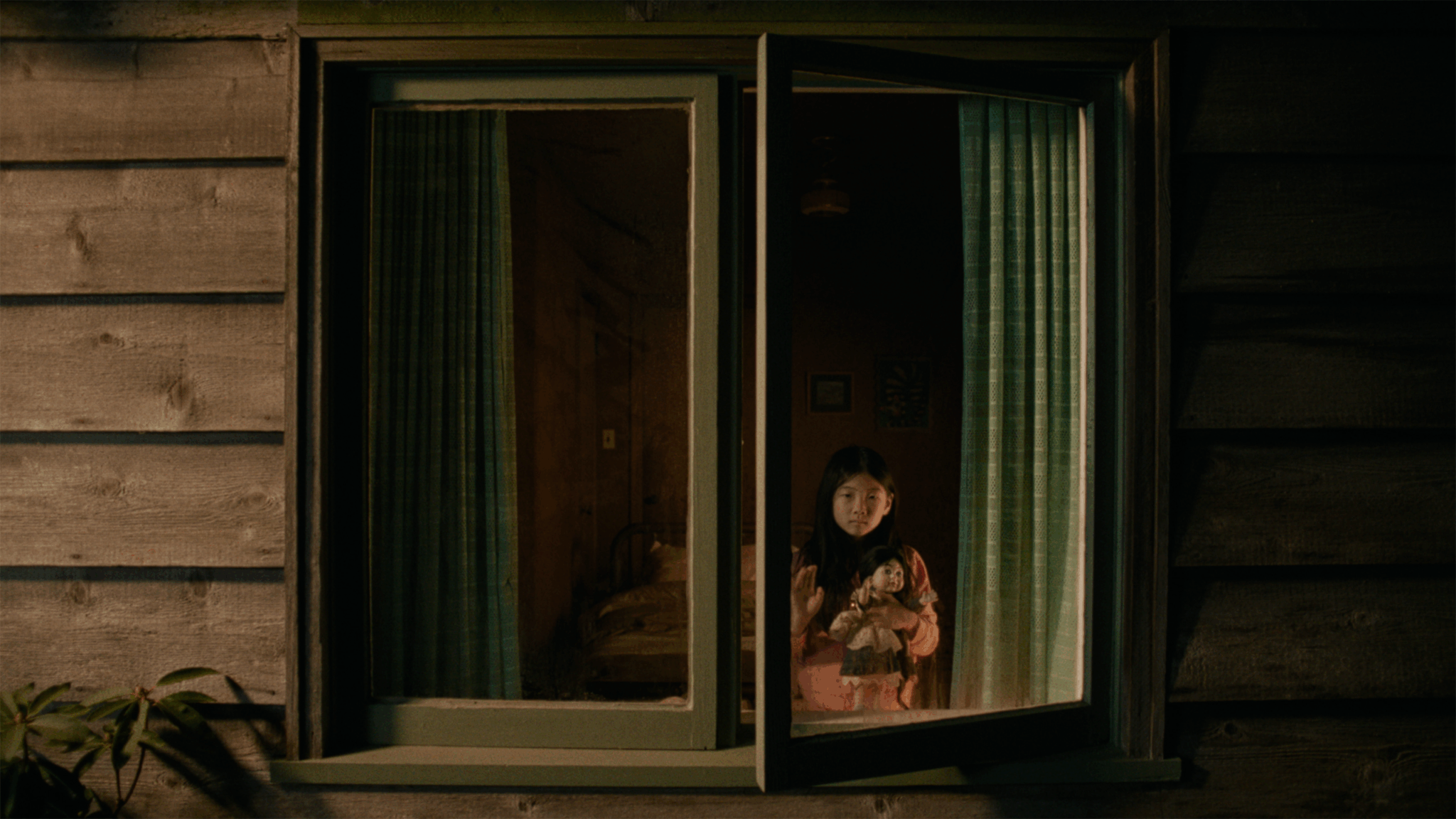
Why does this story need to be told now?
As part of its story, Rock Springs spotlights an ugly moment in American immigrant history and follows characters in the present day who find catharsis through learning and embracing history — personal and collective — rather than denying it. This seems timely in 2025, when immigrants (from certain countries) again became the boogeyman, the national government increased ICE’s budget to more than most [countries’] militaries, and federal troops are sent into cities to support cruel abduction and deportation assaults by masked men in the name of immigration policy.
When I started writing this ghost horror story years ago, I didn’t understand just how timely it would be, and just how horrifying the real-life context is when I finally get to share it. In the film, time is not linear, and the past is present is past is future. How I wish that weren’t so clearly true.

Describe who you want this film to reach.
At the risk of being naive, everyone, ideally. An anecdote to illustrate this: the dialogue is spoken in three languages — English, Mandarin, and Cantonese — and even includes a fourth, made-up language. We were shooting the first scene of 1885 — our four main Chinese miners (played brilliantly by Benedict Wong, Jimmy O. Yang, Ricky He, Cardi Wong) on their day off, playing dominoes and talking shit. It was entirely in Cantonese, which the vast majority of my crew does not speak, including myself. I saw all these crew members laughing along at the monitor with the jokes in the scene, and realized they understand everything.
Tell us an anecdote about casting or working with your actors.
This cast is amazing, and no lie, I still can’t believe how blessed I was. Performances are what give the film its heart and soul, and my God did they deliver, often outside in the rain and cold, often without trailers to escape to. Besides their tremendous talent and emotional authenticity, what sticks with me is how supportive the cast was of each other and the production, regardless of how famous, how veteran, or how completely new to acting.
Kelly Marie Tran traveled to set on a day off to watch Benedict Wong, Jimmy O.Yang, Ricky He, Cardi Wong, and a large cast of stunt actors and extras bring 1885 Rock Springs Chinatown to life. Benedict deejayed a party, Fiona Fu brought homemade food to set every time she shot, Kelly presented a birthday cake to Aria Kim, who played her daughter, on her wrap day (she was about to turn 9). And did I mention, it rained all the time?
What was your favorite part of making Rock Springs? Memories from the process?
All of it, even the hard bits, of which there were many. I do not take for granted what a privilege and honor it is to make a film, in any time, especially this one. Full stop.
What was a big challenge you faced while making Rock Springs?
There are a lot of elements to this film and a lot of challenges — almost all of them of my own making. Heavy practical SFX? Check. Meaningful, complex VFX to tell the story? Check. Period piece? Check. Multiple languages? Check. Child lead? Check. I even threw a dog in there just to make sure I made it as hard as I could. But one of the biggest challenges was the story structure itself — told in chapters in nonlinear time, revisiting the same moments from different POVs. That is very hard to prep, schedule, and shoot when you have a modest budget, too few shoot days, and a lot of rain messing with everything. And boy, did I have a lot of time in the edit to reflect on my choices.
Tell us why and how you got into filmmaking.
I am reminded of the Beatles’ lyric “The long and winding road…” I was a massive nerd child, incessantly read books (especially horror), watched TV (Twin Peaks forever), and rented movies from the VHS store in Chinatown where my grandfather worked (exclusively kung fu for me please), the public library (hello, Kurosawa’s Dreams at 14!) and Blockbuster (Carpenter’s The Thing over and over).
I’ve breathed stories for as long as I can remember, and they functioned as an additional parent for me growing up a latchkey kid [and] child of immigrant parents. To be honest, it didn’t cross my mind for most of my life that I could ever be part of telling them. I spent years in the nonprofit and activist sectors, much of it supporting movement activists and young people in low-income communities. They inspired me to dream beyond what I was programmed to think was possible; that “another world is possible” can’t just be an ideal, it has to be a practice.
One day, I knew I needed to step away and focus on creating, on storytelling. That exploration first took me to acting, which made it very clear that I am a director at heart! As an actor, I wrote and produced my own stuff — a web series, a microbudget feature — until I built up the foundation and gave myself permission to direct. After that, everything clicked into place.
What is something that all filmmakers should keep in mind in order to become better cinematic storytellers?
Turn off your phone, close all your screens, and allow yourself to be in the world, be bored, and pay attention. It’s how we build the quiet for ideas to come from the body rather than the mind, and to create the magic to turn those ideas into stories.