



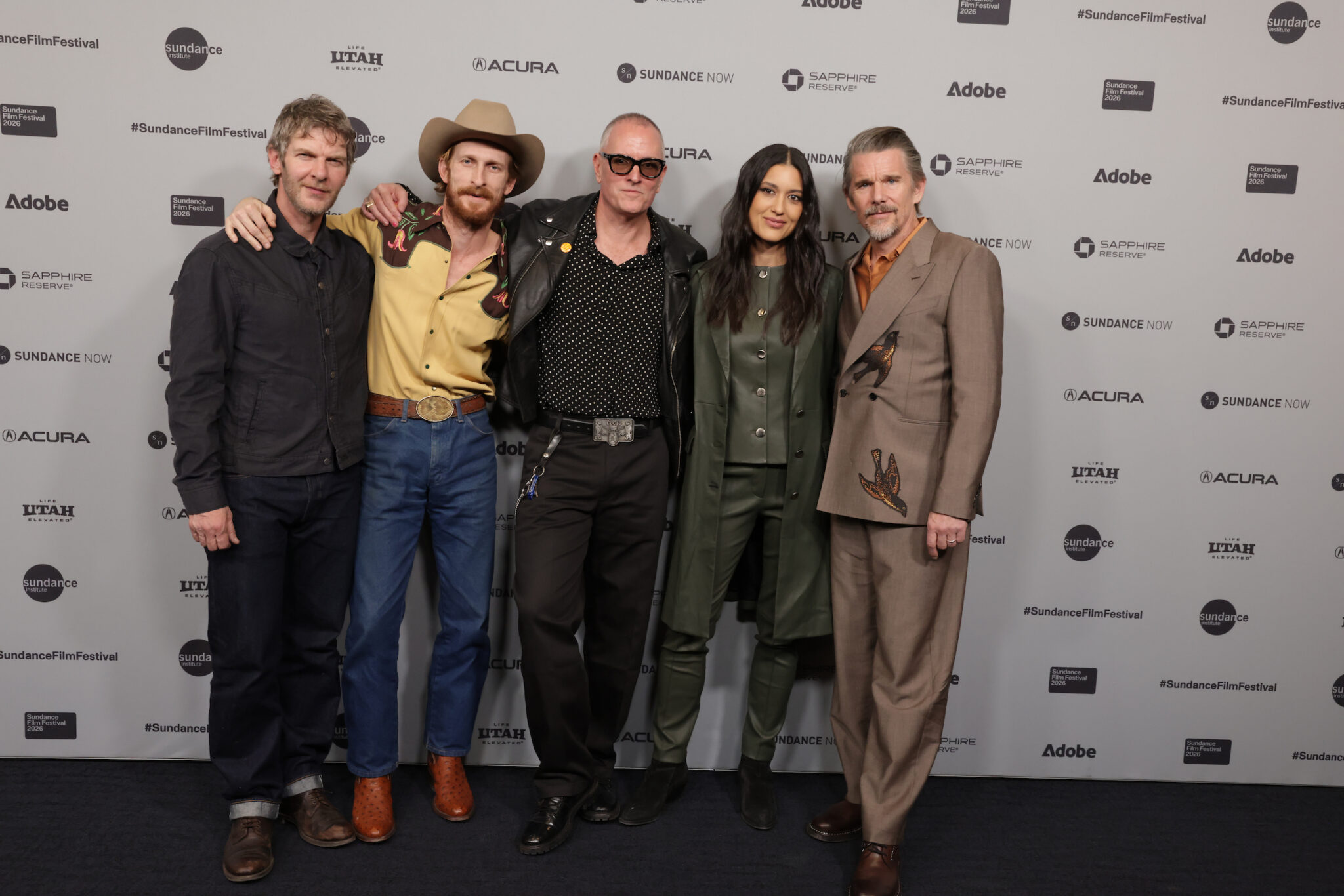
Sam Hazeldine, Austin Amelio, Padraic McKinley, Julia Jones, and Ethan Hawke attend the premiere of “The Weight” at The Ray Theatre on January 26, 2026, in Park City, UT. (Photo by Jason Peters/Sundance Institute)
By Jessica Herndon
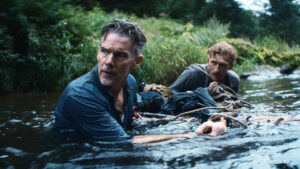
Set in Oregon during the depths of the Great Depression, The Weight opens with Samuel Murphy (Ethan Hawke) forcibly separated from his young daughter and sent to a remote labor camp where survival is a daily negotiation. When a warden (Russell Crowe) offers Murphy a chance at early freedom in exchange for a dangerous job smuggling gold through the wilderness, he sees it as a step toward mending his broken family.
When Murphy and a small crew of convicts set out on a journey through the backcountry, the trip becomes increasingly treacherous, pushing them beyond their physical limits and testing them with suspicion, fear, and betrayal. Along the way, bonds form under pressure, creating a fragile sense of family among those who have little left to lose.
At its core, The Weight, debuting in the Premieres section of the 2026 Sundance Film Festival, is less about holding onto gold than what it takes for Murphy to endure a brutal voyage in the hopes of seeing his child again. “We wanted to make this sort of old school, adrenalized, adventure film,” says director Padraic McKinley following the premiere of The Weight. “We wanted to dedicate ourselves to the ethos of those films.”
Inspired by movies like 1972’s Jeremiah Johnson, which starred Robert Redford, and 1977’s Sorcerer, The Weight feels gnarled, urgent, and grounded. For Hawke, classic films like these “conjure a feeling,” he says while standing next to McKinley after the film’s debut. “There’s a grittiness to them, a sloppiness. And by sloppy, I mean earthy, salt, sole, sweat. You feel the movie rather than watch it. And in the integration of performance, cinema, score, although they happen together, and they’re not about human beings that are superheroes. They’re about real people and how our lives are action packed, and how I was really drawn to try to create a portrait of masculinity that I admired and respected.”
Hawke adds that he grew up watching and admiring actors like Robert Redford and Paul Newman and the characters they played. “You could watch their movies and know that they were good people in their honor, dignity, integrity,” he says. “Those things were fundamental to their characters, and they gave you something, a North Star to follow.” Hawke says that he wanted to embody those traits in The Weight. “To see people fighting for what they believe in, and for what those words mean — this character came out of that.”
Hawke anchors the film with a quietly commanding performance, embodying a man whose resolve hardens even as doubt creeps in. Crowe plays his adversary, Clancy, with measured intensity, while Austin Amelio and Avi Nash add texture and tension as convicts. Julia Jones brings grit and grace to Anna, the sole woman in the group. “One of the things I was the most drawn to was that she defied your expectations or anything you’ve ever seen in a female character and in this time period,” says Jones. The film’s atmosphere is heightened by Matteo Cocco’s sweeping cinematography and brothers Latham and Shelby Gaines’ unsettling score, which underscores the beauty and danger of their surroundings.
When an audience member comments that The Weight was probably the most badass movie he’d ever seen, Hawke says, “To hear that you feel that way is so rewarding, because that’s the feeling that the movies that I love have given me, and we were trying to give that forward.”
Filmed in Germany over about five months, Hawke says that though the conditions while filming weren’t perfect, the process, overall, was a beautiful one. “We spent our summer outdoors running around the forest, and, like, you know, there’s ticks and there’s Lyme disease, and there’s logs in your face, but everybody was trying to take care of each other. And when you’re doing that and you believe in the movie, it’s so much fun. It’s a high that you chase.”
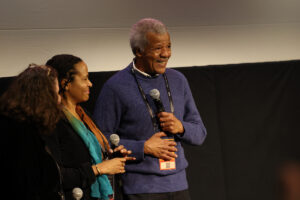
As time began to run out for the Q&A following The Weight’s debut, Sundance Film Festival senior programmer John Nein asked Hawke, who has appeared in films that have premiered at the Festival since the ’90s, how he feels about independent cinema today. “I was at the Redford tribute on Friday night, and it was like sticking your finger in an electric socket in a good way. It was like, I felt totally charged, and I felt that vibration that you get when somebody says the truth when you haven’t heard the truth in a long time,” says Hawke.
“They played a bunch of Redford’s quotes about why he started this, and he was talking about diversity of voices and not letting the industry run the art form, but the art form run the industry. It wasn’t a PC thing. It was ‘Oh, I want to hear other voices.’ It was a sincere desire to listen. With no agenda, but to go, ‘I need to hear you.’ He built this lightning rod and so many people cared.”
He added that so many generations of filmmakers have been given a platform at the Sundance Institute and during the Festival. “It’s not just that they got to make their work,” he said. “That’s very beautiful, but they also got to launch it into the world.” He concluded by saying, “It’s gonna be so important as we all say goodbye to Park City that we carry the fire that was created here — we carry it forward into all our lives, into all of what we’re doing.”