




By Gina McIntyre
(L–R) Sara Dosa and Andri Snær Magnason attend the “Time and Water” premiere during the 2026 Sundance Film Festival at Library Center Theatre on January 27, 2026, in Park City, Utah. (Photo by Neilson Barnard/Getty Images)
It was a particularly poignant article by Icelandic author Andri Snær Magnason that set Time and Water, the poetic new film from Sara Dosa, into motion, the director explains.
“I read an article written by Andri titled ‘How do you say goodbye to a glacier?’” she says, addressing the audience gathered at the Library Center Theatre January 27 for the premiere of the documentary. “I thought that was such a profound question to ask at this critical juncture in our planet’s history, where so many people are grappling with a loss that they can’t comprehend. That was the spark, and also knowing how [Andri’s] mind works — it’s so wonderfully expansive that it almost feels kind of cosmic to me, how he’s able to draw these overwhelming concepts and make them human and personal. That’s what got me really excited about the potential to make a film.”
Part of the 2026 Sundance Film Festival’s Premieres section, Time and Water centers on the demise of Okjökull, a 700-year-old glacier that became the first to be declared dead due to climate change in 2014. “A funeral for a glacier feels surreal, like my sense of home is slipping away,” Magnason says early in the documentary, which becomes, rather than a straightforward environmental chronicle, something more complex and elusive.
Using archival footage supplied by Magnason as well as new material captured for the film, Dosa marries science, myth, and personal history to craft an eerily beautiful time capsule. Magnason’s family is tied to the ice. Ancient and formidable, the glacier weeps as it warms, freeing secrets collected over millennia until they flow like rivers across the barren landscape. It’s a perfect complement to Magnason’s 2021 work of narrative nonfiction On Time and Water, a bestseller in his native Iceland, though the film is not exactly an adaptation. Rather, Dosa and her editors pored over the footage of Magnason, his parents, and his grandparents, mining their past to make a profound statement about our perilous present.
“I think that’s an honor for anybody in the world that has such a pile of things on a hard drive to get somebody like Sara and her team, her amazing editor and everybody, to make a poem out of it,” says Magnason, who attended the premiere, along with nearly a dozen or so members of Dosa’s crew. “So I wasn’t really demanding anymore that it had to follow the book because the archives were a different animal. … It was really important to get maybe a guest eye on my archive.”
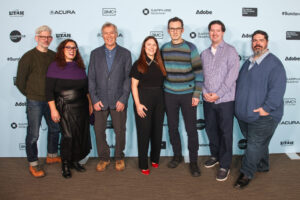
Time and Water is Dosa’s follow-up to Fire of Love, which similarly explored some of the most extreme geography on Earth. Following scientists who died in a volcanic explosion, it premiered at the 2022 Sundance Film Festival and went on to earn an Academy Award nomination. Notably, Dosa reunited with some of the same principals who had helped shape that film on the new documentary, people like editors Erin Casper and Jocelyne Chaput (who worked with Mark Harrison) and producers Shane Boris and Elijah Stevens, all of whom were in attendance at the January 27 premiere.
Cinematographer Pablo Alvarez-Mesa notes that during trips to Iceland to capture new footage, he and the other crew members always sought to tread lightly over the land. “We’re not just capturing images, we’re not just capturing time,” he says, “we’re communicating with respect with the landscape and with other people who communicate with it.”
Although the film’s composer Dan Deacon was not present, Dosa takes a moment to praise his contributions to the film. “Dan has a way of taking an emotion and just making it so big and so magical and so visceral all at once, and that was something that felt really fitting for a story about love and time and glaciers,” she says. “I feel like Dan brings his own heart deeply to the process.”
For Dosa, though, so much of the heart of the film was found in the material Magnason had supplied — without that, Time and Water could not exist in its current form. “It was such a gift to work with these generational archives as well as cultural archives spanning back 1,000 years,” Dosa says. “It was really important to us to braid the theme of human memory encoded in the archives as well as planetary memory encoded in glaciers, to put those together so we can feel kinship with the natural world. … As I step back, there’s something kind of beautiful about it, especially with Andri’s archives. He was filming life, and I think the messy beauty of life defies narrative containers.”